• The Tournament Trap: Why “More Competition” is the Silent Killer of Junior Potential

    In the frantic arms race of junior tennis, a dangerous “Common Sense” has taken hold: To get better at winning, you must play more matches. Parents see a plateauing UTR or a stagnant national ranking and instinctively reach for the tournament calendar. They believe exposure creates experience, and experience creates champions.

    They are wrong.

    After decades in the “laboratory” of high-performance coaching …. watching careers rise, stall, and quietly disappear …. I am here to tell you the honest truth: Excessive competition does not build elite players; it merely reveals, and often cements, their limitations.


    1. The Neuro-Economics of Failure

    Most people view tennis as a physical or technical battle. At the competitive level, tennis is a Nervous System battle. Every tournament taxes three finite internal resources:

    • Threat Perception: The ability to see a ball as an opportunity rather than a danger.
    • Decision Bandwidth: The mental energy required to choose the right shot under stress.
    • Emotional Inhibition: The power to suppress frustration after an error.

    When tournament volume exceeds the nervous system’s capacity to recover, the brain shifts from Learning Mode (Neuroplasticity) to Survival Mode (Coping). In Survival Mode, the player stops growing. They start “pushing,” they stop taking risks, and they bake in mediocre habits just to survive the weekend.


    2. The 3:1 Rule: The Math of Mastery

    The greatest players in history, Nadal, Federer, and the Williams sisters, did not become greats in the heat of a Sunday final. They became greats in the “Laboratory” of the practice court.

    Elite development requires a 3:1 Ratio: Three hours of high-intensity, specific skill development for every one hour of match play.

    • The Tournament: A diagnostic tool. It shows you what is broken.
    • The Laboratory: Where you actually fix it.

    If you reverse this ratio, you are effectively trying to “race a car while the engine is being repaired.” You might finish the race, but you’ll never reach top speed.


    3. The “Golden Ratio”: The 30-30-40 Rule

    A world-class schedule isn’t about how many tournaments you play, but the composition of the draw. To build a robust competitor, you must follow the 30-30-40 Rule:

    • 30% Below Level (Confidence Matches): Where the player is the “Alpha.” This is the only place they feel safe enough to use new weapons.
    • 30% Above Level (Stretching Matches): Where the player has “house money.” No pressure to win, only to observe the speed and discipline of the next tier.
    • 40% At Level (Grit Matches): The 50/50 dogfights that test emotional recovery and point construction.

    The Error: Most families play 90% “At” or “Above” level. This results in Performance Anxiety, where the player becomes “careful.” Carefulness wins junior matches but destroys professional potential.


    4. The Readiness Thresholds: An Internal Audit

    Before increasing a tournament load, a player must cross three invisible thresholds. If they haven’t crossed these, more tournaments are simply “extracting emotional capital” they don’t have.

    1. Technical Stability: Do the shots retain their shape and margin under 90% stress?
    2. Tactical Identity: Does the player know how they win points, or are they just hitting balls?
    3. Emotional Reset: Can the player return to a neutral state within 15 seconds of a devastating error?

    5. Case Study: The “Grinder” vs. The “Architect.”

    • The Grinder: Played 40 events a year. He became “match tough” early but developed “Survival Mechanics”—short swings and defensive movement. By age 16, he plateaued. He was a master of a mediocre game.
    • The Architect: Played 12-15 purposeful events. Spent 8-week “Development Blocks” in the Laboratory. He lost early matches because he was implementing a pro-style serve that wasn’t “cooked” yet.
    • The Outcome: By age 18, the Architect’s game scaled to the collegiate level. The Grinder was burnt out and technically stuck.

    6. The Silent Confidence Leak

    Confidence is not built by winning; confidence is built by understanding. A player who loses but understands why (and has a plan to fix it in the Laboratory) grows stronger. A player who wins by “pushing” without understanding becomes fragile.

    Excessive tournaments produce Emotional Callusing, not resilience. The player stops caring as a defense mechanism. This is the “silent exit” where the heart leaves the sport long before the body does.


    7. The Performance Code Protocol: A 12-Month Vision

    The most successful systems in the world do not solve for “next weekend.” They solve for the End State. Your 12-month calendar should look like a staircase, not a treadmill.

    The Annual Framework

    • The Technical Block (6–8 Weeks): High-volume “Laboratory” work. No tournaments. This is where you build the weapons.
    • The Transition Block (3–4 Weeks): Introduction of “30% Below Level” matches. Focus on using new weapons in a low-stakes environment.
    • The Competitive Peak (2–3 Weeks): Back-to-back tournaments to find “Match Rhythm.” This is the Earning Phase.
    • The Restoration (1 Week): Total rest. Video analysis. Mental recovery.

    8. A Coach’s Responsibility: The Hard Truth

    Let’s be honest: Most coaches will not tell you to play fewer tournaments. Tournaments keep kids “in the system,” and trophies make for good social media posts.

    But trophies won at age 12 by “pushing” are actually debts that must be paid back with interest at age 18. If your child is winning because they are “safe,” they are actually losing the long-game. Real toughness is the courage to skip a tournament to fix a backhand.


    The Final Word: Stop the Race, Start the Build

    Tournaments are mirrors. They reflect the preparation you have already done …. they do not create it. If the reflection is unclear, the answer is not more mirrors; the answer is better work behind the scenes in the Laboratory. In the Performance Code, we understand that staying patient is not falling behind …. it is the only way to get ahead. Trophies are temporary, but a world-class foundation is permanent.

    Are you building an elite player, or are you stuck in the Tournament Trap?

    To find out, click the button below to download The Performance Code Audit. This is my professional-grade diagnostic tool designed to help you analyze your current schedule and reveal the “Honest Truth” about your junior’s development path.

    If you want clarity…. not noise …. this audit will show you exactly where your current schedule is helping or harming long-term development.
  • Tennis Improvement Timeline: A Reality Check

    “Why the Scoreboard is a Lagging Indicator.”

    The Question Nobody Asks Loudly

    Every player asks it silently; every parent carries it like a weight: “How long should this take?”

    We aren’t just asking about forehands or footwork. We are asking, “How long before the sacrifice feels worth it?”

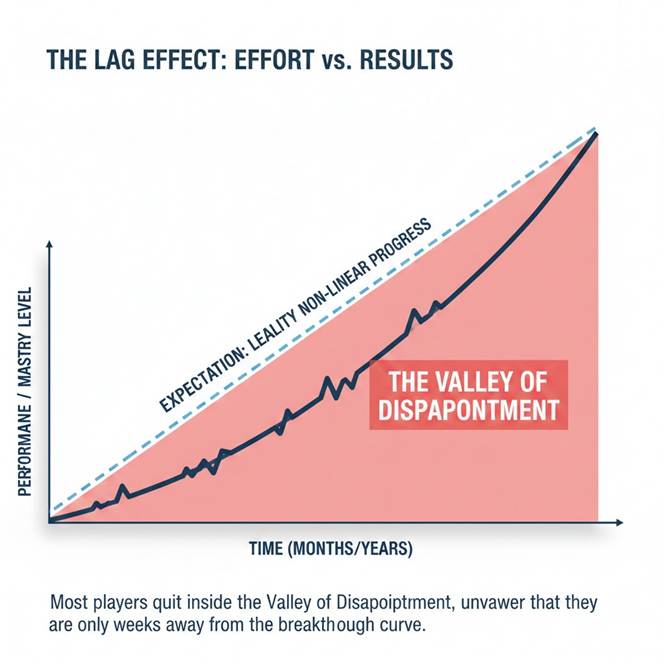
    In a culture of 60-second highlight reels and “13-year-old prodigy” headlines, the truth has been buried. We have been sold a lie that progress is a straight line. It isn’t. It’s a series of long, invisible plateaus punctuated by sudden, violent leaps in performance.

    If you feel like you’re standing still, you probably aren’t. You’re just in the “Lag Phase.”

    I once worked with a player for 18 gruelling months. We were rebuilding his technical foundation and his mental approach from the ground up. During that time, he didn’t win a single tournament. To the outside world, he was “failing.” To his parents, the investment felt like it was disappearing into a black hole.

    We were weeks away from them removing him from the program. We sat down, looked at the Invisible Layers of Progress, and I asked them to trust the “Lag Phase” for just one more season.

    Three months later, he won three consecutive titles.

    He hadn’t suddenly become a better player overnight; his results simply caught up to the work we had been doing for a year and a half. Use this article as a “Contract of Patience.” Remind yourself: a temporary dip in results is often the prerequisite for a permanent jump in performance.


    1. The Outcome Fallacy: Why Your Clock is Wrong

    Most people borrow their timelines from Outcomes, not Development.

    When you see a junior jump 200 spots in the rankings in six months, you are seeing the eruption, not the tectonic shift. That “sudden” success is usually the result of two years of grueling, un-glamorous work that finally “clicked.”

    The Trap: When you compare your internal struggle to someone else’s external highlight reel, you create a “Developmental Debt.” You feel behind, so you rush. You rush, so you skip fundamentals. You skip fundamentals, and your ceiling collapses.


    2. The Five Layers of Invisible Progress

    Coaches don’t look at the scoreboard to see if a player is improving. They look for the “Lead Indicators.” If these five things are happening, the wins are inevitable, even if they haven’t arrived yet:

    • Layer 1: Cognitive Calm. The game “slows down.” The player isn’t panicking between shots.
    • Layer 2: Shot Selection. They are losing points because they missed the right shot, not because they chose the wrong one.
    • Layer 3: Recovery Efficiency. Not just physical, but emotional. How long does it take to reset after a double fault? 30 seconds? Or three games?
    • Layer 4: Technical Robustness. The swing doesn’t break down at 4-4 in the third set.
    • Layer 5: Match Expression. The ability to do in a tournament what you did in practice on Tuesday. (This is the final layer to settle).

    The 10x Truth: You can be improving 1% every day in Layers 1 through 4 while still losing matches. This isn’t failure; it’s “loading.”


    3. The Honest Timeline (By Phase, Not Hype)

    PhaseDurationThe “Vibe”The Danger Zone
    Foundational6–12 MonthsHigh excitement. Rapid “newbie” gains.False Confidence. Thinking the whole journey will be this easy.
    Reconstruction1–2 YearsFrustrating. “I was better a month ago.”The Regression Trap. Reverting to old, bad habits just to win a local match.
    The Grind2–4 YearsLong plateaus. Subtle tactical shifts.The Quit Point. Most players stop here because the “ROI” feels low.
    High Performance5–8+ YearsMargins of 1%. Non-linear jumps.Burnout. Treating tennis like a job instead of a craft.

    The “Contract of Patience”

    Remember the player I mentioned at the start of this article? The one who went 18 months without a trophy?

    His breakthrough didn’t happen because we found a ‘secret’ technique in month 19. It happened because he and his parents signed a silent Contract of Patience. They understood that the ‘Competitive to High Performance’ phase (which we discussed above) is a test of character, not just talent.

    If you are a coach or a parent reading this: your job is to be the ‘Guardian of the Timeline.’ When the player is in the Valley of Disappointment, they cannot see the upward curve. You have to see it from their perspective.

    How to Audit Your Progress This Weekend

    To get out of the “Outcome Trap,” stop looking at the score and start tracking these 5 Performance Codes. If you can check 3 out of 5, you are winning the “Invisible Game”:

    • [ ] The Technical Lock: Did your swing stay fluid on break points, or did you start “pushing”?
    • [ ] The 15-Second Reset: After a double fault or a bad miss, did you regain focus before the next point started?
    • [ ] Tactical Intent: Did you hit the right shot to the right target, even if the ball went out by an inch?
    • [ ] Physical Floor: Did your footwork intensity stay the same from the first point to the last?
    • [ ] Emotional Neutrality: Did you stay “level” regardless of whether you were winning or losing?

    4. The “Lag Effect”: Why Progress Feels Slow

    In physics, there is a concept called Hysteresis, the lag between a change in a force and the manifestation of its effect.

    Tennis is the ultimate Hysteresis sport. Your work today will not show up in Saturday’s tournament. It will show up in a tournament six months from now.

    This is why “Coach Shopping” is so lethal. Parents often fire a coach right when the player is at the peak of the “Lag Phase.” They switch coaches, the “click” occurs two months later, and the new coach gets credit for the previous coach’s two years of labour.


    5. What Parents Feel (But Rarely Say)

    If you are a parent, you have likely felt the “Quiet Panic”:

    • “Are we pouring money into a black hole?”
    • “Why is the kid we beat last year winning titles now?”

    These thoughts don’t make you a “bad tennis parent” …. they make you human. But remember: Tennis is a long-term apprenticeship. You are not building a result; you are building a person who can handle pressure, solve problems, and endure boredom.


    The Final Reality Check

    Tennis does not reward impatience. In fact, it actively punishes it.

    If you are obsessed with the “When,” you lose sight of the “How.” But if you focus on the habits, the layers of invisible progress, and the 1% shifts in decision-making, the timeline takes care of itself.

    The hardest part of tennis isn’t the 100mph serve. It’s the three-year wait.

    Trust the work. The work is always recording, even when the scoreboard isn’t.

    Ready to Crack the Code?

    Improvement feels slow because most players track the wrong metrics. I’ve developed a Developmental Milestone Map designed specifically for serious players and parents who want to see the “invisible” progress they are making every day.

    If this article helped you understand why progress feels slow, keep this PDF with you. Read it again when doubt creeps in.

  • Part 2: Why Net Play Is a Reward …. Not a Strategy

    This article is a continuation of “Why Great Volleying Has Never Guaranteed Grand Slam Success.”

    In Part 1, we established an uncomfortable but necessary truth ….
    great volleying has never guaranteed Grand Slam success.

    That insight naturally leads to the next question many serious players ask ….

    “If net play isn’t the strategy, then why do champions still come to the net?”

    The answer is simple, and often misunderstood.


    The Net Was Never the Battlefield

    At the highest level, the net has never been the place where battles are fought.
    It has always been the place where battles are concluded.

    Champions do not go to the net to fight.
    They go to the net to finish.

    This distinction changes everything.


    Why ‘Using the Net More’ Is the Wrong Goal

    Many players tell themselves:

    • “I must use the net more”
    • “I must look aggressive”
    • “I must play complete tennis”

    These goals sound positive …. but they are dangerously vague.

    They shift focus away from ….

    • Rally quality
    • Decision-making
    • Timing
    • Court awareness

    And they replace it with forced intention.

    Net play driven by intention is pressure.
    Net play driven by opportunity is freedom.


    How Champions Actually Reach the Net

    Elite players arrive at the net only after one of these conditions is met ….

    • The opponent is stretched
    • The opponent is late
    • The ball is short
    • The court is clearly open

    In other words, the opponent has already lost balance, time, or control.

    The net appearance is not brave.
    It is logical.


    The Most Important Skill Is Not the Volley

    This may surprise many players.

    The most important net skill is not volley technique.

    It is approach selection.

    A simple volley after a good approach wins more points than ….

    • A beautiful volley after a neutral approach
    • A stylish touch volley under pressure

    Most volley errors happen before the volley, at the moment the player chooses to come forward.


    What High-Percentage Net Play Looks Like

    When net play is used correctly, it looks boring, and that is a compliment.

    • No rushing
    • No drama
    • No forced angles
    • No unnecessary touch

    Just ….

    • One good approach
    • One simple finish

    Champions are not artists at the net.
    They are accountants …. collecting what is already earned.


    Why Rushing the Net Backfires Under Pressure

    Under pressure, forced net play causes ….

    • Tight hands
    • Poor footwork
    • Low-percentage volleys
    • Momentum swings

    That is why many players “feel” net play is unreliable.

    In reality, it was not the net that failed.
    It was the decision to go there.


    The Sequence That Never Fails

    Elite tennis always follows this order ….

    1. Control the rally
    2. Take time away
    3. Force a short ball
    4. Step forward
    5. Finish simply

    When this sequence is respected, net play becomes easy.
    When it is skipped, net play becomes risky.


    A Simple Reality Check for Players

    Ask yourself before every approach:

    “Is my opponent defending …. or am I just bored?”

    If the opponent is defending, the net is correct.
    If you are bored, the net is a trap.


    Why This Understanding Changes Careers

    Players who understand net play as a reward ….

    • Stay patient longer
    • Choose better moments
    • Reduce unforced errors
    • Win ugly matches

    Players who treat net play as a strategy ….

    • Rush points
    • Lose close sets
    • Feel confused under pressure

    The difference is not skill.
    It is clarity.


    Final Closing Thought (Part-2)

    The net does not create winners.
    It reveals them.

    Those who arrive there after doing the hard work look calm.
    Those who arrive there early look rushed.

    In modern tennis, success belongs to players who understand one timeless rule ….

    First earn control.
    Then accept the reward.

    About the Author

    Alex Gomes is a high-performance tennis coach and mentor with decades of on-court experience working with serious junior and competitive players.

    His coaching philosophy, The Gomesee Way, focuses on understanding why improvement stalls, how training disconnects from match performance, and how players regain clarity under pressure.

    This platform reflects lived court-side observation …. not borrowed theory.

  • Why Great Volleying Has Never Guaranteed Grand Slam Success

    Part 1 of a two-part series on net play and modern match reality.

    For decades, tennis players have been told a simple story ….
    “If you want to become a champion, you must be great at the net.”

    It sounds logical.
    It sounds elegant.
    And it sounds completely convincing.

    But tennis history …. real match history, not highlight reels …. tells a very different story.


    The Myth That Refuses to Die

    Volleying has always been associated with ….

    • Skill
    • Courage
    • “Complete tennis”
    • Classical beauty

    Because of this, many players grow up believing that net play is the ultimate separator between good players and champions.

    This belief has damaged more careers than it has helped.

    Not because volleying is unimportant ….
    but because volleying has never been the deciding factor at the highest level.


    What Tennis History Quietly Shows Us

    If great volleying alone created champions, then tennis history would look very different.

    Some of the cleanest, most natural volleyers the game has ever seen ….

    • Had textbook serve-and-volley skills
    • Possessed beautiful touch and instincts
    • Finished points effortlessly at the net

    Yet many of them ….

    • Never won a Grand Slam
    • Or had only brief success
    • Or were exposed over long matches

    Why?

    Because matches were not decided at the net.
    They were decided before the net ever came into play.


    The Real Battleground of Modern Tennis

    Modern tennis is not decided by ….

    • Who volleys better
    • Who looks more stylish
    • Who finishes prettier points

    Modern tennis is decided by ….

    • Depth control
    • Quality of return
    • Rally tolerance
    • Movement under pressure
    • Mental patience

    The baseline is no longer a waiting area.
    It is the command center of the match.


    Why Even Great Volleyers Struggled at the Top

    Even the best volleyers faced unavoidable realities ….

    • Passing shots improved dramatically
    • Returns became more aggressive
    • Heavy topspin pushed them back
    • Neutral net approaches were punished

    Volleying became a reaction skill, not a domination skill.

    And at the highest level, reaction is never enough.


    The 67% Net-Point Myth …. What the Data Really Means

    Modern match analytics, often highlight an important statistic ….

    • Points won at the net: ~63–67%
    • Points won from the baseline: ~45–48%

    At first glance, this seems to suggest that net play is more effective than baseline play.

    The data itself is correct.
    The interpretation is where mistakes happen.


    Why Net Points Show a Higher Win Percentage

    Net points do not show a higher win percentage because volleying is superior.

    They show a higher win percentage because players usually come to the net only after they have already won the baseline battle.

    In most professional matches, a net point begins when ….

    • The opponent is stretched or late
    • The ball is short or floating
    • The court is already open
    • The rally advantage is already established

    The volley does not create the advantage.
    It collects the reward.


    What the Data Does Not Say

    The data does not say ….

    • Rush the net early
    • Serve-and-volley more
    • Volley better to win more

    In fact, the same analytics consistently show ….

    • Neutral-ball net approaches lose points
    • Forced approaches fail under pressure
    • Most volley errors come from poor decisions, not poor technique

    The problem is not volleying.
    The problem is approaching without earning the advantage.


    Baseline Tennis Is the Engine …. Net Play Is the Finish

    Baseline play:

    • Builds pressure
    • Steals time
    • Breaks legs
    • Breaks patience

    Only after this work is done does the net become a high-percentage option.

    That is why net points show higher success rates …. not because net play dominates,
    but because dominance was already achieved from the baseline.


    A Hard Truth Most Players Don’t Like Hearing

    You don’t win matches at the net.
    You earn the right to finish at the net.

    Ignoring this sequence leads to ….

    • Forced approaches
    • Low-percentage volleys
    • Momentum loss
    • Emotional frustration

    Volleying without advantage is not bravery.
    It is misjudgment.


    What High-Percentage Tennis Actually Looks Like

    At the elite level ….

    • Net approaches are earned, not attempted
    • Volleys are simple, not artistic
    • Finishes are inevitable, not rushed

    The best players don’t look aggressive.
    They apply pressure quietly until the opponent cracks.


    Why This Matters for Serious Players Today

    Many players stall their progress by ….

    • Chasing “complete tennis” too early
    • Forcing net play to look aggressive
    • Copying highlights instead of match patterns

    What actually builds winners is ….

    • Mastery of neutral balls
    • Comfort in long rallies
    • Physical and mental endurance
    • Clear decision-making

    Volleying is a support skill, never the foundation.


    A Final Word

    Tennis has never rewarded beauty in isolation.
    It rewards control before courage.

    Players who dominate from the baseline decide when the point ends.
    Players who rush the net hope it ends quickly.

    That difference …. between deciding and hoping …. is the difference between admiration and trophies.


    Stats Clarification Box (For Parents & Juniors)

    “Why do net points show a higher win percentage?”

    • Net points are usually played after the opponent is already under pressure
    • Players come forward when the ball is short or weak
    • The rally advantage is already established

    👉 This does NOT mean ….

    • Net play is better than baseline play
    • Players should rush the net early

    👉 It means ….

    • First win the rally from the baseline
    • Then finish at the net when it is easy

    Sequence matters more than style.


    One Line to Remember

    History is full of beautiful volleyers without trophies.
    It is ruled by players who first controlled the baseline.

    Continued in Part 2: Why Net Play Is a Reward …. Not a Strategy

    About the Author

    Alex Gomes is a high-performance tennis coach and mentor with decades of on-court experience working with serious junior and competitive players.

    His coaching philosophy, The Gomesee Way, focuses on understanding why improvement stalls, how training disconnects from match performance, and how players regain clarity under pressure.

    This platform reflects lived court-side observation …. not borrowed theory.

  • Good Coaching Is Not Enough: What Tennis Parents Often Miss

    (A complete, honest guide for parents who truly want their child to grow in tennis …. and in life)


    Introduction: The Confusion Many Good Parents Feel

    Most tennis parents genuinely want the best for their child.

    They choose good academies.
    They trust experienced coaches.
    They invest time, money, and emotional energy.
    They rearrange schedules and family life around training and tournaments.

    And yet, many parents feel confused when progress slows or results fluctuate—even after doing “everything right”.

    A quiet thought begins to form:

    “The coaching is good. My child is working hard.
    So why isn’t everything moving smoothly?”

    This article addresses a truth that is rarely discussed openly ….

    A tennis player does not develop only on the court.
    What happens at home …. emotionally, mentally, and structurally …. matters just as much.

    This is not about blaming parents.
    It is about understanding the invisible influences that shape a player’s growth.


    1. Why Even the Best Coaching Has Limits

    Good coaching is essential.
    But it is not magical.

    A coach typically sees a player ….

    • A few hours a day
    • In a controlled training environment
    • With a performance lens

    The remaining hours …. where habits, emotions, and mindset are shaped …. happen outside the court.

    When parents expect coaching alone to solve everything, they unknowingly place:

    • Excess pressure on the coach
    • Unrealistic expectations on the child

    Coaching builds skills.
    Environment builds character and resilience.

    Both must work together.


    2. The Home Environment: The Silent Training Ground

    Home is where ….

    • Emotional reactions are processed
    • Confidence is either strengthened or shaken
    • Wins and losses are interpreted

    A calm home creates ….

    • Emotional safety
    • Mental recovery
    • Long-term consistency

    An anxious or reactive home creates ….

    • Fear of failure
    • Overthinking
    • Emotional fatigue

    Parents often underestimate this influence, but players feel it deeply.


    3. Emotional Comfort vs Competitive Readiness

    One of the most misunderstood areas in junior tennis is emotional comfort.

    Comfort feels loving.
    But too much comfort delays growth.

    Competitive readiness requires ….

    • Allowing children to face disappointment
    • Not rescuing them emotionally after every loss
    • Teaching responsibility instead of reassurance

    As one of the most respected voices in sport, Billie Jean King, said ….

    “Pressure is a privilege …. it only comes to those who earn it.”

    Shielding children from pressure may feel kind, but it delays their readiness for competition.


    4. How Over-Protection Delays Mental Maturity

    Over-protection does not look harmful on the surface.

    It appears as ….

    • Explaining losses for the child
    • Blaming conditions or opponents
    • Intervening quickly during emotional discomfort

    But over time, this prevents players from learning ….

    • Self-regulation
    • Accountability
    • Emotional recovery

    Mental toughness is not taught through words.
    It is learned through experience …. especially uncomfortable ones.


    5. When Support Becomes Subtle Pressure

    Many parents unknowingly transfer pressure through:

    • Constant reminders about results
    • Frequent performance discussions
    • Silent expectations

    Children may not say it, but they feel it.

    This often leads to ….

    • Playing to please
    • Fear of disappointing parents
    • Performance anxiety

    True support feels steady, not intense.


    6. Lifestyle Factors Parents Often Underestimate

    Development does not happen only during training hours.

    Parents play a major role in ….

    • Sleep quality
    • Daily routine
    • Nutrition consistency
    • Recovery habits
    • Screen time control

    Small lifestyle inconsistencies silently undo good training.

    High performance is built on boring discipline, repeated daily.


    7. Why Long-Term Development Requires Patience at Home

    Tennis development is non-linear.

    There will be ….

    • Plateaus
    • Regressions
    • Sudden jumps

    Parents who panic during slow phases ….

    • Create insecurity
    • Rush decisions
    • Damage confidence

    Parents who stay patient ….

    • Create stability
    • Protect the learning process
    • Build resilient athletes

    This directly complements what was discussed in Article 2 about effort needing direction.


    8. How the Best Tennis Parents Think Differently

    The most effective tennis parents ….

    • Focus on effort, not outcomes
    • Respect the coach’s process
    • Allow mistakes without drama
    • Encourage independence
    • Stay emotionally neutral around results

    They understand one key truth ….

    Their role is not to manage performance, but to protect the process.


    9. What Parents Can Control …. and What They Must Let Go

    Parents can control ….

    • Environment
    • Routine
    • Values
    • Emotional tone at home

    Parents must let go of ….

    • Match outcomes
    • Rankings obsession
    • Comparison with others
    • Short-term validation

    Clear boundaries reduce conflict and confusion ….for everyone.


    10. Final Truth: Coaching Works Best When Parents Support the Process

    Good coaching matters.
    Hard work matters.
    But without the right home environment, both struggle to reach their full potential.

    This is why the strongest player development systems always involve ….

    • Coach clarity
    • Player responsibility
    • Parent understanding

    When parents align with the process …. not just the results …. progress becomes sustainable.

  • Why Hard-Working Tennis Players Still Don’t Break Through

    (A complete, no-nonsense guide for players who are “doing everything” yet staying stuck)


    Introduction: The Most Confusing Situation in Tennis

    Some of the most frustrated tennis players are not lazy.
    They are not inconsistent.
    They are not avoiding work.

    In fact, they are often the hardest working players on the court.

    They train daily.
    They sweat honestly.
    They show up on time.
    They listen to their coach.
    They rarely miss sessions.

    And yet …. year after year …. their results barely change.

    This creates a quiet, painful confusion that most players never say aloud ….

    “If I’m working so hard, why am I still not breaking through?”

    Parents feel it.
    Players feel it.
    Coaches sense it.

    The uncomfortable truth is this ….

    Hard work alone does not guarantee progress in tennis.
    Very often, it only guarantees repetition.

    This article explains why that happens, and what must change if a serious player truly wants to move to the next level.


    1. Hard Work Is Common. Breakthroughs Are Rare.

    At every academy, you will find many players working hard.
    But only a few actually move forward year after year.

    This immediately tells us something important ….

    Hard work is not the differentiator.

    What differentiates players is ….

    • How they work
    • Why they work the way they do
    • What decisions they make during training

    Most players believe effort is the solution.
    Elite progress comes from direction, not effort.

    Hard work is the entry ticket.
    It is not the winning formula.


    2. When Training Becomes Busy Instead of Meaningful

    One of the biggest hidden problems in modern tennis is busy training.

    Busy training looks impressive ….

    • Long sessions
    • Many drills
    • Lots of balls hit
    • High heart rate

    But meaningful training looks different:

    • Clear objective
    • Defined learning focus
    • Feedback during and after the session
    • Adjustments made consciously

    Many players train for movement and sweating, not for learning.

    They leave the court tired …. but unchanged.

    This usually happens because players make poor training decisions and lack mental clarity about what they are trying to improve.

    If a session ends without clarity, it did not create progress …. only fatigue.


    3. Repeating Effort Without Reflection Is the Fastest Way to Get Stuck

    This is where most hard-working players unknowingly sabotage themselves.

    They repeat ….

    • The same mistakes
    • The same patterns
    • The same emotional reactions

    But because they are working hard, they assume they are improving.

    In reality ….

    • Practice without reflection strengthens old habits
    • Matches without analysis strengthen old decision-making
    • Effort without honesty strengthens comfort zones

    Repetition creates mastery only when it is conscious.
    Otherwise, it creates stagnation.


    4. Why Some Players Improve With Fewer Hours

    This is uncomfortable …. but true.

    You will often see ….

    • One player training 2–3 hours with clarity
    • Another training 5–6 hours with confusion

    And the first player improves faster.

    Why?

    Because progress is not about volume.
    It is about feedback loops.

    Players who improve faster ….

    • Review sessions mentally
    • Identify one weakness clearly
    • Adjust one thing at a time
    • Stay emotionally neutral about mistakes

    They don’t train more.
    They train better.


    5. The Real Missing Skill …. Honest Self-Assessment

    Most players think they lack ….

    • Better strokes
    • More power
    • More fitness

    In reality, what they lack most is honest self-assessment.

    Hard-working players often protect themselves emotionally ….

    • “I lost because the opponent was lucky”
    • “I played well, just a few mistakes”
    • “Conditions were not good”

    These statements feel safe …. but they block growth.

    Progress begins the day a player can say ….

    “This part of my game is not good enough yet.”

    Without excuses.
    Without emotion.
    Without self-pity.

    That level of honesty is rare, and powerful.


    6. Why Effort Alone Can Become a Trap

    Hard work has a hidden danger.

    It gives emotional comfort.

    Players start believing ….

    • “I deserve results because I work hard”
    • “I am doing more than others”
    • “Eventually it should click”

    But tennis does not reward deserving.
    It rewards adapting.

    When effort becomes a shield, players stop questioning ….

    • Their shot selection
    • Their patterns under pressure
    • Their emotional reactions
    • Their training structure

    Hard work without questioning creates stubborn players, not better players.


    7. What Serious Players Must Start Asking Themselves

    Players who want to break through must regularly ask ….

    • What exactly am I trying to improve this week?
    • Which mistake keeps repeating under pressure?
    • Am I training to win points—or just to feel good?
    • What uncomfortable truth am I avoiding?

    These are not motivational questions.
    They are performance questions.

    And performance always responds to truth.


    8. The Difference Between Emotional Training and Directed Training

    Emotional training feels intense ….

    • High energy
    • High volume
    • High emotions

    Directed training feels quieter ….

    • Focused
    • Intentional
    • Sometimes uncomfortable

    Emotional training satisfies the ego.
    Directed training builds the player.

    Breakthroughs come from sessions that challenge your thinking, not your lungs.


    9. Why Breakthroughs Often Come Suddenly (But Are Never Accidental)

    When players finally break through, it looks sudden from outside.

    But internally, it is the result of ….

    • Better decisions
    • Cleaner thinking
    • Reduced emotional noise
    • Increased awareness

    The breakthrough did not come from more effort.
    It came from less confusion.


    10. The Quiet Truth Every Serious Player Must Accept

    If you are a hard-working tennis player and still not breaking through, understand this clearly:

    You are not failing because you are lazy.
    You are stuck because effort is not being guided well enough yet.

    This is not criticism.
    This is clarity.

    And clarity is the beginning of every real improvement.


    Final Thought …. Hard Work Needs Direction, Not Emotion

    Hard work is admirable.
    But in tennis, it is only the starting point.

    The players who move forward are not always the most intense.
    They are the most aware.

    They train with purpose.
    They reflect honestly.
    They accept discomfort.
    They reduce emotional noise.

    That is how effort transforms into progress.

    And that is how serious players finally break through.

  • Why Most Serious Tennis Players Plateau …. Even With Good Coaching

    At some point in their journey, most serious tennis players encounter a frustrating phase: progress slows, results fluctuate, and confidence begins to feel fragile.

    They train consistently.
    They have access to coaching.
    They put in honest effort, week after week.

    Yet improvement no longer follows effort in a predictable way.

    This plateau most often appears between the intermediate and advanced stages …. precisely when tennis begins to demand better decisions, not merely better strokes.

    This article explains why that plateau occurs even with good coaching, and why many players and parents misunderstand what is actually missing at this level.


    The Plateau Is Rarely a Lack of Talent

    When progress stalls, the first assumption is usually simple ….

    “Something is missing …. strength, skill, or ability.”

    In most cases, this diagnosis is incorrect.

    As Novak Djokovic once explained ….

    “At the highest level, everyone hits the ball well.
    The difference is how clearly you make decisions under pressure.”

    That insight applies long before the professional level.

    From a developmental perspective, players who plateau are usually ….

    • technically sound
    • physically capable
    • mentally willing

    What they lack is clarity about what the game now requires from them.

    Early stages reward effort.
    Later stages reward judgment.

    The transition between the two is where most players get stuck.


    What Actually Changes as Players Move Forward

    In the early years, improvement is visible and rapid:

    • better grips
    • cleaner swings
    • improved consistency

    As players advance, progress becomes quieter and less obvious.

    The game begins to shift:

    • from execution → selection
    • from repetition → recognition
    • from intensity → restraint

    Many players continue to train as if they are still beginners, even though the game has already moved on.

    This mismatch between training focus and match reality is one of the deepest causes of stagnation worldwide.


    The Practice–Match Gap (What Parents Notice First)

    Parents often describe a familiar pattern:

    “My child practices so well, but in matches everything disappears.”

    This is not imagination.
    It is accurate observation.

    As legendary coach Nick Bollettieri once put it ….

    “Practice builds strokes.
    Competition exposes habits.”

    If training never exposes habits under uncertainty, competition will …. often brutally.

    This is not a confidence problem.
    It is a training design problem.


    Why More Practice Often Makes the Plateau Worse

    When results stagnate, the most common response is predictable ….

    • more hours
    • more drills
    • more intensity

    Effort increases.
    Direction does not.

    This creates a dangerous illusion ….

    “I’m doing everything possible, so improvement should happen.”

    But tennis has never rewarded effort alone.

    As Rafael Nadal has often emphasized:

    “Improvement is not about doing more.
    It’s about doing things better, with the right intention.”

    Repetition without clarity often deepens existing patterns instead of correcting them.


    Small Errors That Quietly Accumulate

    Plateaus are rarely caused by one dramatic flaw.

    They usually emerge from small, repeated decisions such as ….

    • rushing neutral balls
    • poor margin awareness
    • defensive choices disguised as aggression
    • playing “safe” without purpose
    • unclear patterns under pressure

    Each error seems minor in isolation.
    Together, they stall development.

    This is why plateaus feel confusing …. nothing looks obviously wrong, yet progress stops.


    Why Mental Toughness Is Often Misdiagnosed

    When performance dips, players are often told ….

    • “Be mentally stronger”
    • “Believe more”
    • “Stay confident”

    But confidence does not exist independently.

    Clarity creates confidence.

    Sports psychology consistently shows that under pressure, the brain defaults to deeply rehearsed decision patterns, not conscious instructions.

    If training does not encode clear decisions, motivation alone cannot survive match stress.


    Re-Introducing Clarity

    Breaking a plateau rarely requires dramatic change.
    It requires precise correction.

    This involves ….

    • identifying the player’s true developmental stage
    • aligning training with actual match demands
    • reducing unnecessary choices
    • simplifying patterns instead of adding complexity
    • training decisions, not just strokes

    As coach Darren Cahill once observed:

    “Players don’t need more information.
    They need better priorities.”

    When priorities become clear, calm follows naturally.


    A Final Perspective

    Plateaus are not failures.
    They are signals.

    They indicate that a player has outgrown their current approach.

    Those who ignore the signal stagnate.
    Those who understand it evolve.

    At higher levels, improvement becomes slower, quieter, and more deliberate …. but also far more stable.

    Effort is common.
    Clarity is rare.

    And in tennis, clarity changes everything.


    What to Reflect On Next

    If this article resonates, the answer is not to train harder.

    It is to re-examine how and why you train.

    That is where real progress begins.


    About the Author

    Alex Gomes is a high-performance tennis coach and mentor with decades of on-court experience working with serious junior and competitive players.

    His coaching philosophy, The Gomesee Way, focuses on understanding why improvement stalls, how training disconnects from match performance, and how players regain clarity under pressure.

    This platform reflects lived court-side observation …. not borrowed theory.