In the frantic arms race of junior tennis, a dangerous “Common Sense” has taken hold: To get better at winning, you must play more matches. Parents see a plateauing UTR or a stagnant national ranking and instinctively reach for the tournament calendar. They believe exposure creates experience, and experience creates champions.
They are wrong.
After decades in the “laboratory” of high-performance coaching …. watching careers rise, stall, and quietly disappear …. I am here to tell you the honest truth: Excessive competition does not build elite players; it merely reveals, and often cements, their limitations.
1. The Neuro-Economics of Failure
Most people view tennis as a physical or technical battle. At the competitive level, tennis is a Nervous System battle. Every tournament taxes three finite internal resources:
- Threat Perception: The ability to see a ball as an opportunity rather than a danger.
- Decision Bandwidth: The mental energy required to choose the right shot under stress.
- Emotional Inhibition: The power to suppress frustration after an error.
When tournament volume exceeds the nervous system’s capacity to recover, the brain shifts from Learning Mode (Neuroplasticity) to Survival Mode (Coping). In Survival Mode, the player stops growing. They start “pushing,” they stop taking risks, and they bake in mediocre habits just to survive the weekend.
2. The 3:1 Rule: The Math of Mastery
The greatest players in history, Nadal, Federer, and the Williams sisters, did not become greats in the heat of a Sunday final. They became greats in the “Laboratory” of the practice court.
Elite development requires a 3:1 Ratio: Three hours of high-intensity, specific skill development for every one hour of match play.
- The Tournament: A diagnostic tool. It shows you what is broken.
- The Laboratory: Where you actually fix it.
If you reverse this ratio, you are effectively trying to “race a car while the engine is being repaired.” You might finish the race, but you’ll never reach top speed.
3. The “Golden Ratio”: The 30-30-40 Rule
A world-class schedule isn’t about how many tournaments you play, but the composition of the draw. To build a robust competitor, you must follow the 30-30-40 Rule:
- 30% Below Level (Confidence Matches): Where the player is the “Alpha.” This is the only place they feel safe enough to use new weapons.
- 30% Above Level (Stretching Matches): Where the player has “house money.” No pressure to win, only to observe the speed and discipline of the next tier.
- 40% At Level (Grit Matches): The 50/50 dogfights that test emotional recovery and point construction.
The Error: Most families play 90% “At” or “Above” level. This results in Performance Anxiety, where the player becomes “careful.” Carefulness wins junior matches but destroys professional potential.
4. The Readiness Thresholds: An Internal Audit
Before increasing a tournament load, a player must cross three invisible thresholds. If they haven’t crossed these, more tournaments are simply “extracting emotional capital” they don’t have.
- Technical Stability: Do the shots retain their shape and margin under 90% stress?
- Tactical Identity: Does the player know how they win points, or are they just hitting balls?
- Emotional Reset: Can the player return to a neutral state within 15 seconds of a devastating error?
5. Case Study: The “Grinder” vs. The “Architect.”
- The Grinder: Played 40 events a year. He became “match tough” early but developed “Survival Mechanics”—short swings and defensive movement. By age 16, he plateaued. He was a master of a mediocre game.
- The Architect: Played 12-15 purposeful events. Spent 8-week “Development Blocks” in the Laboratory. He lost early matches because he was implementing a pro-style serve that wasn’t “cooked” yet.
- The Outcome: By age 18, the Architect’s game scaled to the collegiate level. The Grinder was burnt out and technically stuck.
6. The Silent Confidence Leak
Confidence is not built by winning; confidence is built by understanding. A player who loses but understands why (and has a plan to fix it in the Laboratory) grows stronger. A player who wins by “pushing” without understanding becomes fragile.
Excessive tournaments produce Emotional Callusing, not resilience. The player stops caring as a defense mechanism. This is the “silent exit” where the heart leaves the sport long before the body does.
7. The Performance Code Protocol: A 12-Month Vision
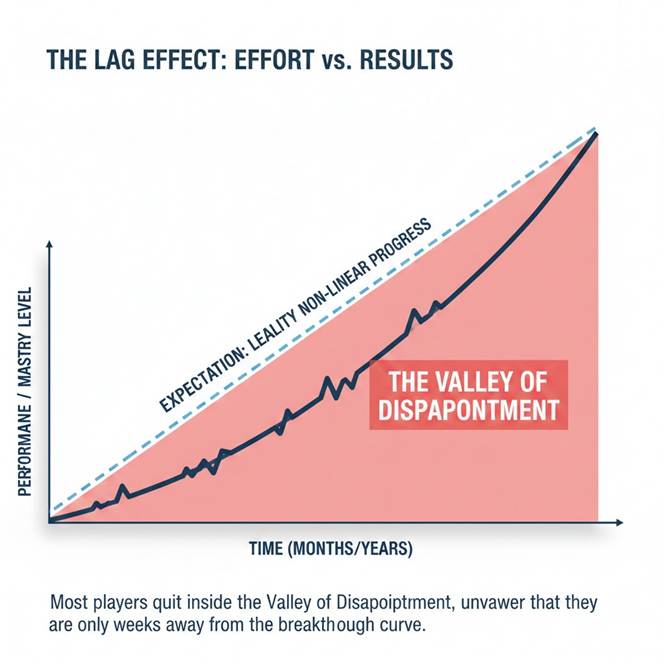
The most successful systems in the world do not solve for “next weekend.” They solve for the End State. Your 12-month calendar should look like a staircase, not a treadmill.
The Annual Framework
- The Technical Block (6–8 Weeks): High-volume “Laboratory” work. No tournaments. This is where you build the weapons.
- The Transition Block (3–4 Weeks): Introduction of “30% Below Level” matches. Focus on using new weapons in a low-stakes environment.
- The Competitive Peak (2–3 Weeks): Back-to-back tournaments to find “Match Rhythm.” This is the Earning Phase.
- The Restoration (1 Week): Total rest. Video analysis. Mental recovery.
8. A Coach’s Responsibility: The Hard Truth
Let’s be honest: Most coaches will not tell you to play fewer tournaments. Tournaments keep kids “in the system,” and trophies make for good social media posts.
But trophies won at age 12 by “pushing” are actually debts that must be paid back with interest at age 18. If your child is winning because they are “safe,” they are actually losing the long-game. Real toughness is the courage to skip a tournament to fix a backhand.
The Final Word: Stop the Race, Start the Build
Tournaments are mirrors. They reflect the preparation you have already done …. they do not create it. If the reflection is unclear, the answer is not more mirrors; the answer is better work behind the scenes in the Laboratory. In the Performance Code, we understand that staying patient is not falling behind …. it is the only way to get ahead. Trophies are temporary, but a world-class foundation is permanent.
Are you building an elite player, or are you stuck in the Tournament Trap?
To find out, click the button below to download The Performance Code Audit. This is my professional-grade diagnostic tool designed to help you analyze your current schedule and reveal the “Honest Truth” about your junior’s development path.
If you want clarity…. not noise …. this audit will show you exactly where your current schedule is helping or harming long-term development.