
Tennis recovery after a match in the heat can decide whether a player enters the next round ready to compete or already beaten before walking on court. It was a ₹2.5 lakh prize money tournament here in Ahmedabad. The temperature was around 42°C.
For people sitting outside the court, it is just a number. For a tennis player playing three hours on a clay court, it is punishment. The sun does not just shine on you. It presses on you. It drains you. It slowly takes away your legs, your timing, your patience, your decision-making, and finally, your belief.
I was watching one of my players, Tirth.
Twenty-one years old. Unseeded. Tall, talented, hardworking, and someone who has gone through enough ups and downs in tennis to understand what fighting means.
In the first round, he beat the sixth seed. Clean tennis. Composed tennis. Brave tennis.
The next day, he came back again and beat another strong player in the second round.
Two matches. Two wins. Two tough battles in Ahmedabad heat.
The tournament had started noticing him.
And then came Round 3.
The Three-Round Story
Round 1: Win — defeated the sixth seed as an unseeded player.
Round 2: Win — beat another strong opponent in Ahmedabad heat.
Round 3: Could not compete with his full body. The monkey was already sitting on the shoulder.
Round 3 was not just another match.
Tirth walked in, but his body had not fully come with him.
Maybe the opponent was strong. Maybe the match would still have been difficult. I never disrespect an opponent. But as a coach, I could see something else.
The real battle had started before the first point.
His stomach had cramped badly. His legs were stiff. His movement was heavy. His energy was not coming from inside. His body had not recovered from the two previous matches played in that brutal heat.
And there it was …. the monkey.
Not visible to the crowd. Not visible to the tournament desk. Not visible to people who only see the score.
But a coach can see it.
The weight of fatigue.
The fear of the body breaking down again.
The silent voice that says:
“I cannot do this today.”
“He was not only fighting the opponent. He was fighting the monkey already sitting on his shoulder.”
This has not happened only to Tirth. I have seen this again and again in Indian tennis.
A player plays one good round. Then another good round. Parents get excited. Coaches feel positive. The player also starts believing, “This tournament can be mine.”
And then suddenly, the third match is gone.
Not because the player forgot tennis.
Not because the player became weak overnight.
Not because the player lacks talent.
But because nobody has properly taught our players one of the most important subjects in tournament tennis:
How to recover after a match in extreme heat.
This article is not written to blame Tirth.
It is written. After all, I care for him, because I have seen his pain, and because I do not want another talented Indian player to say again and again:
“Sir, body recover nahi hua.”
At some point, we have to stop just feeling bad. We have to understand. We have to learn. We have to build a system.
Tennis Recovery After Match in Heat: What Actually Happens to Your Body
Most players think fatigue means tiredness.
They think:
“Sleep kar lunga.”
“Thoda stretch kar lunga.”
“Electrolyte pee lunga.”
“Kal theek ho jayega.”
This is the biggest misunderstanding.
A long match in 42°C heat is not simple tiredness. It is not only sweating. It is not only leg pain. It is a full-body attack.
Heat attacks the muscles.
Heat attacks the fuel tank.
Heat attacks the nervous system.
Heat attacks the mind.
Heat attacks belief.
That is why a player may look physically present on court, but internally, the system is already struggling.
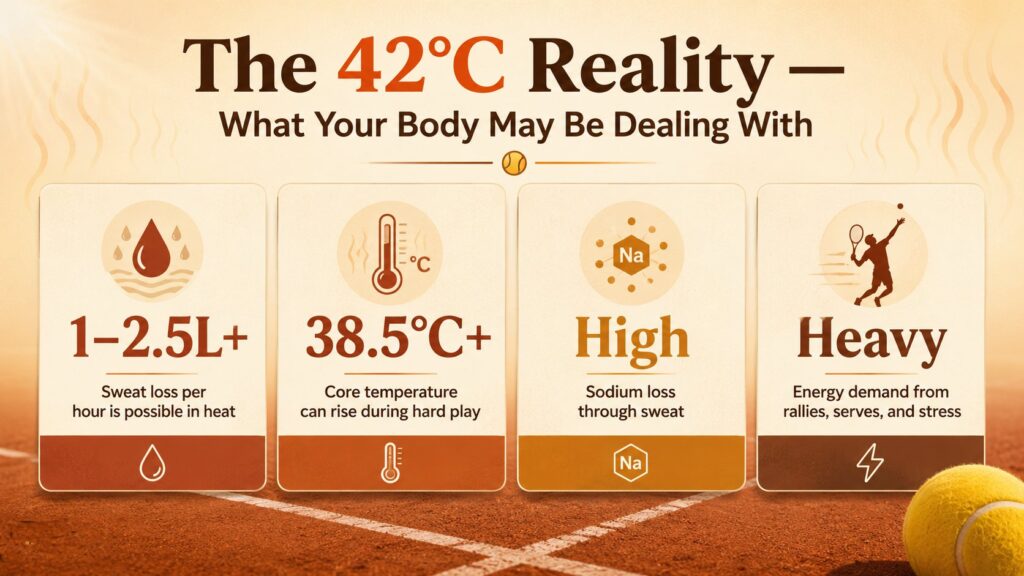
The 42°C Reality …. What Your Body May Be Dealing With
1–2.5 litres or more: Sweat loss per hour is possible in heat.
38.5°C or more: Core body temperature can rise during hard play.
High sodium loss: Sweat removes not only water but also important salts.
Heavy energy demand: Long rallies, repeated sprints, serves, recovery steps, and emotional stress all burn energy.
This is why heat tennis is different from normal tennis.
In normal weather, you are playing the opponent.
In extreme heat, you are playing two opponents:
The player across the net.
And the heat inside your own body.
The Four-Level Breakdown …. What a Heat Match Really Does
1. Muscle Damage
Every sprint, every sudden stop, every wide ball, every serve, every recovery step creates stress inside the muscle. This is normal. This is part of competitive sport.
But in heat, the body has one extra duty: it has to cool itself. Blood has to go toward the skin to release heat. The heart has to work harder. The body is trying to survive and perform at the same time.
So recovery becomes harder.
That is why the player may say:
“Sir, legs heavy hai.”
“Sir, body uth nahi raha.”
“Sir, movement nahi aa raha.”
This is not always drama. Sometimes, the body is genuinely overloaded.
2. Glycogen Depletion
Muscles need fuel. That fuel is called glycogen, stored carbohydrate energy.
A long match in the heat can empty a large part of this fuel tank.
When glycogen levels go down, the player not only feels tired. The whole game changes.
Split step becomes late.
The first step becomes slow.
Recovery after a wide ball becomes poor.
Serve loses pop.
The mind becomes negative.
Small mistakes start looking very big.
This is why, after two tough matches, a player may suddenly feel as if someone has removed the battery from his body.
The game is still there.
But the current is gone.
3. Fluid and Electrolyte Loss
Now comes a very important point.
Tirth’s stomach cramps and leg cramps were not just about “not drinking enough water.”
Many players drink water. But water alone is not recovery.
When you sweat, you do not lose only water. You also lose sodium and other electrolytes.
In hot tennis conditions, sodium loss can become a serious issue, especially when matches are played on back-to-back days.
When fluid and sodium are not replaced properly, the body becomes more vulnerable.
Muscles may misfire.
Nerves may struggle.
Cramps may come.
The stomach may revolt.
The player may panic.
And once cramps enter the mind, the monkey becomes even heavier.
Research – Journal of Science and Medicine in Sport

“When a tennis player cramps in warm to hot conditions, extensive sweating across current and previous matches , and the resulting sodium deficit …. are usually the primary contributing factors. Plain water, however much of it, is often not enough.”
This is exactly what players and parents must understand.
The cramp in Round 3 may not begin in Round 3. It may begin in Round 1, with the first litre of sweat that was not properly replaced.
It may begin when the player finishes the match, talks for ten minutes, sits in the heat, drinks randomly, eats late, sleeps poorly, and thinks:
“Kal dekh lenge.”
No.
In tournament tennis, “kal dekh lenge” is not a recovery plan.
It is a trap.
4. CNS Fatigue – The Invisible Damage
This is the one most people do not talk about.
Your central nervous system also gets tired. The brain, spinal cord, and nerve-muscle communication become overloaded.
This is why a player may say:
“Sir, mentally done lag raha tha.”
And people may reply:
“Be strong.”
“Don’t think negative.”
“Fight.”
Yes, fighting is important. I believe in fighting. I have built players on fighting spirit.
But I also believe in truth.
Sometimes the player is not mentally weak. Sometimes the nervous system is genuinely fatigued.
The body does not simply run out of water. It can also run out of coordination.
Modern sports science does not explain exercise cramps with one simple answer. It is not always only dehydration. It is not always only electrolytes. In many tennis situations, especially after repeated matches, neuromuscular fatigue also plays a major role.
That is why we must stop giving childish advice like:
“Bas paani pee lo.”
“Bas banana kha lo.”
“Bas stretch kar lo.”
These things may help, but they are not the full system.
A serious tennis player needs a serious recovery protocol.
Novak Djokovic on Heat
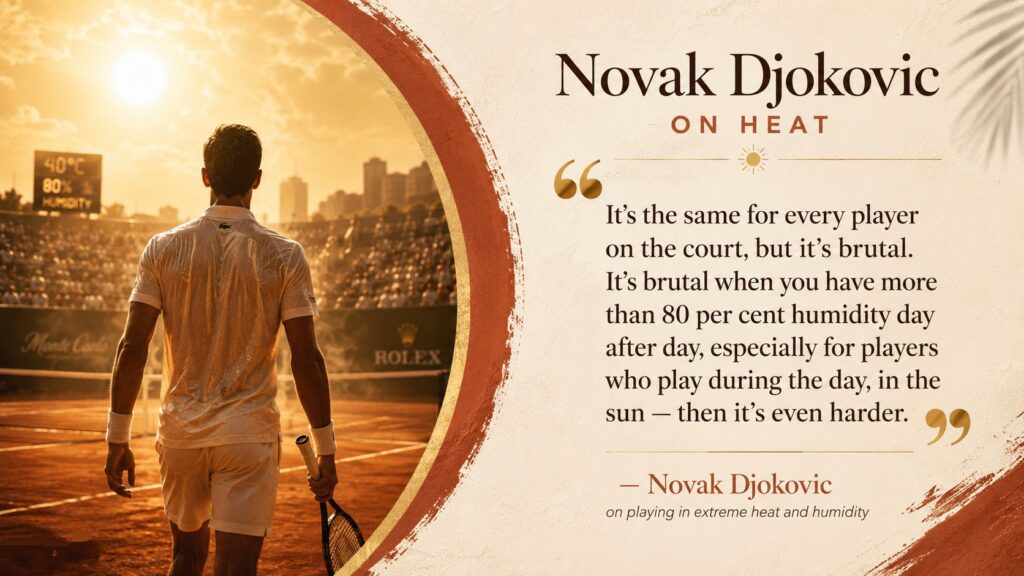
“It’s the same for every player on the court, but it’s brutal. It’s brutal when you have more than 80 per cent humidity day after day, especially for players who play during the day, in the sun, then it’s even harder.”
— Novak Djokovic, Shanghai Masters, after several players struggled in extreme heat and humidity
When Djokovic says brutal, we must listen.
This is not an excuse-maker speaking. This is one of the most disciplined and recovery-conscious athletes in tennis.
Even he accepts that playing day after day in heat and humidity becomes survival mode.
So when our Indian juniors, young adults, and tournament players struggle in 40°C-plus heat, we should not simply call them weak.
We must educate them. We must prepare them.
We must make them tougher, yes …. but toughness without knowledge becomes foolishness.
Real toughness is not ignoring the body. Real toughness is preparing the body so well that it can fight again tomorrow.
That is why recovery is not a luxury.
Recovery is performance preparation.
A player who does not recover properly is not entering the next match with the same body. He is entering with yesterday’s damage still sitting inside him.
Why Even Doing the Right Things Is Sometimes Not Enough
Now I want to say something very clearly, because this is where my heart is involved.
Tirth is not a careless player.
He is not the boy who drinks only water, eats anything, sleeps late, and then gives excuses.
No. He tries.
He takes his sodium tablets.
He uses magnesium gel.
He does hot and cold showers.
He foam rolls.
He stretches.
He takes electrolytes …. not just plain water.
He is already doing more than many players his age.
And still, he broke down in Round 3.
This is the painful part.
Because sometimes, doing the right things is still not enough if they are not done in the right order, at the right time, in the right quantity, and with the right understanding.
What Tirth Was Already Doing Between Matches
- Sodium tablets
- Magnesium gel
- Hot and cold showers
- Foam rolling
- Stretching
- Electrolytes with every drink
So the question is not:
“Was he doing anything?”
The question is:
“Was there a complete recovery system?”
Because recovery is not a random collection of good habits. Recovery is a sequence. It has timing, windows, priorities, science, and discipline.
Doing the right things without the right timing is like filling a leaking bucket.
The effort is real.
The intention is right.
But the system is incomplete.
And I say this with full honesty: this is not only Tirth’s gap. This is a gap in Indian tennis.
Many of us were never taught this properly. I was not taught it either.
I had to learn it through years of watching players suffer, through my own son’s journey on the Indian circuit, through mistakes, through research, through pain, through observation, and through the simple coach’s question:
“Why is this happening again and again?”
That question has brought me to this article.
And that question must now become a system for my players.
What Tirth Needed
What Tirth needed was not just ingredients.
He already had many ingredients.
What he needed was the recipe.
What he needed was not just effort.
He already gives effort.
What he needed was the map.
The hour-by-hour map.
What to do immediately after the match.
What to drink.
What to eat.
How to cool.
How to calm the nervous system.
How to sleep.
How to prepare the next morning.
How to know whether the body is ready or pretending to be ready.
That is where real recovery begins.
“Recovery has time windows. Miss those windows, and no amount of sleep will bring you back fully.”
This line is very important.
Because many players think recovery starts at night.
Wrong.
Recovery starts the moment the last point finishes.
The first 30 minutes after the match are gold.
If you waste them, you may carry the damage into tomorrow.
And tomorrow, that damage may come back as the monkey.
The Lesson Is Simple
Recovery is not one thing.
It is not only water.
It is not only stretching.
It is not only sleep.
It is not only one electrolyte tablet after the match.
Real recovery is timing, cooling, sodium, carbohydrate, protein, nervous-system calming, and smart next-day preparation.
In tournaments, the next match is often not lost on the next day.
It is lost in the first 30 minutes after the previous match.
That is when the player either starts repairing the body …. or quietly starts losing tomorrow’s match.
Parents must also understand this.
When a player says, “My body is not recovered,” sometimes it can become an excuse.
Yes, I know this. I have seen this also. Some players start using body pain as a mental escape route.
But sometimes it is not an excuse. Sometimes it is a real physiological warning.
The coach’s job is to separate laziness from genuine breakdown.
The player’s job is to stop hiding behind the sentence:
“Body recover nahi hua.”
If recovery is your problem, then recovery must become your discipline.
Not your excuse.
That is the Gomesee Way.
I will care for you from the heart. I will support you like my own.
But I will not allow you to keep the monkey permanently on your shoulder.
We will understand it.
We will respect it.
We will remove it.
And then we will go back and compete.
Tirth, if you are reading this …. those two wins were outstanding. I am proud of the way you fought. This article exists because of you, and also for every player who has talent but has not yet understood recovery deeply enough.
Coach’s Note
This article is for player education, not medical diagnosis.
Severe cramps, dizziness, vomiting, confusion, chest discomfort, repeated heat collapse, or unusual stomach pain should be discussed with a qualified doctor, sports physician, or sports nutrition expert.
Heat is not a small matter.
Respect it before it punishes you.
As a coach, I can guide, observe, educate, and build systems. But when the body gives serious warning signs, we must be mature enough to involve the right medical expert.
That is not weakness.
That is wisdom.
Coming in Part 2
In Part 2, I will share the complete hour-by-hour recovery protocol.
What to do in the first 30 minutes.
What to do in the first 2 hours.
What to do before sleeping.
What to do the next morning.
What to drink.
What to eat.
How to cool the body.
How to calm the nervous system.
How to prepare for the next match.
This will not be theory.
This will be built for Indian conditions, Indian tournaments, Indian players, Indian summers, and Indian realities.
Because our players do not need fancy words.
They need systems that work.
And if one player reads this and saves one match because he recovered better, then this article has done its job.
You can read more player-development articles on Tennis Performance Code.
Written by Gomesee
Your Next Level Is Guaranteed
Leave a Reply