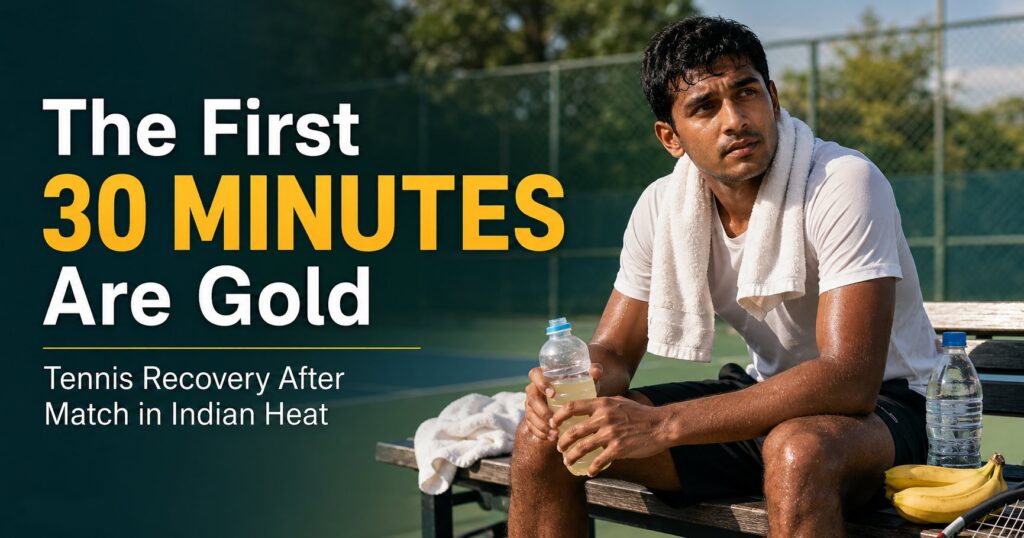
• The First 30 Minutes Are Gold: Tennis Recovery After Match in Indian Heat

    Tennis recovery after match in Indian heat

    The First 30 Minutes Are Gold: Tennis Recovery After Match in Indian Heat

    Tennis Performance Code  ·  Recovery Series  ·  Part 2

    By Gomesee

    A complete hour-by-hour recovery map for Indian tennis players — built for our heat, our tournaments, and our realities.

    Tennis recovery after match is not just rest; in Indian heat, it is the first preparation for tomorrow’s performance.

    Part 1 ended with the monkey sitting on Tirth’s shoulder in Round 3 — legs stiff, stomach cramping, body refusing to cooperate, despite the talent being fully there.

    Part 2 is the map he needed — built for our heat, our conditions, our players. Because:

    “Many players do not lose tomorrow’s match tomorrow.
    They lose it in the first 30 minutes after today’s match ends.”

    Why Recovery Has Time Windows — And Why Missing Them Costs You

    Recovery has time windows. Miss them, and no amount of sleep the following night will fully undo the damage. Dr. Stacy Sims, exercise physiologist at Stanford:

    “The first 30–45 minutes post-exercise represent a critical window for glycogen resynthesis and muscle protein synthesis. Delaying nutrition in this window — even by 60 minutes — measurably reduces the speed and quality of recovery.” — Dr. Stacy Sims, ROAR: How to Match Your Food and Fitness to Your Unique Female Physiology (and male principles apply equally)
    “In high-intensity sport, it is not just what an athlete does in training that determines readiness. It is how well the athlete recovers between sessions. Poor recovery is the single most underrated performance limiter in competitive sport.” — Dr. Tim Gabbett, Journal of Sports Sciences

    For Indian junior players — who may play two or three rounds in 40°C plus heat, with limited facilities, on hard courts, in back-to-back days — this is not theoretical. This is survival.
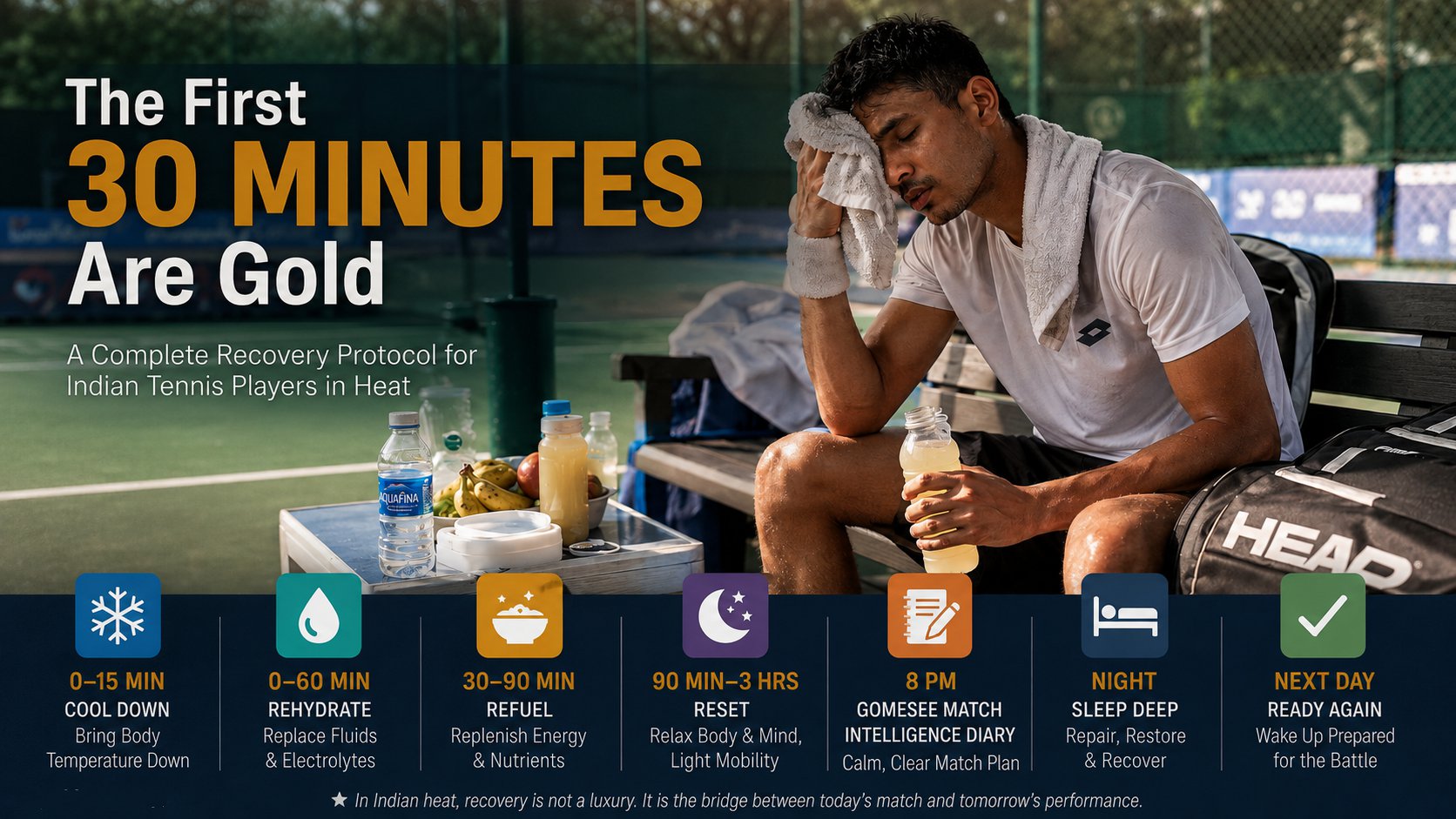

    Tennis recovery after match recovery map for Indian tennis players

    The Recovery Map

    Seven phases. One goal: walk onto tomorrow’s court as a fully loaded player, not a patched-up one.

    Phase 1 — Immediate Cooling (Minutes 0 to 15)

    ● What is happening in the body

    Core body temperature can reach 38.5°C to 39.5°C or higher during hard play in extreme Indian heat. Until the core temperature begins dropping, the internal recovery process cannot begin properly.

    ● What to do — immediately after leaving the court

    • Get out of direct sunlight. Find shade, an indoor space, or sit under an umbrella.
    • Do not stand and talk in the heat. Sit down. Lower the metabolic demand on the body immediately.
    • Take a cold, wet towel and place it on your neck, forehead, and wrists — areas where blood vessels sit close to the skin. This helps bring core temperature down faster.
    • If available, a cold water bottle pressed against the neck or wrists works well.
    • Avoid immediately sitting in a cold AC room with soaking wet clothing. Go to shade first, change out of wet clothes, then enter a cooler environment if available.

    ● Research note

    A 2012 review published in the British Journal of Sports Medicine confirmed that neck and forehead cooling provides meaningful reduction in perceived thermal strain during and after exercise in hot conditions — and is practical even in low-resource environments.

    ● Indian tournament reality

    At any tournament — whether in Ahmedabad, Bhuj, or anywhere on the Indian circuit — a player sitting courtside between matches will not always have immediate access to an ice bath or a physio’s table. That is completely normal. A small insulated cool bag, two thin towels, and shade are enough to begin this phase correctly. Work with what you have — but work with it immediately.

    The Sports Authority of India (SAI) and the All India Tennis Association (AITA) operate within this Indian reality. Recovery protocols must be calibrated for our dry heat, high solar radiation, and subcontinental conditions — not imported wholesale from temperate climates. Our players deserve guidance built for where they actually play.

    Phase 2 — Rehydration and Electrolyte Replacement (Minutes 0 to 60)

    ● The most misunderstood part of recovery

    When a player sweats heavily for two or three hours in 42°C heat, they do not only lose water. They lose sodium. They lose potassium. They lose chloride. These electrolytes are not optional extras. They are the electrical system that runs the muscles and nerves.

    “When a tennis player cramps in warm to hot conditions, extensive sweating across current and previous matches — and the resulting sodium deficit — are usually the primary contributing factors. Plain water, however much consumed, is often not enough to restore the sodium balance required for normal neuromuscular function.” — Dr. Michael F. Bergeron, Journal of Science and Medicine in Sport (2003)
    Heat Cramps: Fluid and Electrolyte Challenges During Tennis in the Heat

    This is exactly what happened to Tirth. The cramp in Round 3 did not begin in Round 3. It began quietly — possibly in Round 1 — with the first litre of sweat that was replaced with plain water and no sodium.

    ● The two-bottle rule — practical for Indian conditions

    • Bottle 1: Plain water — drink slowly, not in large gulps.
    • Bottle 2: Electrolyte drink — ORS (Electral or similar) mixed per packet instructions, OR homemade nimbu pani with a small pinch of kala namak (black salt) and a little sugar if needed.

    The goal in the first 60 minutes is not to flood the system with liquid. It is to replace fluid and sodium steadily — sipping, not gulping.

    Research by Maughan & Shirreffs (2010), published in the Scandinavian Journal of Medicine & Science in Sports, confirms that effective rehydration after exercise in hot conditions requires both fluid volume and electrolyte replacement together — neither alone is sufficient to fully restore the body’s balance.

    ● Budget-friendly electrolyte options for Indian players

    Option How to Use
    ORS / Electral packetMix one sachet in 1 litre of water. Sip over 45–60 minutes.
    Nimbu PaniFresh lemon juice, water, small pinch of kala namak, small amount of sugar. Easy to carry in a flask.
    Sports drink (Gatorade etc.)If available and budget allows. Read the label — dilute if too sweet.
    Coconut waterNatural electrolytes. Excellent if fresh and available locally.
    Plain waterAlways important — but combine with one of the above, do not use alone after heavy sweating.

    Phase 3 — Carbohydrate and Protein Recovery (Minutes 30 to 90)

    ● The fuel tank and the repair crew

    A long match in heat depletes glycogen — the stored carbohydrate fuel inside your muscles. When glycogen is low, everything suffers: movement, reaction speed, serve power, mental sharpness, and emotional resilience. A player with empty glycogen tanks does not just feel tired. They feel like the battery has been removed from their game.

    Research published in the Journal of Pediatric Orthopaedics and the American College of Sports Medicine supports a recovery ratio of approximately 3:1 carbohydrates to protein in the first 90 minutes post-exercise for young athletes in high-intensity sport.

    ● The ideal recovery food timing

    Time After Match What to Eat Indian Options
    0–30 minsEasy-to-digest carbohydrates. Nothing heavy.Banana, dates, raisins, chikki
    30–90 minsCarbohydrate + protein together.Curd-rice (if kept cool and fresh), peanut-butter sandwich, roasted chana, paneer if kept cool
    90 mins+Proper meal. Real food.Dal-chawal, sabzi-roti, curd, vegetables. Avoid heavy fried food.

    ● Important notes

    • Curd-rice, paneer, and milk-based items should only be consumed if kept cool and fresh. In 42°C heat, dairy spoils quickly. When in doubt, carry these in an insulated dabba with ice.
    • Peanuts and heavier foods are better as later recovery food, not immediately after the match when the stomach is under stress.
    • Do not eat a large meal immediately after the match. The stomach, like the muscles, is in recovery mode. Give it easy, digestible food first.
    • Bananas are not magic. They help — potassium is useful — but they cannot replace a full electrolyte and carbohydrate protocol on their own.
    “For young athletes competing in multiple events, the post-exercise nutrition window is not optional. It is the foundation of next-day performance. Carbohydrate-protein co-ingestion in the 30–90 minute window post-exercise significantly accelerates glycogen resynthesis compared to carbohydrate alone.” — Burke, L.M. et al., Journal of Sports Sciences, 2011

    Phase 4 — Light Mobility and Avoiding Stiffness (Minutes 20 to 45)

    ● The mistake most players make

    After a tough match, most players want to collapse. This is understandable. But if the body is left completely still and cold — especially after a heat match — the muscles begin to stiffen. Lactic acid and metabolic waste sit in the tissue instead of being flushed out. The next morning, the player wakes up feeling like concrete.

    ● What to do

    • 5 to 10 minutes of slow walking after drinking and cooling. Just easy movement. No intensity.
    • Gentle calf stretches, hip flexor stretches, quad stretches — holding each for 30 to 45 seconds, not bouncing.
    • Foam rolling if available — slow, gentle passes on the calves, quads, and upper back. Not aggressive.
    • Change out of wet, salty clothes immediately. Staying in wet, salty clothing keeps the body in a low-grade stress state.
    • Dry socks and clean footwear matter more than most players realise. The feet carry the entire match. Give them air and rest.

    Dr. Shona Halson, a leading recovery researcher who spent over a decade at the Australian Institute of Sport, has written that low-intensity active recovery accelerates the removal of metabolic by-products from exercised muscle more effectively than complete rest — and that the greatest gains from this type of recovery are seen in athletes who perform it consistently, not occasionally.

    Phase 5 — Nervous System Reset (Hours 1 to 3)

    ● The part nobody talks about

    The muscles are not the only system that gets fatigued in a long, tough match. The central nervous system — the brain, the spinal cord, the nerve-to-muscle communication pathways — also accumulates fatigue. This is central nervous system fatigue. And it responds poorly to pressure, noise, urgent conversations about the next match, and analysis of what went wrong.

    Professor Samuele Marcora of the University of Kent, whose research on the psychobiological model of exercise fatigue has been widely cited, has shown that perceived effort and mental fatigue directly impair physical performance — independently of what the muscles are doing. The brain that is tired sends a tired body onto the court.

    ● The mental reset protocol — simple and practical

    • Find a quiet corner. Away from the courts, the results board, the noise, and other players talking about their matches.
    • Ten minutes with earphones in — calm music, not high-energy. Or silence. The nervous system needs quiet to begin settling.
    • No coach analysis for at least 60 to 90 minutes after the match. The player’s nervous system is not ready to process tactical feedback in this window. Information given here is often not properly retained.
    • No social media. No watching other matches immediately. Just rest the mind.
    • Some players find it helpful to write three things that went well in the match — not what went wrong. This shifts the brain from survival mode to learning mode.

    Phase 6 — Sleep and Next-Day Readiness

    ● Sleep is the master recovery tool

    “Sleep is the single most effective thing we can do to reset our brain and body health each day — and it is the most powerful performance-enhancement tool in any athlete’s toolkit.” — Professor Matthew Walker, Why We Sleep: Unlocking the Power of Sleep and Dreams (2017)

    ● Sleep targets for tournament players

    • Minimum 8 hours for juniors and young adults in heavy tournament play. 9 hours is better when multiple matches are involved.
    • Sleep before midnight. The hours between 10pm and 2am are particularly rich in deep sleep and growth hormone release.
    • Cool, dark room if possible. Body temperature needs to drop slightly for deep sleep to occur — which is why a cool room helps even more after a heat match.
    • No screens for 30 to 45 minutes before sleeping. Blue light suppresses melatonin — the sleep hormone.

    ● The night-before failure that haunts Round 3

    A player who sleeps at 12:30am is not sleeping 8 hours even if they wake at 8:30am. The growth hormone window has closed. They wake up unrested — and wonder why.

    Sleep discipline in tournaments is not optional. It is as important as the match plan.

    Phase 7 — The Pre-Sleep Match-Plan Conversation

    ● The session most coaches skip

    ● What the pre-sleep conversation should include

    • What is the opponent’s main pattern? One or two lines only. Not an analysis. Just the key read.
    • What is our game plan? Simple. How are we going to play — not how we are going to avoid losing.
    • What is our first-ball focus? Give the player one clear, specific intention for the start of the match.
    • What do we stay away from? One thing to avoid. That is all.
    • Finish with belief. Not pressure. Close with something like: “Your body is recovering. Your mind knows what to do. Sleep well and go compete.”

    This conversation should feel like a coach speaking to a trusted athlete — not a general giving orders before a battle. The tone is calm confidence. The length is short. The message is clear.

    Phase 8 — The Gomesee Match Intelligence Diary (Around 8:00 pm)

    ● The step that completes the circle

    Around 8:00 pm — after the body has been cooled, fed, hydrated, and allowed to rest — the player sits with the coach or the parent. Not to receive a lecture. Not to replay the mistakes of today. But to do something very specific and very powerful:

    They fill the Gomesee Match Intelligence Diary.

    This is the tool that ensures the player does not just recover physically — but goes to sleep with a completely clear, calm, and focused mind. No open questions. No anxiety about tomorrow. No confusion about how to play. Just clarity.

    ● Why the diary matters — the science of pre-sleep mental clarity

    Dr. Jim Loehr, sports psychologist and co-author of The Power of Full Engagement, who spent decades working with world-class tennis players, wrote that elite competitors distinguish themselves not only by physical preparation but by the quality of their mental recovery rituals.

    “The mental demands of competition are just as real as the physical ones. Recovery that addresses only the body while leaving the mind in emotional chaos is incomplete. The best performers in the world prepare the mind for the next performance with the same rigour they prepare the body.” — Dr. Jim Loehr & Tony Schwartz, The Power of Full Engagement (2003)

    ● Before Sleep: Diary, Not Drama

    Goal: sleep with clarity, not pressure.

    Before sleep, the player should not receive a long tactical lecture. The body is repairing. The mind is tired. This is not the time to overload the player. But the player should also not sleep blindly.

    In my coaching system, filling the Gomesee Match Intelligence Diary is non-negotiable. I will not reveal the internal structure of that diary here. That belongs to my player-coach system.

    But the principle is simple:

    Recover the body. Calm the mind. Create clarity for tomorrow. Then sleep.

    The diary prevents two dangerous things: confusion and overthinking. A player should not go to bed with twenty voices inside the head. One clear direction is enough.

    The player closes the diary. The player sleeps. And in the morning, they wake up as a complete athlete — body restored, mind focused, plan in place, belief intact. Not just recovering the legs. Recovering the whole player — body and mind, together.

    “The key to high performance and personal renewal is the skillful management of energy, not time. Recovery is not the opposite of performance. It is the foundation of it.” — Dr. Jim Loehr & Tony Schwartz, The Power of Full Engagement (2003)

    The Indian Tournament Recovery Bag

    This is not a luxury list. It is a practical, budget-conscious toolkit that every Indian junior player and their parent can put together before every tournament.

    Category Item Why It Matters
    COOLING2 thin towels in a cool bagNeck/forehead cooling reduces core temperature
    COOLINGSmall umbrella or wide-brim capShade between matches reduces heat load
    HYDRATION2L plain waterBase hydration — always essential
    HYDRATIONORS sachets or nimbu pani flask with small pinch of saltSodium replacement — prevents cramping
    FUEL2 bananas or a small box of dates/raisinsImmediate carbohydrate — easy to digest
    FUELPeanut-butter sandwich or roasted chanaCarb + protein — muscle repair fuel
    FUELCurd-rice in insulated dabba (if fresh and cool)Carb + protein + gut-cooling effect
    COMFORT3 spare T-shirts and 2 extra pairs of socksDry, clean clothing removes salt stress from the skin
    COMFORTFlip-flops or open footwearLet feet breathe and recover between matches
    MENTAL RESETEarphones — for 10 minutes of quiet after the matchNervous system cannot recover inside noise
    MENTAL RESETSmall notebook — write 3 things that went wellShifts brain from survival mode to learning mode

    Stop Play Immediately — Know These Signs

    Heat is not a small matter. What begins as tiredness can escalate into a medical emergency quickly. Every parent, coach, and player must know when to stop.

    If the player shows any of the following, stop play and seek medical help without delay:

    • Confusion or unusual behaviour — says things that do not make sense
    • Dizziness or inability to stand or walk normally
    • Vomiting that does not stop
    • Fainting or loss of consciousness
    • Severe weakness where the body cannot function
    • Severe cramps that do not respond to rest and fluids
    • Stops sweating while still in the heat — the body’s cooling system is shutting down

    Health comes before the trophy. There is no match, no prize money, and no ranking point that is worth a serious medical event.

    This article is coaching guidance and player education — not medical advice. Any serious heat illness, persistent cramping, recurring collapse, chest discomfort, or unusual symptoms must be assessed by a qualified sports physician or doctor. As a coach, I can guide, observe, educate, and build systems. For serious warning signs, we involve the right medical expert. That is not weakness. That is wisdom.

    The Body Is Ready. Now Go Compete.

    Recovery is not what you do after the match.

    Recovery is the first decision of the next match.

    The players who last in tournaments are not always the most talented. They are the most prepared — in every meaning of that word. They prepare their rackets. They prepare their tactics. And the ones who win multiple rounds, day after day, in heat and pressure — they prepare their bodies.

    The map is in your hands now. It does not require a fancy facility. It does not require an expensive physio or a sports science lab. It requires discipline, timing, and the understanding that the tournament does not pause between matches — and neither should your preparation.

    “Champions aren’t made in the gyms. Champions are made from something they have deep inside them — a desire, a dream, a vision.” — Muhammad Ali

    But I will add to this, with respect to Ali’s greatness:

    Champions are also made in the hours after the match ends — in the quiet discipline of recovery, when nobody is watching.

    The trophy does not go to the strongest player in Round 1. It goes to the player who was most ready for Round 3.

    Take care of the body tonight. The match is already beginning.


    Tirth — those two wins in the Ahmedabad heat were outstanding. Every player who saw them saw real tennis and real fighting spirit.

    This article was written because of you, and it was written for every talented Indian player who has not yet been given the recovery map they deserve. Now you have it. Use it.

    🔗 Read Part 1 of the Recovery Series here

    References and Research Sources

    The following sources informed the research framework for this article:

    • Bergeron, M.F. (2003). Heat cramps: fluid and electrolyte challenges during tennis in the heat. Journal of Science and Medicine in Sport, 6(1), 19–27.
    • Burke, L.M. et al. (2011). Carbohydrates for training and competition. Journal of Sports Sciences, 29(sup1), S17–S27.
    • Gabbett, T.J. (2016). The training-injury prevention paradox. British Journal of Sports Medicine.
    • Halson, S.L. (2014). Monitoring training load to understand fatigue in athletes. Sports Medicine, 44(S2), 139–147.
    • Marcora, S.M., Staiano, W., & Manning, V. (2009). Mental fatigue impairs physical performance in humans. Journal of Applied Physiology, 106(3), 857–864.
    • Maughan, R.J. & Shirreffs, S.M. (2010). Dehydration and rehydration in competitive sport. Scandinavian Journal of Medicine & Science in Sports.
    • Sims, S. (2016). ROAR: How to Match Your Food and Fitness to Your Unique Female Physiology. Rodale Books.
    • Walker, M. (2017). Why We Sleep: Unlocking the Power of Sleep and Dreams. Scribner.
    • British Journal of Sports Medicine (2012). Cooling interventions for exercise-induced hyperthermia.
    • JPOSNA / American College of Sports Medicine youth athlete recovery guidelines.
    • NHS / CDC criteria for heat exhaustion and heat stroke.
    • Sports Authority of India (SAI) — Sports Science and Research Division. Guidelines for athlete health, hydration, and heat management in Indian climatic conditions. NCSSR, New Delhi.
    • All India Tennis Association (AITA) — Tournament regulations and player welfare framework. Ministry of Youth Affairs and Sports, Government of India.

    Coach’s Note: All quotes attributed to named researchers reflect positions from their documented published work. The Muhammad Ali quote is widely attributed. No quotes in this article have been invented.

    Tennis Performance Code  ·  Recovery Series  ·  Part 2

  • Tennis Recovery After a Match in Heat: The Monkey on the Shoulder

    Tennis Recovery After a Match in Heat: The Monkey on the Shoulder


    Tennis recovery after a match in the heat can decide whether a player enters the next round ready to compete or already beaten before walking on court. It was a ₹2.5 lakh prize money tournament here in Ahmedabad. The temperature was around 42°C.

    For people sitting outside the court, it is just a number. For a tennis player playing three hours on a clay court, it is punishment. The sun does not just shine on you. It presses on you. It drains you. It slowly takes away your legs, your timing, your patience, your decision-making, and finally, your belief.

    I was watching one of my players, Tirth.

    Twenty-one years old. Unseeded. Tall, talented, hardworking, and someone who has gone through enough ups and downs in tennis to understand what fighting means.

    In the first round, he beat the sixth seed. Clean tennis. Composed tennis. Brave tennis.

    The next day, he came back again and beat another strong player in the second round.

    Two matches. Two wins. Two tough battles in Ahmedabad heat.

    The tournament had started noticing him.

    And then came Round 3.


    The Three-Round Story

    Round 1: Win — defeated the sixth seed as an unseeded player.

    Round 2: Win — beat another strong opponent in Ahmedabad heat.

    Round 3: Could not compete with his full body. The monkey was already sitting on the shoulder.

    Round 3 was not just another match.

    Tirth walked in, but his body had not fully come with him.

    Maybe the opponent was strong. Maybe the match would still have been difficult. I never disrespect an opponent. But as a coach, I could see something else.

    The real battle had started before the first point.

    His stomach had cramped badly. His legs were stiff. His movement was heavy. His energy was not coming from inside. His body had not recovered from the two previous matches played in that brutal heat.

    And there it was …. the monkey.

    Not visible to the crowd. Not visible to the tournament desk. Not visible to people who only see the score.

    But a coach can see it.

    The weight of fatigue.
    The fear of the body breaking down again.
    The silent voice that says:

    “I cannot do this today.”

    “He was not only fighting the opponent. He was fighting the monkey already sitting on his shoulder.”

    This has not happened only to Tirth. I have seen this again and again in Indian tennis.

    A player plays one good round. Then another good round. Parents get excited. Coaches feel positive. The player also starts believing, “This tournament can be mine.”

    And then suddenly, the third match is gone.

    Not because the player forgot tennis.
    Not because the player became weak overnight.
    Not because the player lacks talent.

    But because nobody has properly taught our players one of the most important subjects in tournament tennis:

    How to recover after a match in extreme heat.

    This article is not written to blame Tirth.

    It is written. After all, I care for him, because I have seen his pain, and because I do not want another talented Indian player to say again and again:

    “Sir, body recover nahi hua.”

    At some point, we have to stop just feeling bad. We have to understand. We have to learn. We have to build a system.


    Tennis Recovery After Match in Heat: What Actually Happens to Your Body

    Most players think fatigue means tiredness.

    They think:

    “Sleep kar lunga.”
    “Thoda stretch kar lunga.”
    “Electrolyte pee lunga.”
    “Kal theek ho jayega.”

    This is the biggest misunderstanding.

    A long match in 42°C heat is not simple tiredness. It is not only sweating. It is not only leg pain. It is a full-body attack.

    Heat attacks the muscles.
    Heat attacks the fuel tank.
    Heat attacks the nervous system.
    Heat attacks the mind.
    Heat attacks belief.

    That is why a player may look physically present on court, but internally, the system is already struggling.

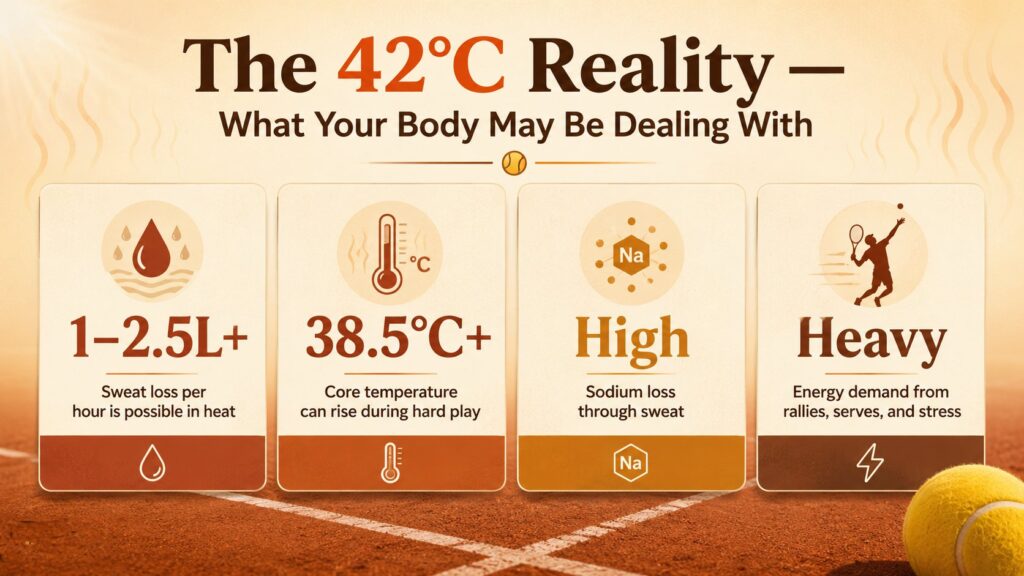
    Tennis heat recovery sweat loss and sodium loss

    The 42°C Reality …. What Your Body May Be Dealing With

    1–2.5 litres or more: Sweat loss per hour is possible in heat.

    38.5°C or more: Core body temperature can rise during hard play.

    High sodium loss: Sweat removes not only water but also important salts.

    Heavy energy demand: Long rallies, repeated sprints, serves, recovery steps, and emotional stress all burn energy.

    This is why heat tennis is different from normal tennis.

    In normal weather, you are playing the opponent.

    In extreme heat, you are playing two opponents:

    The player across the net.
    And the heat inside your own body.


    The Four-Level Breakdown …. What a Heat Match Really Does

    1. Muscle Damage

    Every sprint, every sudden stop, every wide ball, every serve, every recovery step creates stress inside the muscle. This is normal. This is part of competitive sport.

    But in heat, the body has one extra duty: it has to cool itself. Blood has to go toward the skin to release heat. The heart has to work harder. The body is trying to survive and perform at the same time.

    So recovery becomes harder.

    That is why the player may say:

    “Sir, legs heavy hai.”
    “Sir, body uth nahi raha.”
    “Sir, movement nahi aa raha.”

    This is not always drama. Sometimes, the body is genuinely overloaded.


    2. Glycogen Depletion

    Muscles need fuel. That fuel is called glycogen, stored carbohydrate energy.

    A long match in the heat can empty a large part of this fuel tank.

    When glycogen levels go down, the player not only feels tired. The whole game changes.

    Split step becomes late.
    The first step becomes slow.
    Recovery after a wide ball becomes poor.
    Serve loses pop.
    The mind becomes negative.
    Small mistakes start looking very big.

    This is why, after two tough matches, a player may suddenly feel as if someone has removed the battery from his body.

    The game is still there.

    But the current is gone.


    3. Fluid and Electrolyte Loss

    Now comes a very important point.

    Tirth’s stomach cramps and leg cramps were not just about “not drinking enough water.”

    Many players drink water. But water alone is not recovery.

    When you sweat, you do not lose only water. You also lose sodium and other electrolytes.

    In hot tennis conditions, sodium loss can become a serious issue, especially when matches are played on back-to-back days.

    When fluid and sodium are not replaced properly, the body becomes more vulnerable.

    Muscles may misfire.
    Nerves may struggle.
    Cramps may come.
    The stomach may revolt.
    The player may panic.

    And once cramps enter the mind, the monkey becomes even heavier.


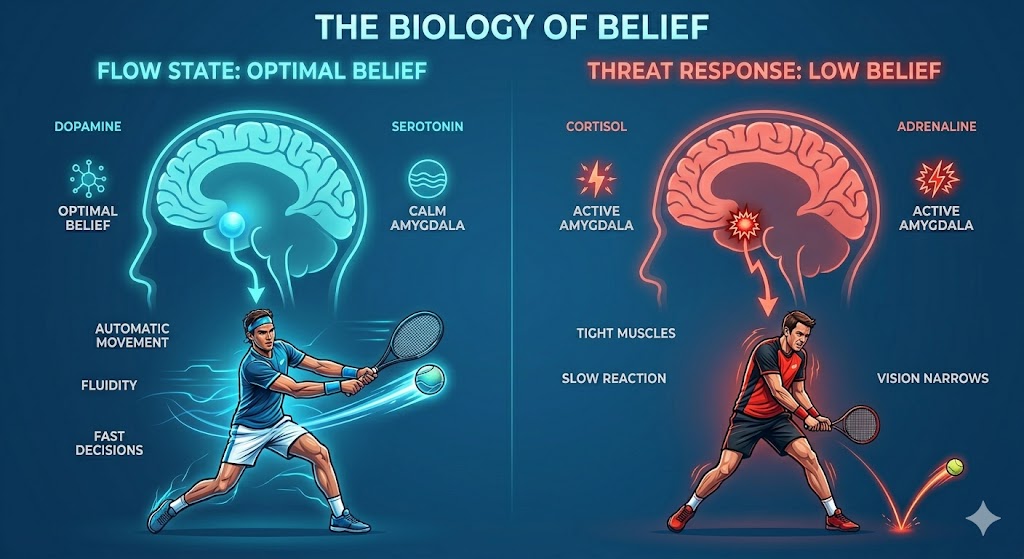
    Research – Journal of Science and Medicine in Sport

    Tennis heat cramps research sodium loss

    “When a tennis player cramps in warm to hot conditions, extensive sweating across current and previous matches , and the resulting sodium deficit …. are usually the primary contributing factors. Plain water, however much of it, is often not enough.”

    Bergeron, M.F. (2003). Heat cramps: fluid and electrolyte challenges during tennis in the heat. Journal of Science and Medicine in Sport.

    This is exactly what players and parents must understand.

    The cramp in Round 3 may not begin in Round 3. It may begin in Round 1, with the first litre of sweat that was not properly replaced.

    It may begin when the player finishes the match, talks for ten minutes, sits in the heat, drinks randomly, eats late, sleeps poorly, and thinks:

    “Kal dekh lenge.”

    No.

    In tournament tennis, “kal dekh lenge” is not a recovery plan.

    It is a trap.


    4. CNS Fatigue – The Invisible Damage

    This is the one most people do not talk about.

    Your central nervous system also gets tired. The brain, spinal cord, and nerve-muscle communication become overloaded.

    This is why a player may say:

    “Sir, mentally done lag raha tha.”

    And people may reply:

    “Be strong.”
    “Don’t think negative.”
    “Fight.”

    Yes, fighting is important. I believe in fighting. I have built players on fighting spirit.

    But I also believe in truth.

    Sometimes the player is not mentally weak. Sometimes the nervous system is genuinely fatigued.

    The body does not simply run out of water. It can also run out of coordination.

    Modern sports science does not explain exercise cramps with one simple answer. It is not always only dehydration. It is not always only electrolytes. In many tennis situations, especially after repeated matches, neuromuscular fatigue also plays a major role.

    That is why we must stop giving childish advice like:

    “Bas paani pee lo.”
    “Bas banana kha lo.”
    “Bas stretch kar lo.”

    These things may help, but they are not the full system.

    A serious tennis player needs a serious recovery protocol.


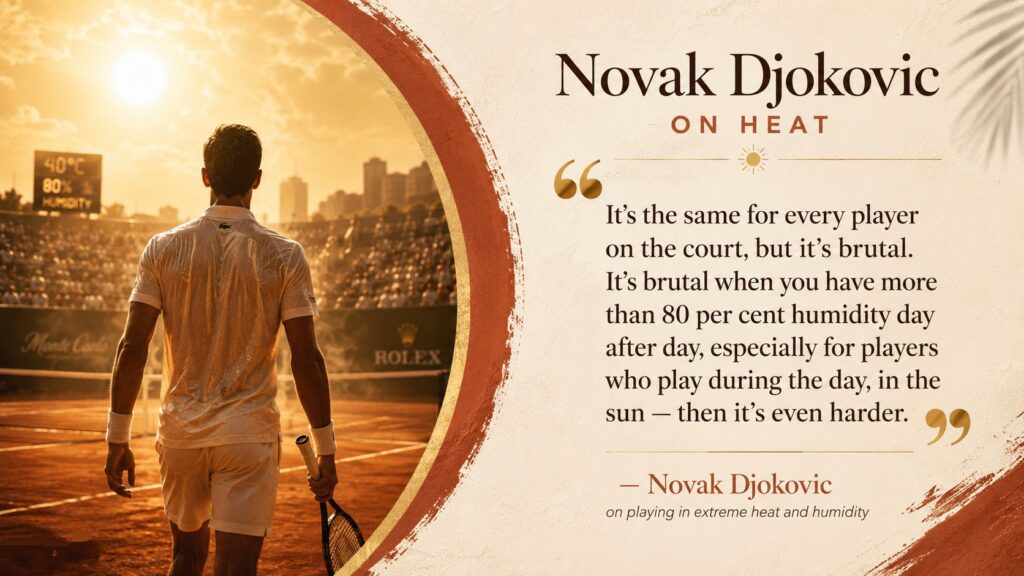
    Novak Djokovic on Heat

    Novak Djokovic heat quote tennis recovery

    “It’s the same for every player on the court, but it’s brutal. It’s brutal when you have more than 80 per cent humidity day after day, especially for players who play during the day, in the sun, then it’s even harder.”

    Novak Djokovic, Shanghai Masters, after several players struggled in extreme heat and humidity

    When Djokovic says brutal, we must listen.

    This is not an excuse-maker speaking. This is one of the most disciplined and recovery-conscious athletes in tennis.

    Even he accepts that playing day after day in heat and humidity becomes survival mode.

    So when our Indian juniors, young adults, and tournament players struggle in 40°C-plus heat, we should not simply call them weak.

    We must educate them. We must prepare them.

    We must make them tougher, yes …. but toughness without knowledge becomes foolishness.

    Real toughness is not ignoring the body. Real toughness is preparing the body so well that it can fight again tomorrow.

    That is why recovery is not a luxury.

    Recovery is performance preparation.

    A player who does not recover properly is not entering the next match with the same body. He is entering with yesterday’s damage still sitting inside him.


    Why Even Doing the Right Things Is Sometimes Not Enough

    Now I want to say something very clearly, because this is where my heart is involved.

    Tirth is not a careless player.

    He is not the boy who drinks only water, eats anything, sleeps late, and then gives excuses.

    No. He tries.

    He takes his sodium tablets.
    He uses magnesium gel.
    He does hot and cold showers.
    He foam rolls.
    He stretches.
    He takes electrolytes …. not just plain water.

    He is already doing more than many players his age.

    And still, he broke down in Round 3.

    This is the painful part.

    Because sometimes, doing the right things is still not enough if they are not done in the right order, at the right time, in the right quantity, and with the right understanding.


    What Tirth Was Already Doing Between Matches

    • Sodium tablets
    • Magnesium gel
    • Hot and cold showers
    • Foam rolling
    • Stretching
    • Electrolytes with every drink

    So the question is not:

    “Was he doing anything?”

    The question is:

    “Was there a complete recovery system?”

    Because recovery is not a random collection of good habits. Recovery is a sequence. It has timing, windows, priorities, science, and discipline.

    Doing the right things without the right timing is like filling a leaking bucket.

    The effort is real.
    The intention is right.
    But the system is incomplete.

    And I say this with full honesty: this is not only Tirth’s gap. This is a gap in Indian tennis.

    Many of us were never taught this properly. I was not taught it either.

    I had to learn it through years of watching players suffer, through my own son’s journey on the Indian circuit, through mistakes, through research, through pain, through observation, and through the simple coach’s question:

    “Why is this happening again and again?”

    That question has brought me to this article.

    And that question must now become a system for my players.


    What Tirth Needed

    What Tirth needed was not just ingredients.

    He already had many ingredients.

    What he needed was the recipe.

    What he needed was not just effort.

    He already gives effort.

    What he needed was the map.

    The hour-by-hour map.

    What to do immediately after the match.
    What to drink.
    What to eat.
    How to cool.
    How to calm the nervous system.
    How to sleep.
    How to prepare the next morning.
    How to know whether the body is ready or pretending to be ready.

    That is where real recovery begins.

    “Recovery has time windows. Miss those windows, and no amount of sleep will bring you back fully.”

    This line is very important.

    Because many players think recovery starts at night.

    Wrong.

    Recovery starts the moment the last point finishes.

    The first 30 minutes after the match are gold.

    If you waste them, you may carry the damage into tomorrow.

    And tomorrow, that damage may come back as the monkey.


    The Lesson Is Simple

    Recovery is not one thing.

    It is not only water.
    It is not only stretching.
    It is not only sleep.
    It is not only one electrolyte tablet after the match.

    Real recovery is timing, cooling, sodium, carbohydrate, protein, nervous-system calming, and smart next-day preparation.

    In tournaments, the next match is often not lost on the next day.

    It is lost in the first 30 minutes after the previous match.

    That is when the player either starts repairing the body …. or quietly starts losing tomorrow’s match.

    Parents must also understand this.

    When a player says, “My body is not recovered,” sometimes it can become an excuse.

    Yes, I know this. I have seen this also. Some players start using body pain as a mental escape route.

    But sometimes it is not an excuse. Sometimes it is a real physiological warning.

    The coach’s job is to separate laziness from genuine breakdown.

    The player’s job is to stop hiding behind the sentence:

    “Body recover nahi hua.”

    If recovery is your problem, then recovery must become your discipline.

    Not your excuse.

    That is the Gomesee Way.

    I will care for you from the heart. I will support you like my own.

    But I will not allow you to keep the monkey permanently on your shoulder.

    We will understand it.
    We will respect it.
    We will remove it.

    And then we will go back and compete.

    Tirth, if you are reading this …. those two wins were outstanding. I am proud of the way you fought. This article exists because of you, and also for every player who has talent but has not yet understood recovery deeply enough.


    Coach’s Note

    This article is for player education, not medical diagnosis.

    Severe cramps, dizziness, vomiting, confusion, chest discomfort, repeated heat collapse, or unusual stomach pain should be discussed with a qualified doctor, sports physician, or sports nutrition expert.

    Heat is not a small matter.

    Respect it before it punishes you.

    As a coach, I can guide, observe, educate, and build systems. But when the body gives serious warning signs, we must be mature enough to involve the right medical expert.

    That is not weakness.

    That is wisdom.


    Coming in Part 2

    In Part 2, I will share the complete hour-by-hour recovery protocol.

    What to do in the first 30 minutes.
    What to do in the first 2 hours.
    What to do before sleeping.
    What to do the next morning.
    What to drink.
    What to eat.
    How to cool the body.
    How to calm the nervous system.
    How to prepare for the next match.

    This will not be theory.

    This will be built for Indian conditions, Indian tournaments, Indian players, Indian summers, and Indian realities.

    Because our players do not need fancy words.

    They need systems that work.

    And if one player reads this and saves one match because he recovered better, then this article has done its job.

    You can read more player-development articles on Tennis Performance Code.


    Written by Gomesee
    Your Next Level Is Guaranteed

  • TENNIS REVOLUTION EVERY SERIOUS PLAYER, PARENT, AND COACH SHOULD NOTICE

    TENNIS REVOLUTION EVERY SERIOUS PLAYER, PARENT, AND COACH SHOULD NOTICE

    Three rare technologies entering tennis right now, and why the players who know them first will win.

    By Coach Gomes · Roland Garros Week, May 2026


    Picture this. It is a warm Monday morning. The French Open …. Roland Garros, the qualifying rounds and practice week before the main draw.” has just begun its first day of play in Paris. Millions of tennis fans are watching. Coaches around the world are glued to their screens, studying technique, observing tactics, taking notes.

    This tennis technology revolution is not coming someday, it has already started.

    But here is what almost none of them noticed.

    While everyone was watching who was playing, something far more important was happening quietly on the sidelines. A technology revolution, one that has been building for three years …. silently crossed a threshold this week that changes tennis coaching forever.

    I noticed. And today, I want to share it with you, because that is what this blog is for. Not the obvious. Not the mainstream. The rare. The genuine. The things that give you and your game a real edge before anyone else even knows they exist.

    The Tennis Technology Revolution Has Already Started

    Here are three technologies that are changing tennis at the highest level right now, and what they mean for every player, at every level, including yours.

    Player development is no longer only about strokes; it is about recovery, mindset, decision-making, and smarter training.


    DISCOVERY ONE The Wristband Inside the Grand Slam

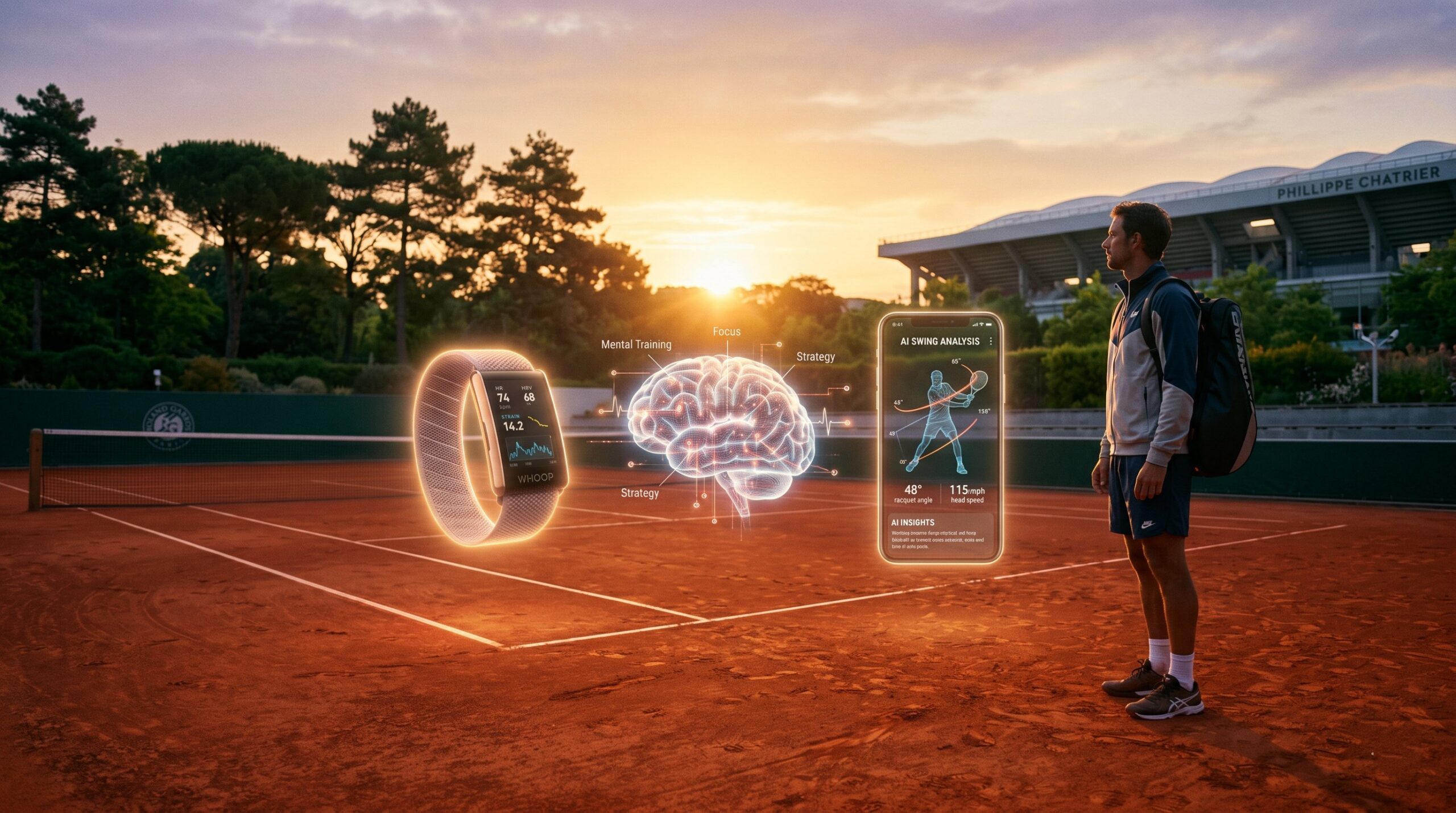
    For the first time in the history of Grand Slam tennis, players are now officially permitted to wear connected biometric devices …. like the Whoop band, during competition. This started today. Day one of Roland Garros 2026.

    The Whoop band tracks heart rate variability, sleep quality, recovery scores, respiratory rate, and strain levels in real time. Players can now collect real biometric data during competition, information that can later help them and their teams understand strain, recovery, and physical readiness more accurately.

    This is not a gadget. This is a physiological truth-teller worn on the wrist.

    Think about what this means at the coaching level. For years, we have been asking our players “how do you feel?” And they say “fine” ….. because they are competitors, they want to play, they do not want to show weakness. But their body tells a different story.

    The Whoop band removes the guessing. It does not care about ego. It reads the body’s honest signals: heart rate variability, recovery percentage, sleep debt. And now, for the first time, this data is permitted inside a Grand Slam court.

    “Wearable devices monitor physiological metrics such as heart rate variability, fatigue, and recovery, providing a comprehensive view of an athlete’s readiness.” – Euro School of Tennis, Technology in Tennis Report, 2026

    What should you take from this as a player or parent? Simple. Recovery is not laziness. It is strategy. The best players in the world are now wearing science on their wrist. You do not need a Grand Slam to start thinking this way. You need a coach who understands it.


    DISCOVERY TWO The App That Trains Your Mind Like a Muscle

    Ask any great coach what separates the good from the great. They will not say the forehand. They will not say fitness. They will say …. the mind.

    Vodar is a new coaching app built on neuroscience and cognitive psychology. Every week, new mental drills are released …. covering focus, resilience, emotional control, and confidence. Each drill comes with step-by-step instructions and animated 3D video. On-court. Practical. No psychology degree needed.

    The science behind it? It enhances BDNF …. Brain-Derived Neurotrophic Factor …. a protein that literally strengthens memory and resilience in the brain. This is not motivation talk. This is biology.

    The man behind Vodar’s methodology is Jeff Greenwald …. one of the most respected sports psychology consultants in the world, who has worked with USTA, Stanford Men’s Tennis, and UC Berkeley Men’s Tennis. This is not a startup built in a garage by someone who plays twice a week. This is credentialed, tested, real-world thinking – brought onto the court.

    Here is the insight that stunned me when I first read about Vodar. They described it like this: imagine playing tennis with one hand tied behind your back. That is what players do when they train only technique and fitness, and ignore the mind. They play at 75% of their potential. Every single match.

    “Mental strength often becomes the deciding factor in high-pressure moments, yet it remains one of the most neglected aspects of training. Remove mental coaching, and a player instantly loses 25% of their potential.” – Vodar App Research Brief, as reported by Tennis365, 2025

    At grassroots level, at our level, nobody is using this yet. Parents are spending money on rackets, on shoes, on private lessons. And the mind …. the thing that determines whether your child holds serve at 5-4 in the third set, is left entirely to chance.

    That ends here. That ends today. Know about Vodar.


    DISCOVERY THREE Compare Your Swing to Djokovic. From Your Phone.

    Here is the question I want you to sit with for a moment. What if you could compare your student’s backhand …. in real time …. to Novak Djokovic’s? Not conceptually. Not by watching YouTube. Actually, scientifically, biomechanically …. stroke by stroke?

    SportAI makes this possible. Using only a standard phone camera, the app uses computer vision and machine learning to analyse a player’s swing: hip rotation, shoulder velocity, wrist speed, kinetic chain, follow-through. Everything. Then it generates a detailed overlay, comparing the player’s swing curve to a professional’s.

    SportAI received a Special Mention in TIME Magazine’s Best Inventions of 2025. And very few academy-level coaches have started using this kind of technology yet.

    This was built by Lauren Pedersen …. a former NCAA Division I tennis player from New Zealand who grew up far from elite coaching resources. Her mission was personal: she knew what it felt like to have raw talent but no access to elite analysis. So she built the tool she wished she had.

    “This technology means that anyone could compare their serve against Serena or their backhand against Djokovic,” says Pedersen. “It’s an incredible tool for both recreational players and professionals, giving insights that might otherwise go unnoticed.”

    “SportAI gives tennis players elite-level technique analysis …. straight from their phone. It turns complex data into clear, actionable guidance …. exactly what coaches need to help athletes get better, faster.” – SportAI.com · Named TIME Best Invention, 2025

    And here is the detail that made even me pause. One of SportAI’s early investors …. the person who looked at this technology and said “yes, I believe in this” …. is Magnus Carlsen. The greatest chess player in the history of the game. A man who understands pattern recognition, precision, and the science of performance at the deepest possible level. He put his money into this tennis AI company. That tells you something.


    THE COACH’S PERSPECTIVE The Gap Is Opening. Which Side Are You On?

    Three technologies. One wristband now inside the Grand Slams. One neuroscience app training the mind like a muscle. One AI that puts Djokovic’s swing side by side with your student’s …. from a phone camera.

    None of these require a million-dollar budget. None require a high-performance centre. They require awareness. They require curiosity. They require a coach who cares enough to look beyond the obvious.

    I have spent my career believing that world-class coaching is not about geography. It is not about how close you are to a centre of excellence. It is about how far you are willing to go in your thinking.

    The players at Roland Garros in Paris this week are wearing Whoop bands. Their coaches are working with SportAI analysis. Their mental coaches are implementing structured resilience drills just like Vodar prescribes. This is the reality at the top of the sport – today.

    And now you know it too. That is the whole point of this blog.

    Technology will not replace good coaches.
    But it will reward the coaches who keep learning.

    “The difference between a good coach and a great one is not technique. It is the relentless pursuit of what others are not yet seeing.” – Coach Gomes

    Share this with one coach, one parent, one player who deserves to know. Knowledge shared is coaching elevated.

    See you on the court.

    Coach Gomes Tennis Coach Lifelong Student of the Game

  • AITA Singles, Doubles and Higher Age Group: A Practical Guide For Tennis Parents

    Information reviewed against available AITA sources on 15 May 2026.

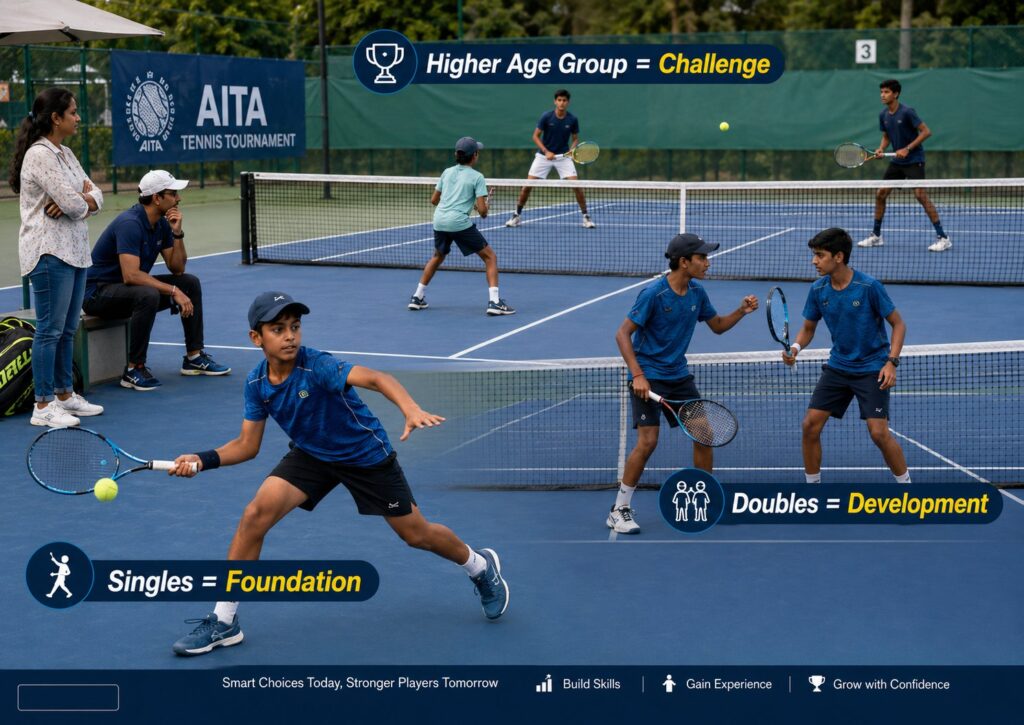
    higher age group singles doubles AITA tennis parents

    Higher age group, singles and doubles decisions should always support the child’s long-term development, not ego or pressure.


    The three tools every junior tennis parent needs to understand:

    Singles is the foundation. Doubles is the development tool. Higher age group is the challenge tool.

    But tools are only as good as the hands that use them.

    A child should not play singles only for ranking points. A child should not play doubles only as a shortcut to ranking. A child should not play a higher age group only to satisfy ego.

    Before every tournament entry, the right question is not:

    “Can my child enter this event?”

    The better question is:

    “Will this event help my child grow as a player?”

    That is where mature tennis parenting begins.

    For ranking-points basics, read the previous article …. How AITA Ranking Points Work.


    1. Singles: The Foundation That Cannot Be Faked

    Singles reveals a player’s true competitive identity.

    There is no partner to cover weaknesses. No hiding place. The child must manage the full court alone — serve, return, rally construction, movement, fitness, shot selection, and emotional control. Everything is exposed.

    This is why, no matter how well a child performs in doubles or how boldly they compete in a higher age group, if the singles foundation is weak, ranking progress will not hold.

    A good parent does not watch only the score. A good parent learns to watch the player.

    Better questions after a singles match:

    • Did the child compete more maturely than before?
    • Did the child recover after mistakes?
    • Did the child handle pressure points better?
    • Did the child construct points rather than just trade shots?
    • Did the child show improved emotional control?

    These questions tell you more about a player’s development than the final scoreline ever will.


    2. Doubles: More Than a Ranking Supplement

    Many parents treat doubles as an afterthought.

    “Doubles is only extra.” “Let us play doubles only if points come.”

    That is a mistake.

    Ranking Value

    As per AITA’s 2026 Junior Circuit Rules, for Under-18, Under-16, Under-14, and Under-12 categories, 25% of the best 8 doubles tournament points are included in rankings, along with category-specific additions stated in the rules.

    So yes, doubles supports ranking. But that is the smaller reason to play it.

    Development Value

    Doubles builds a different and more complete tennis player:

    • Return quality sharpens because the ball comes faster with less margin
    • Net play and volley confidence grows under real match pressure
    • Serve placement becomes more deliberate
    • Reaction speed improves
    • Tactical intelligence develops through partner communication and court awareness
    • Pressure-point courage is tested at the net

    A chronic baseliner who avoids the net becomes braver in doubles. A player with a weak return becomes sharper. A nervous player at the net gains courage. These improvements feed directly back into singles.

    What Parents Must Know Before Entering Doubles

    Per AITA’s 2026 Junior Circuit Rules:

    • There is no doubles in Championship Series 3-Day tournaments
    • For TS7, CS7, SS, NS, and Nationals — doubles is part of the event and points count toward rankings
    • The minimum draw size for points to be awarded is 8 pairs
    • Doubles entry is decided on the merit of combined ranking

    Before planning doubles, verify:

    1. Does this tournament include doubles?
    2. Is a suitable partner available?
    3. What is the combined ranking situation?
    4. Is the draw valid for points?
    5. Will doubles create excessive physical or mental load for the child this week?

    3. Higher Age Group: Useful Tool or Ego Trap?

    This is the most emotionally charged area of junior tennis parenting.

    An Under-12 playing Under-14 looks impressive. An Under-16 competing in Under-18 feels like progress. Parents take pride. But pride and development are not always the same thing.

    When Higher Age Group Genuinely Helps

    Playing up benefits a child who is:

    • Physically ready for the heavier pace and more physical play
    • Technically stable enough to compete, not just survive
    • Mentally mature enough to handle losses without confidence damage
    • Guided by a coach with a specific developmental purpose in mind

    When It Harms

    When the child is pushed up before readiness:

    • Repeated heavy losses damage confidence
    • Physical mismatch raises injury risk
    • Mental wear begins to create tournament fear rather than competitive hunger

    Playing higher age group must be a development decision, not a status decision.

    The question is not: “My child is playing above age — doesn’t that mean something?”

    The better question is: “What exactly are we trying to develop here, and is the child ready?”

    If the answer is clear and grounded, proceed with purpose. If the answer is ego, comparison, or anxiety, pause.

    Ranking Value

    AITA’s 2026 Junior Circuit Rules allow higher age-group results to count in junior rankings:

    • Under-16 ranking includes points from the best 8 AITA Under-18 results
    • Under-14 ranking includes points from the best 8 AITA Under-16 results
    • Under-12 ranking includes points from the best 8 AITA Under-14 results

    Category-specific provisions exist for Asian tournaments, ITF Juniors, and AITA Men’s/Women’s tournaments where applicable.

    Rules may permit it. Ranking may benefit from it. But development must decide it.

    A wise parent understands the difference between permission and readiness.


    4. Tournament Load: The Hidden Cost Parents Ignore

    AITA’s 2026 Junior Circuit Rules set yearly tournament limits:

    Age GroupAnnual Tournament Limit
    Under-1218 AITA tournaments
    Under-1425 AITA tournaments
    Under-1630 AITA tournaments
    Under-18No restriction

    Critically: A tournament played in any age group counts toward the total. An Under-12 player eligible for Under-12, Under-14, and Under-16 still has a combined limit of 18 tournaments.

    This rule carries a message beyond compliance: children are not machines.

    More tournaments do not automatically produce better players. Over-scheduling affects body freshness, injury risk, school balance, emotional health, training quality, and — most importantly — the child’s hunger to compete.

    The proud parent who says “My child is playing every week” should instead be asking: “Is my child improving every month?”

    A child needs tournaments. A child also needs training blocks, recovery blocks, and time to reflect and reset.


    5. Event Combination Rules: Know the Limits

    AITA rules also govern how events can be combined within a single tournament week:

    • A player cannot enter two different tournaments at different venues during the same week
    • If a tournament runs two age groups, a player cannot play qualifying in both. The player may play the main draw of one age group and qualifying of the other
    • In a multi-age-group tournament, a player may enter a maximum of three events: two singles main draws and one doubles main draw
    • A player cannot enter one singles and two doubles events

    Do not approach tournament entry like shopping. Every entry carries body load, mental load, and recovery cost. A disciplined tournament plan protects the child.


    The Five Questions Before Every Entry

    Before entering doubles or a higher age group, any parent can run this simple check:

    1. Purpose — Why are we entering this event?
    2. Readiness — Is the child physically, technically, and mentally ready?
    3. Load — Will this create excessive body or travel load?
    4. Confidence — Will this stretch the child or break the child?
    5. Review — After the tournament, what will we learn and improve?

    These five questions cut through emotional decision-making before it does damage.


    Common Mistakes Parents Make

    Ignoring doubles entirely. Doubles builds match skills that singles practice cannot replicate and contributes to ranking. Skipping it is a real cost.

    Playing doubles only for points. Points are a by-product. The real return is a sharper return game, braver net play, and better tactical thinking.

    Pushing higher age group too early. Repeated heavy losses before the child is ready do not build resilience — they erode confidence.

    Treating higher age group as a badge. It is a test, not a trophy. Use it with a specific purpose.

    Forgetting recovery. A tired player cannot compete at full quality. Recovery is not optional — it is part of the development plan.


    The Bottom Line

    Singles is the foundation. Doubles is valuable. Higher age-group tournaments can be useful.

    All three must be planned with maturity.

    The best question before entering any event:

    Will this help my child grow as a player?

    If yes — enter with purpose. If the honest answer is ego, comparison, pressure, or fear of missing out — think again.

    A child is not a ranking project. A child is a developing athlete. The goal is not to collect tournaments. The goal is to build a player.


    Coming Next: Tournament Procedures — Entry, Fact Sheet, Sign-In, Qualifying, Main Draw, Seeding, Lucky Loser, Withdrawal, and No-Show. Many parents lose opportunities not because their child cannot play, but because they do not understand tournament procedure.


    Disclaimer: This article is written for educational guidance only. AITA rules, tournament formats, ranking systems, eligibility conditions, points structure, and participation limits may change. Always verify current information from the official AITA website, tournament fact sheets, official circulars, and the tournament referee before making any tournament decisions.

  • The Wall Is a Weapon: How Iga Swiatek Exposed Blind First-Strike Tennis in Rome 2026

    AI illustration of Iga Swiatek Rome 2026 showing the wall is a weapon tennis lesson on red clay

    Iga Swiatek Rome 2026 was not just about a 6-2, 6-1 win over Naomi Osaka at the Foro Italico. It was a coaching lesson for every serious tennis player. In a game obsessed with quick winners and short patterns, Iga showed that the real weapon is not blind hitting. The real weapon is position, balance, heavy shape, rally tolerance and controlled pressure.

    On May 11, 2026, we did not just see a tennis match. We saw a powerful reminder that modern tennis is not only about first strike. It is about who can build pressure, absorb pressure, and repeat quality under pressure.

    The scoreboard looks like a blowout, but the story is far deeper. For the last few years, the coaching world has been obsessed with “Short Patterns” …. the idea that points should be won in three shots or less. But in the slow, heavy night conditions of Rome, Świątek proved that the short pattern is often a trap. If your timing is off by just 1%, you lose. Yesterday, Iga stopped playing the lottery and started playing the Geometry of Pressure.

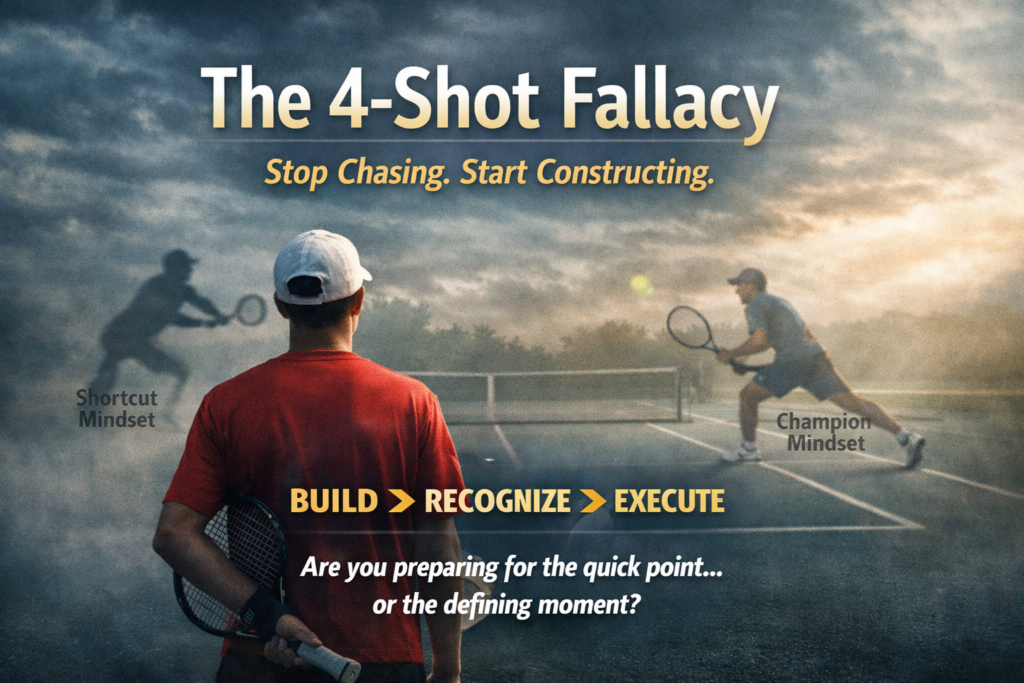
    This is exactly why I earlier wrote about the danger of the 4-Shot Fallacy. Short patterns are useful, but when young players become addicted to finishing too early, they lose the ability to build pressure.

    1. The Francisco Roig Influence …. The “Mallorca Mindset”

    Why did Iga hire Francisco Roig? Because for 17 years, he helped build the most indestructible wall in history: Rafael Nadal. Following a split with Wim Fissette and a intensive training block at the Rafa Nadal Academy, Iga has undergone a tactical metamorphosis.

    Under Roig, she is no longer just a “hitter”; she has become a navigator. She has moved her game away from the fragility of “First-Strike” and back to a foundation of Rally Dominance. She isn’t avoiding risk; she is redefining it. By choosing to play longer, heavier rallies, she is removing the “luck factor” from the court. She is turning the red clay into a prison for her opponents.

    2. If You Want to Break the Wall, You Must BECOME the Wall

    I tell my players this every day …. You cannot out-hit a player you cannot out-suffer.

    Naomi Osaka is a hammer. She wants to hit through you. But yesterday, she hit against a wall that didn’t just block …. it pushed back.

    🎾The Gomesee Masterclass ….

    “A hitter tries to win the point with their racket. An aggressor wins the point with their feet. If you are in the right position, the shot becomes easy. If you are in the wrong position, even a 150mph shot is just a lucky gamble.”

    (Meaning: When you win the battle of the feet, the racket doesn’t have to work as hard. You steal time with movement, not just muscles. In the Rome night air, Iga’s positioning was so perfect that Naomi felt she had to do “something extra” just to stay in the rally. That “extra” is where the errors come from.)


    Watch the official WTA highlights of Swiatek vs Osaka in Rome ….

    Analyze the rally starting at 1:45. Notice how Iga doesn’t panic when Osaka hits big. She uses her feet to get behind the ball and neutralize the power with heavy topspin. This is the ‘Champion Wall’ in motion—she isn’t just surviving; she is resetting the geometry of the court until Osaka collapses

    3. The Death of the “Blind Hitter”

    Indian juniors, listen to me closely. If you play only for the highlight reel, you will play for the losing side. Świątek finished the match with 23 winners and only 18 errors. That is the Golden Ratio. She landed 67% of her first serves. She wasn’t trying to be spectacular; she was trying to be repeatable.

    As reported by Tennis Now, quoting her interview with Sport.pl, Iga said she wanted to return to “solid foundations” and feel like a wall on court again. But don’t be mistaken. This isn’t a passive wall of a “pusher.” This is a Champion Wall. It is deep, it is heavy, it is balanced, and it is relentless. It is a wall that keeps asking the opponent: “Can you hit one more great shot? How about ten more?”

    4. The Gomesee Takeaway …. System vs. Mood

    Don’t be a hitter who depends on a “good mood.” Be a System that depends on Legs and Shape.

    In modern tennis, aggression is positioning. By taking the ball on the rise and using heavy topspin to force your opponent to hit from their shoulders, you are being more aggressive than the player swinging blindly at 100mph.

    My advice to you ….

    • Stop looking for the winner; look for the discomfort.
    • Make the court feel small for your opponent.
    • When they feel like they have nowhere to go, they will give you the match.

    Aggression without tolerance is gambling. Aggression with discipline is champion tennis.

    FAQs

    What did Iga Swiatek prove in Rome 2026?

    Iga Swiatek proved that controlled aggression can be more dangerous than blind first-strike tennis. Against Naomi Osaka, she used footwork, heavy topspin, depth and rally tolerance to turn defence into pressure.

    What is the Champion Wall in tennis?

    The Champion Wall is not passive pushing. It is a disciplined style of tennis where the player stays balanced, plays heavy and deep, repeats quality balls, and forces the opponent to take extra risk.

    What can junior players learn from Iga Swiatek’s Rome performance?

    Junior players must learn that power alone is not enough. The real goal is to build a system: better feet, better balance, better shape, better recovery and better shot selection under pressure.

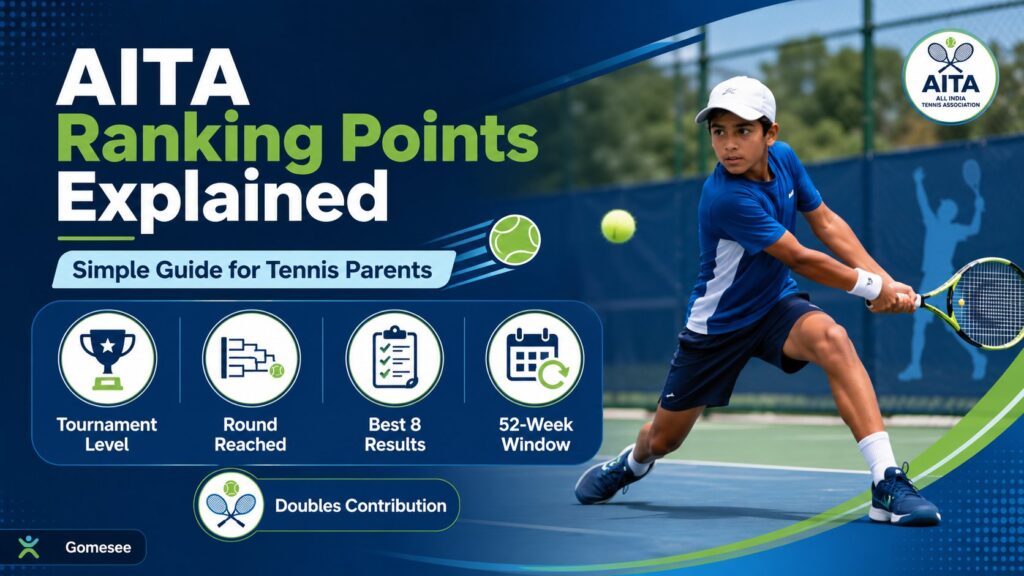
  • How AITA Ranking Points Work: Simple Explanation for Tennis Parents

    Information reviewed against available AITA sources on 10 May 2026.

    AITA ranking points explained for tennis parents


    AITA ranking points can confuse parents, but once the system is understood, tournament planning becomes calmer and smarter.

    In Part 1, we understood what AITA ranking really means.

    In Part 2, we understood the AITA tournament ladder – Talent Series, Championship Series, Super Series, National Series, and Nationals.

    Now we come to the question that creates the most confusion for parents ….

    “How does my child actually get AITA ranking points?”

    Many parents feel that if their child wins two or three matches, the ranking should immediately jump. Sometimes it happens. Sometimes it does not.

    The reason is simple ….

    Ranking points depend on tournament level, round reached, draw validity, ranking rules, and the ranking window.

    So before getting emotional about ranking, parents should understand the points system calmly.

    AITA’s 2026 Junior Circuit Rules include the official points system for Talent Series, Championship Series, Super Series, National Series, and Nationals. The same document also mentions important ranking concepts like the 52-week period and best 8 tournament results.


    AITA Ranking Points Explained in Simple Words

    For parents, the first basic rule is this:

    A player gets points mainly according to the tournament level and the round reached.

    This means a quarterfinal in Talent Series and a quarterfinal in Nationals are not the same.

    A semifinal in Championship Series and a semifinal in National Series are not the same.

    A final in Super Series and a final in Nationals are not the same.

    So parents should not ask only ….

    “Did my child win?”

    They should also ask ….

    “Which tournament level did my child play, and which round did my child reach?”

    That gives a much clearer picture.


    Official AITA Junior Points Table

    As per AITA’s 2026 Junior Circuit Rules, the points increase according to the grade of the tournament and the round reached. The official points table lists points for R64, R32, R16, quarterfinal, semifinal, finalist, and winner.

    Tournament LevelR64R32R16QFSFFinalistWinner
    Talent Series 7 Days268101215
    Championship Series 3 Days1346810
    Championship Series 7 Days4810152025
    Super Series51020304050
    National Series5102030405075
    Nationals20406080100150200

    This table explains why all results cannot be treated equally.

    A player winning a Talent Series 7 Days gets 15 points, while a player winning Nationals gets 200 points under the official AITA points table.


    Practical Parent Example

    Suppose two children both say:

    “I reached the semifinal.”

    Parent A’s child reached the semifinal of a Talent Series.

    Parent B’s child reached the semifinal of a National Series.

    Both are semifinals, but the ranking value is different.

    As per the points table, a semifinal in Talent Series 7 Days gives 10 points, while a semifinal in National Series gives 40 points.

    So the better parent question is not only:

    “How far did my child go?”

    The better question is:

    “How far did my child go, and at what tournament level?”

    This one question removes a lot of confusion.


    Best 8 Results: Very Important for Parents

    This is one of the most important ranking concepts.

    AITA’s 2026 Junior Circuit Rules state that the ranking system considers tournaments played during the last 52 weeks. The same rules state that from 2025, the results of the best 8 tournaments are considered for ranking.

    In simple parent language:

    Your child may play more than 8 tournaments, but the ranking calculation focuses on the best 8 results as per the official rules.

    This means playing more tournaments is not automatically better.

    Playing smarter tournaments is better.

    A player who plays 20 tournaments without strong results may not benefit as much as a player who carefully plans tournaments and produces 8 solid results.


    The 52-Week Ranking Window

    Parents often panic when ranking drops.

    But ranking works like a moving window.

    Because AITA ranking considers tournaments played during the last 52 weeks, older results can go out of the calculation.

    Example:

    Suppose your child won a good tournament last year and earned points.

    After the 52-week period moves forward, those points may no longer remain in the ranking calculation. If the child has not replaced those points with new results, the ranking may drop.

    This does not always mean the child has become weaker.

    Sometimes it simply means:

    • old points went out
    • new points were not enough
    • other players gained better points

    So parents should not panic immediately. First, they should check the ranking cycle.


    Singles and Doubles Points

    Singles is the main base, but doubles can also support ranking.

    For Under-18, Under-16, Under-14, and Under-12 categories, AITA’s 2026 Junior Circuit Rules mention that rankings include best 8 singles tournament results along with 25% of the best 8 doubles tournament points. The rules also mention category-specific additions involving ITF Juniors, Asian tournaments, higher AITA age-group results, and AITA Men/Women tournament points where applicable.

    For parents, the simple meaning is:

    Do not ignore doubles.

    Doubles can support ranking, but more importantly, it develops:

    • return quality
    • net game
    • reaction speed
    • communication
    • tactical thinking
    • pressure handling

    But doubles should not be played only as a point trick.

    It should be used to build a more complete tennis player.


    Qualifying Points: Small but Useful

    The official rules also mention qualifying points.

    For National Series and Nationals, qualifying points are listed as 6-4-2. For Talent Series 7 Days, Championship Series 7 Days, and Super Series, 1 point is awarded to players who qualify.

    Parent meaning:

    Even qualifying can have value, especially when the player is trying to enter stronger tournaments.

    But qualifying points should not become the main goal.

    The bigger goal is to improve enough to compete well in the main draw.


    Important: Sometimes No Ranking Points Are Awarded

    This is a very important point for parents.

    As per AITA’s 2026 Junior Circuit Rules, if the singles main draw has fewer than 16 players, or the doubles main draw has fewer than 8 pairs, the tournament may continue, but no ranking points will be awarded. For three-day tournaments, if the draw has fewer than 8 players, the tournament may continue, but no ranking points will be awarded. The rules also mention a North East Sector exception with minimum participation conditions.

    Parent meaning:

    Your child may play and even win matches, but ranking points may not come if the draw does not satisfy the required condition.

    Before travelling, parents should check:

    • draw size
    • tournament level
    • fact sheet
    • official notices
    • whether the event is valid for ranking points

    This can save confusion after the tournament.


    Coach’s Insight: Points Are Important, but Planning Is Bigger

    Parents often ask:

    “How many points will my child get?”

    That is a valid question.

    But a better coach will also ask:

    “What is the purpose of this tournament?”

    Sometimes the purpose is points.

    Sometimes the purpose is match exposure.

    Sometimes the purpose is testing the child against stronger players.

    Sometimes the purpose is confidence.

    Sometimes the purpose is preparation for a bigger event.

    Gomesee Way Insight

    Do not chase points blindly. Build a player who can earn points repeatedly.

    That is the difference between short-term ranking and long-term development.


    Common Mistakes Parents Make About Ranking Points

    Mistake 1: Thinking every win gives the same value

    A win in TS, CS, SS, NS, and Nationals does not carry the same ranking value. Tournament level matters.

    Mistake 2: Playing too many tournaments without planning

    More travel does not always mean more progress. Since best 8 results matter, tournament planning should be intelligent.

    Mistake 3: Ignoring the 52-week window

    Old points can drop. Ranking can fall even if the child has not played badly.

    Mistake 4: Forgetting doubles

    Doubles can support ranking and develop important tennis qualities.

    Mistake 5: Not checking draw size

    If the draw does not meet the minimum requirement, points may not be awarded.


    Parent Takeaway

    AITA ranking points are not emotional. They are systematic.

    They depend on:

    • tournament level
    • round reached
    • best 8 results
    • 52-week ranking window
    • singles and doubles calculation
    • valid draw conditions
    • category-specific rules

    Parents do not need to become mathematicians.

    But they must understand the basics.

    The simple formula is:

    Right tournament + good result + proper planning = stronger ranking progress.

    The deeper formula is:

    Better development creates better results. Better results create better ranking.


    Mini FAQ

    Does playing more tournaments always improve ranking?

    No. Since best 8 results are considered under the current junior ranking rules, quality results matter more than simply playing too many tournaments.

    Why did my child’s ranking drop?

    Possible reasons include old points dropping out of the 52-week window, other players gaining points, or the child not replacing previous strong results with new results.

    Does doubles help AITA ranking?

    Yes. Doubles points can contribute in junior ranking calculation as per category-specific AITA rules, but only a percentage of doubles points is added.

    Should my child play only high-point tournaments?

    Not always. The child should play tournaments that match readiness, confidence, fitness, recovery, and development needs.


    Coming Next

    In Part 4, we will understand:

    Singles, doubles, and playing higher age groups.

    This is important because many parents do not know when doubles helps, when playing higher category is useful, and when it becomes ego-based tournament selection.


    Disclaimer

    This article is written only for educational guidance for tennis parents and players. AITA rules, tournament formats, ranking systems, eligibility conditions, sign-in procedures, points structure, ranking calculation, and selection criteria may change from time to time. Parents and players should always verify the latest information from the official AITA website, official tournament fact sheets, official circulars, and the tournament referee before making tournament decisions.

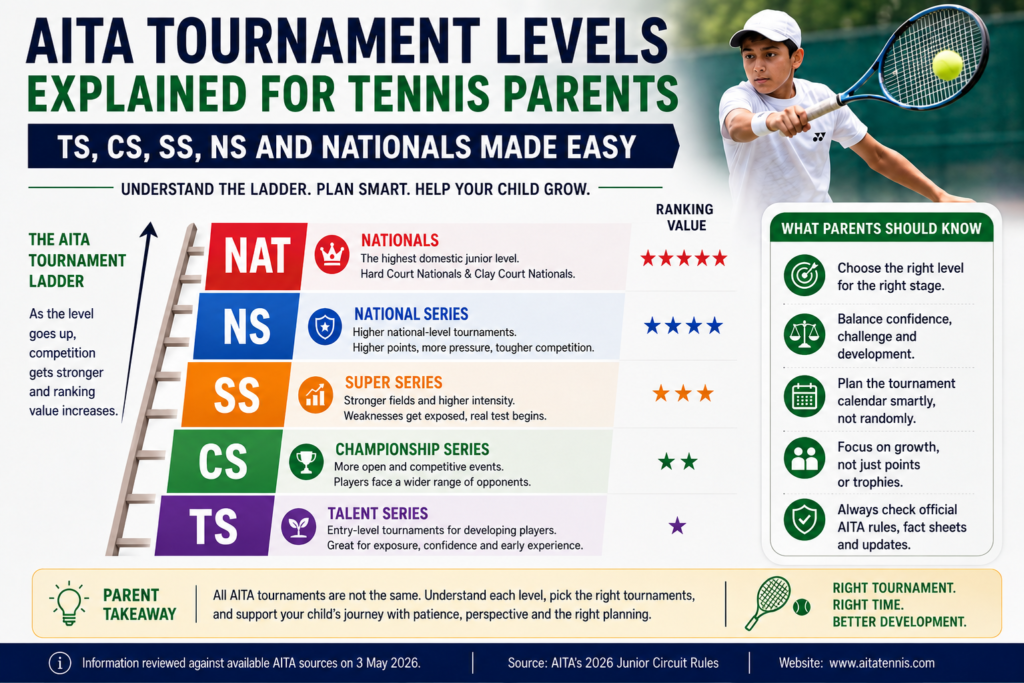
  • AITA Tournament Levels Explained in Simple Words

    Information reviewed against available AITA sources on 3 May 2026.

    AITA tournament levels explained for tennis parents

    In Part 1, we understood that AITA ranking is important, but it is not the full identity of a tennis player.

    Now comes the next big confusion for parents:

    What is TS? What is CS? What is SS? What is NS? What is Nationals?

    Many parents enter tournaments without fully understanding the level of the event. Then they feel confused. Their child may win matches but get fewer points. Another child may lose early in a stronger tournament but still gain valuable experience.

    The simple truth is this ….

    All AITA tournaments are not equal.

    The tournament level decides the strength of the field, the ranking value, the seriousness of the event, and how parents should plan the child’s tournament calendar.

    As per AITA’s 2026 Junior Circuit Rules, the junior tournament structure includes Talent Series, Championship Series, Super Series, National Series, and two Nationals – Hard Court and Clay. The official AITA website also lists these junior circuit categories under its tournament structure. Use the phrase “AITA’s 2026 Junior Circuit Rules” as a hyperlink to the official PDF, and use “official AITA website” as a hyperlink if needed.


    AITA Tournament Levels Explained in Simple Words

    For parents, the easiest way to understand AITA tournament levels is to imagine a ladder.

    At the lower steps, the child gets tournament exposure and learns how competitive tennis works.
    As the child climbs higher, the competition becomes stronger.
    At the top, the child faces stronger national-level players.

    The basic AITA junior ladder is:

    1. Talent Series – TS
    2. Championship Series – CS
    3. Super Series – SS
    4. National Series – NS
    5. Nationals

    This does not mean Talent Series is useless or Nationals is the only important event.

    Every level has a purpose.

    The real wisdom is knowing which tournament level is right for the child at the right time.


    1. Talent Series – TS

    Talent Series is usually the first serious AITA tournament level for many young players.

    For parents, TS should be seen as a starting platform. It gives children tournament exposure, match experience, pressure situations, and a chance to understand the AITA environment.

    A very important rule point …. as per AITA’s 2026 Junior Circuit Rules, there will be no Talent Series tournaments for the Under-18 age group. The rules also state that the top 75 AITA-ranked players in their respective age groups are not permitted to take part in TS tournaments in that age group, and TS tournaments are zone-based.

    Parent Meaning

    Talent Series is not meant for already highly ranked players to keep collecting easy points. It is more useful for developing players who are entering the competitive system.

    Coach’s Insight

    TS is good when a child needs match confidence, basic tournament discipline, and early ranking exposure.

    But if a child is already dominating TS comfortably, staying there too long may slow development. At that stage, the player needs a tougher test.


    2. Championship Series – CS

    Championship Series is the next step above Talent Series.

    AITA has both Championship Series 3 Days and Championship Series 7 Days in the junior structure. As per the official rules, there is no restriction in Championship Series, and ranked players can play irrespective of rank.

    Parent Meaning

    CS is a more open and useful competition level. Since ranked players can participate, the child may face stronger opponents compared to TS.

    Championship Series can be a very good testing ground. The child starts meeting different styles, different temperaments, and different competitive levels.

    Coach’s Insight

    CS is where parents should start observing patterns:

    Can the child handle pressure?
    Can the child beat players of a similar level?
    Can the child compete with slightly stronger players?
    Is the child winning because the draw is weak, or because the game is truly improving?

    This is the real value of CS.


    3. Super Series – SS

    Super Series is a serious step up.

    At this level, the field is usually stronger, the matches are more demanding, and weak habits start getting exposed.

    AITA’s 2026 rules mention that for Super Series and National Series, only one age group is allowed at a venue in a week, and only one Super Series or National Series tournament for a particular age group is permitted in a week across the country. The rules also mention stronger tournament requirements such as minimum court requirements and officiating requirements for Super Series, National Series, and Nationals.

    Parent Meaning

    Super Series is not just “one more tournament.”

    It is a more serious competitive test. A child who does well in Super Series is showing better tournament maturity and stronger competitive ability.

    Coach’s Insight

    Super Series is where weak habits get punished.

    At TS or CS level, a player may escape with an average serve, poor recovery, loose ball control, or emotional reactions.

    At Super Series level, stronger players start attacking these weaknesses.

    That is why SS is a very important mirror for serious players.


    4. National Series – NS

    National Series is a higher national-level tournament. The competition is stronger, the ranking value is higher, and the pressure is more serious.

    AITA’s 2026 Junior Circuit points table shows that National Series carries higher ranking value than Talent Series, Championship Series, and Super Series. For example, the winner’s points increase as the tournament level moves from TS to CS, SS, NS, and then Nationals.

    Parent Meaning

    National Series is not just for participation. A child should ideally go there with some readiness.

    Of course, sometimes even losing early in a National Series can be useful if the child learns what higher-level tennis demands. But if a player is totally unprepared, repeated heavy losses may damage confidence.

    Coach’s Insight

    Before entering a National Series, parents and coaches should ask ….

    Is the child physically ready?
    Is the child mentally ready?
    Can the child handle pace?
    Can the child sustain longer rallies?
    Can the child recover between matches?
    Can the child compete without panic?

    National Series is where a child starts seeing the real national standard.


    5. Nationals

    Nationals sit at the top of the domestic junior structure.

    AITA’s 2026 Junior Circuit Rules mention two Nationals: Hard Court and Clay. The rules also state that participation in Nationals is mandatory for players for selection to Junior Teams.

    Parent Meaning

    Nationals are not ordinary tournaments. They carry prestige, stronger fields, higher competitive value, and greater importance in the domestic junior pathway.

    A good performance in Nationals sends a strong message.

    But parents should remember one thing clearly:

    Going to Nationals only for the name is not enough. The child must be prepared.

    Coach’s Insight

    Nationals require a different mindset.

    At this level, the player must be ready for:

    • strong opponents
    • physical matches
    • pressure points
    • tactical variation
    • emotional control
    • recovery discipline
    • no-excuse competition

    Nationals should not frighten players. But players should respect the level.


    Simple Parent Example

    Suppose your child reaches the semifinal of a Talent Series.

    That is a good result.

    Now suppose another child reaches the semifinal of a National Series.

    Both are semifinals, but they are not equal in ranking value or competitive strength.

    This is why parents should not ask only:

    “How many rounds did my child win?”

    They should also ask ….

    “At what tournament level did my child win those rounds?”

    That one question gives better clarity.


    How Parents Should Choose the Right Tournament Level

    This is the practical part.

    Parents should not blindly chase the biggest tournament.
    They should also not always search for the easiest draw.

    A good tournament calendar should include the right mix:

    1. Confidence tournaments

    These help the child compete, win matches, and build belief.

    2. Level-matching tournaments

    These give close matches where the child learns how to handle pressure.

    3. Challenge tournaments

    These expose the child to stronger players and show the real gap.

    The right tournament is not always the biggest tournament.

    The right tournament is the one that helps the child grow at that stage.


    Common Mistakes Parents Make

    Mistake 1: Thinking all AITA tournaments are the same

    They are not. TS, CS, SS, NS, and Nationals have different value, different strength, and different purpose.

    Mistake 2: Staying too long in comfort-level tournaments

    If a child keeps playing only where winning is easy, the ranking may move slowly, but development may become limited.

    Mistake 3: Jumping too early into very tough tournaments

    The opposite mistake is also dangerous. If a child is not ready, constant early losses in strong tournaments can break confidence.

    Mistake 4: Looking only at points

    Points matter, but match quality, opponent level, pressure handling, and improvement also matter.

    Mistake 5: Not checking the official fact sheet

    Tournament details, entry process, draw, sign-in, venue, and schedule must always be checked from official sources.


    Parent Takeaway

    AITA tournament levels become easier to understand when parents know the purpose of each stage.

    The AITA tournament ladder becomes simple when understood properly.

    Talent Series gives entry-level exposure.
    Championship Series gives broader and stronger competition.
    Super Series tests serious players.
    National Series shows national-level readiness.
    Nationals represent the highest domestic junior level.

    Parents should not blindly chase the biggest tournament or the easiest tournament.

    The better approach is ….

    Choose the right tournament for the child’s current stage of development.

    That is where smart planning begins.


    Gomesee Way Insight

    A tournament calendar should not be made only for ranking points.

    It should be made for the child’s growth.

    Sometimes the child needs confidence.
    Sometimes the child needs a tougher test.
    Sometimes the child needs training, not travel.
    Sometimes the child needs rest.

    The wise parent and wise coach understand timing.

    Right tournament. Right time. Right purpose.

    That is better than blind tournament chasing.


    Mini FAQ

    Which AITA tournament level should my child start with?

    For many developing players, Talent Series or Championship Series is a practical starting point, depending on age, level, confidence, and coach’s advice.

    Is National Series higher than Super Series?

    Yes. In ranking value and national-level seriousness, National Series is placed higher than Super Series in the AITA junior points structure.

    Should my child play Nationals?

    If the child is serious and eligible, Nationals are important. But the child should go with preparation, not just excitement.

    Should parents chase easy draws?

    Easy draws may give short-term comfort, but long-term development needs the right mix of winnable matches and challenging matches.


    Coming Next

    In Part 3, we will understand the most important parent question ….

    How do AITA ranking points actually work?

    We will explain tournament level, round reached, best results, and why ranking may rise or fall even when parents feel confused.


    Disclaimer

    This article is written only for educational guidance for tennis parents and players. AITA rules, tournament formats, ranking systems, eligibility conditions, sign-in procedures, points structure, and selection criteria may change from time to time. Parents and players should always verify the latest information from the official AITA website, official tournament fact sheets, official circulars, and the tournament referee before making tournament decisions.

  • The 4-Shot Fallacy: Why “Modern Tennis” is Ruining Your Development

    By Alex Gomes | The Gomesee Way

    There is a dangerous half-truth spreading through academy bleachers and social media feeds. It sounds like this: “Modern tennis is fast. 70% of points end within four shots. Stop wasting time rallying.”

    On the surface, the math is correct. But the application is a developmental disaster. Especially for players 14 and older, this “shortcut mindset” doesn’t just stall progress, it kills careers. To build a champion, we have to look beneath the statistics and understand the engine that actually drives those short points.

    The Scientific Reality …. Rally Tolerance is Your Engine

    From a physiological standpoint, tennis is an intermittent high-intensity sport. While a point might end in four shots, the threat of the tenth shot is what creates the opening for the fourth.

    In sports psychology, many developing players suffer from Action Bias, the overwhelming urge to “do something” just to relieve the mental pressure of a neutral rally. When you rush to finish a point without an opening, you aren’t playing “modern tennis”; you are simply surrendering to your own lack of physical and mental discipline.

    The Gomesee Truth …. You do not earn the right to finish a point early until you have proven you can survive a point that goes long.


    Research from Grand Slam match analysis (including data tracked by the ATP Tour and performance analytics platforms) consistently shows that while a majority of points finish within four shots, the average rally length still hovers around 3.8 to 4.2 shots.

    However, what is often ignored is that error rates increase dramatically when players are forced beyond their rally tolerance threshold.

    In simple terms ….
    👉 The player who can sustain quality longer… forces the opponent to break first.


    This concept is deeply supported in performance psychology. Research on decision-making under pressure shows that athletes often default to premature action to relieve cognitive stress, rather than making optimal decisions.

    In tennis, this translates into low-percentage shot selection under neutral conditions, not because the player sees an opportunity, but because they cannot tolerate the uncertainty of the rally.

    Respecting the 40% That Defines Your Career

    Analytics tell us the majority of points are short, but they rarely distinguish between “noise” and “signal.” Short points are often the noise, double faults, missed returns, or unforced errors.

    The 40% of points that go beyond five shots are the signal. These are the 30-30 points, the deuce games, and the break points in the deciding set. This 40% is where the match is won or lost. If you haven’t built the “aerobic mental capacity” to handle these moments, you will fold the moment the score reaches 4-4.

    The Hybrid Model of the Modern Elite

    Look at Jannik Sinner or Carlos Alcaraz. Yes, they hit a massive ball, but their dominance isn’t built on “guessing and hitting.” It is built on High-Octane Neutrality and it means playing fast, deep, and strong …. while staying completely in control.

    The foundation of their game is the ability to hit fifteen balls at 80% intensity with zero technical breakdown. Only when they receive a ball that is two inches shorter or 2mph slower do they engage the “4-shot” finish. You cannot skip the building phase to get to the finishing phase. Without the ability to grind, your “attack” is just a gamble, and the house always wins in the long run.


    As elite coach Patrick Mouratoglou has repeatedly emphasised:

    “Top players don’t take risks early in the rally. They build the point until the right ball comes.”

    This is the part most developing players skip.

    Modern Player Insight
    Even today, when analysing players like Jannik Sinner and Carlos Alcaraz, performance data shows that their neutral rally tolerance is among the highest on tour, despite their aggressive playing styles.

    Their ability to finish points early is not instinctive, it is engineered through control.

    The Anatomy of a Constructed Point

    To move toward a world-class game, a player must master the natural evolution of a point. It begins with The Build: hitting 4–6 solid balls with depth and margin. This requires a patient, disciplined mind that respects the net.

    Only then can you move to Recognition …. identifying the short ball or the weak reply. This is the hunter waiting for the right moment. Finally, you reach Execution: a clinical finish with precise intention. It isn’t flashy; it’s effective.


    Novak Djokovic, one of the greatest returners and rally players in history, has often spoken about this principle indirectly through his game style:

    “Tennis is a game of patience… the one who can stay longer in the rally usually has the advantage.”

    His dominance was not built on finishing early…
    It was built on outlasting the opponent’s discipline.

    A Message to the Support Team

    When parents or coaches tell a developing player to “hit winners” or “stop rallying,” they are inadvertently teaching that player to fear the struggle. Development isn’t a highlight reel; it’s a marathon of consistency.

    Players like Tirth, Ruju and Satvi didn’t reach their level by avoiding the hard work. They reached it because they mastered the grind so thoroughly that they made the “hard” parts look effortless.


    👉 If your rally breaks at 5 balls… your match will break at 5–5.

    The Final Reality Check

    You are faced with a choice every time you step onto the court. You can chase the Shortcut Mindset, avoiding rallies, hitting through panic, and looking good in practice while struggling in matches.

    Or, you can embrace the Champion Mindset. You can build patiently, trust the process under pressure, and treat the 4-shot finish as a tool you’ve earned, not a crutch you lean on.


    Studies in skill acquisition consistently show that high-repetition, controlled practice environments build decision-making clarity under pressure, while low-discipline, random play builds inconsistency.

    In tennis terms ….
    👉 Structured rally tolerance builds champions. Shortcut hitting builds frustration.

    Practice is where you build your strength; matches are where that strength is tested. If you skip the hard part, don’t expect easy results.

    Don’t chase quick points. Build the player who is capable of creating them.

    The Gomesee Way

  • The Silent Scoreboard: Why Your Internal Belief Level is the Hard Ceiling in Tennis

    By Coach Alex Gomes

    The Ceiling You Can’t See

    Every tennis player operates under a “hard ceiling.” It isn’t defined by the speed of your serve or the depth of your volley, but by your Internal Belief Level. This is your Invisible Baseline.

    You can train for eight hours a day on the physical court, but if your internal baseline is set to “Intermediate,” your mind will effectively “handcuff” your muscles the moment you start playing like a Pro. Most players think they have a “consistency” problem. They don’t. They have an Identity Conflict. When you perform above your belief level, your brain perceives it as an anomaly and subconsciously “corrects” your performance via tension to bring you back down to your “safe” baseline.

    The First 4 Games Truth: Your Identity Exposed

    Within the first four games, your belief is already exposed. This isn’t about strategy; it is your identity showing itself under pressure.

    • Are you swinging freely… or guiding the ball?
    • Are you playing to dominate… or to survive?
    • Are you deciding… or reacting?

    A player with high belief starts the match. A player with low belief waits for permission from the scoreboard.

    The Biology Behind Belief: The Nervous System Paradox

    Your brain hates uncertainty. To save energy, it predicts outcomes in advance. This is the science of the Silent Scoreboard:

    1. Low Belief: Your nervous system triggers a “Threat Response.” Muscles tighten, reaction time slows, and your peripheral vision narrows. You become a “pusher” as your brain tries to protect you from a predicted mistake.
    2. High Belief: You enter a “Flow State.” Movement becomes automatic, timing improves, and decisions become faster.

    In world-class tennis, you don’t rise to the occasion, you fall to the level of your nervous system.

    The “Borrowed Belief” Trap

    Many players make the mistake of carrying Borrowed Belief. They get their confidence from external sources: their ranking, their coach’s praise, or their parents’ confidence.

    The moment the pressure rises, that borrowed belief collapses. Real belief is self-generated. It is built in the dark, through repetition, clarity, and the habit of keeping promises to yourself. If your belief depends on others, it will disappear exactly when you need it most.

    The 25-Second Sanctuary: Hacking the Silent Scoreboard

    The “gap” in tennis, the 25 seconds between points …. is the only time you can manually reset your “Internal Thermostat.” To protect your baseline, you need a toolkit that works faster than your doubt.


    Gomesees’ High-Performance Toolkit

    • The “Next Ball Contract”: After every point, sign a silent contract: “The next ball deserves my full commitment.” Not the match. Not the score. Just the next ball.
    • The “Smile Defense”: A forced, slight smile sends a signal to the amygdala that you are safe. It breaks the downward stress spiral instantly.
    • The Third-Person Narrator: Never say “I am playing terrible.” Say, “Alex is feeling some tension right now.” This “Cognitive Defusion” shifts you from victim to coach.
    • The Horizon Gaze: Keep your chin parallel to the ground and eyes on the distant horizon. This inhibits the “threat response” and resets your physiology to 0-0.

    Final Thought: Play FROM Victory

    The highest level of mental toughness is the ability to play from a state of victory, not for it. This means your Silent Scoreboard is fixed at “Champion” before you even zip up your racket bag.

    You don’t need a better forehand to win the next tournament. You need a higher ceiling.

    The scorecard follows the spirit. Shift your belief, and the result will follow.

    See you on the court,

    Alex …. The Gomesee Way

  • The Dangerous Habit of Fighting Every “No” for Your Child in Youth Sports

    If you fight every “no” for your child, you may be weakening the one muscle they need most, resilience.

    7-minute read


    Your child didn’t get selected.

    Before you blame the system, pause.

    The lesson they learn from your reaction will shape them far more than the rejection itself.


    I’ve seen this scene too many times.

    A child doesn’t get selected.

    The child is disappointed for a few hours.
    The parent is angry for a few weeks.

    Calls are made.
    Messages are sent.
    Selectors are blamed.
    The system is declared unfair.

    And in all that noise, the child is watching.

    Not the selectors.
    Not the system.

    You.

    And what they learn in that moment will shape them far more than whether they made the team.

    They’re learning what “no” means in their life.


    What You Think Is Happening

    When your child doesn’t get selected, your first instinct is protection.

    “They’re crushing my child’s confidence.”

    So you want to fix it. Defend them. Make sure they know they’re good enough.

    That instinct comes from love.

    But here’s the uncomfortable truth:

    Confidence doesn’t grow when you remove disappointment.

    It grows when the child survives it.

    Your child doesn’t need protection from rejection.
    They need the ability to handle it.

    Every time you fight their battles emotionally, you weaken that ability.


    Selection Is Not a Verdict

    Selection is not:

    • A judgment on your child’s character
    • A final decision about their future
    • A permanent label

    It’s a snapshot.

    On that day.
    Under specific criteria.
    Against that competition.

    In serious sport, athletes get selected and dropped constantly. It’s part of development.

    Elite environments don’t avoid rejection …. they use it. Because resilience is not automatic. It’s trained.

    When parents treat non-selection like injustice, they turn a normal developmental moment into emotional trauma.

    And that’s when the real damage begins.


    The Hidden Cost of Rescue Parenting

    When you attack the system every time your child hears “no,” something subtle changes.

    The child learns:

    “If I don’t get what I want, someone else will fix it.”

    That feels safe at 12.

    It becomes dangerous at 22.

    Because life does not negotiate every rejection.

    Coaches won’t.
    Employers won’t.
    Competition won’t.

    If your child never learns to process setbacks independently, they will always look outward for explanations:

    The coach didn’t see my potential.
    The system is biased.
    Someone else got lucky.

    Outward thinking never builds champions.

    It builds dependency.


    What Do You Really Want?

    Be honest.

    Do you want your child to win early?

    Or last long?

    Those two paths are not always the same.

    Some young athletes shine early and fade because they never learned how to lose.

    Others get dropped early and return stronger because they built resilience.

    The difference is rarely talent.

    It’s how disappointment was handled at home.

    Strong parents say:

    “This hurts. I’m here. Now let’s work.”

    Not:

    “You were robbed.”

    One builds resilience.
    The other builds entitlement.


    What Strong Parenting Looks Like

    Strong parenting in youth sports isn’t loud.

    It’s steady.

    After non-selection, say:

    “I love you.
    This is disappointing.
    Let’s learn from it.”

    No public drama.
    No emotional emails.

    Instead, ask practical questions:

    • What were the criteria?
    • Where did we fall short?
    • What needs improvement?
    • What’s our plan?

    Now you’re building a competitor.

    Not someone who expects the world to adjust for them.


    The 72-Hour Rule

    Within 72 hours, sit down calmly and review five areas:

    1. Technical – Was execution solid under pressure?
    2. Tactical -> Did they understand situations?
    3. Physical -> Were they prepared enough?
    4. Mental -> How was body language and composure?
    5. Coachable -> Did they adapt to feedback?

    Now rejection has direction.

    Now disappointment becomes fuel.


    The Truth

    You cannot protect your child from every setback.

    And you shouldn’t.

    Because one day, they will stand alone.

    In a match.
    In an exam.
    In an interview.
    In life.

    And you won’t be there to negotiate.

    What will carry them then?

    Not your arguments.

    Their resilience.

    And resilience is built when they hear “no” …. and learn how to respond.


    Final Thought

    Sometimes the most loving thing you can say is:

    “You didn’t make it.
    I’m proud of your effort.
    Now let’s get better.”

    Your job is not to open every door.

    Your job is to make sure they are strong enough to knock again.

    That’s not harsh.

    That’s real parenting.


    If your child faced rejection tomorrow, would your reaction build resilience, or entitlement?

    If this resonated with you, share it with a parent who needs to read it.

    About the Author

    Alex Gomes is a high-performance tennis coach and mentor with decades of on-court experience working with serious junior and competitive players.

    His coaching philosophy, The Gomesee Way, focuses on understanding why improvement stalls, how training disconnects from match performance, and how players regain clarity under pressure.

    This platform reflects lived court-side observation …. not borrowed theory.