Information reviewed against available AITA sources on 3 May 2026.
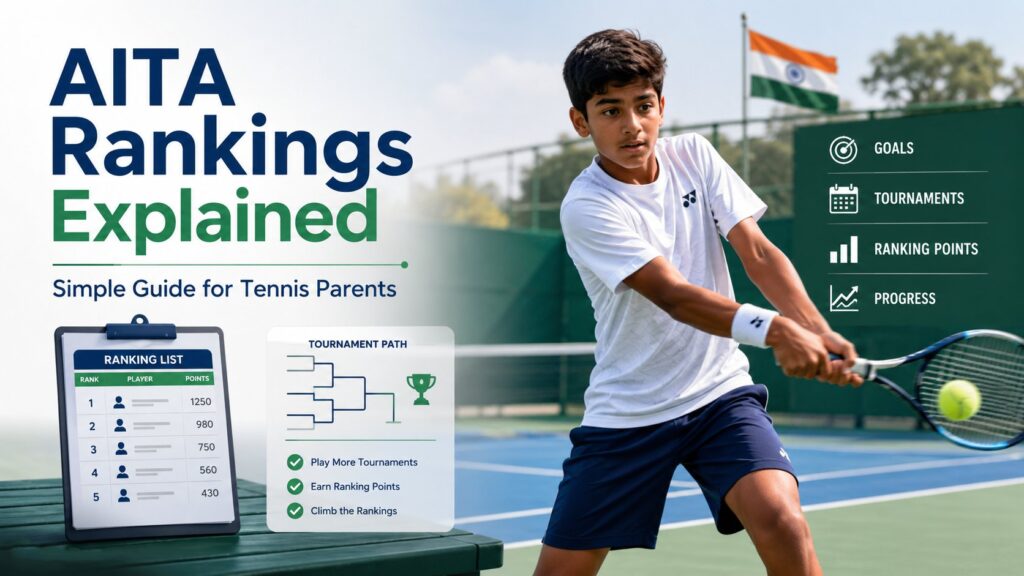
For many Indian tennis parents, AITA rankings explained in simple language can remove a lot of confusion before the tournament journey begins.
Every Indian tennis parent enters the AITA tournament circuit with hope.
Hope that the child will improve.
Hope that the child will win matches.
Hope that the child will get ranking.
Hope that the ranking will open doors.
But after a few tournaments, confusion starts.
One child wins matches, but the ranking does not move much. Another child loses early, but still remains ranked higher. Sometimes ranking suddenly drops, even when the child has not played badly.
Parents naturally ask ….
“What exactly is AITA ranking, and what does it really mean for my child?”
This article is the first part of a simple educational series for Indian tennis parents. The aim is not to make parents rule-book experts. The aim is to give clarity, peace of mind, and better decision-making.
AITA’s official player/ranking section provides links to tournament and player resources such as Junior Circuit Rules, Pro Circuit Rules, Under-10 competition rules, Code of Conduct, tournament calendar, and ranking-related sections. So, whenever we discuss rules, the base should be official AITA information …. not hearsay, WhatsApp talk, or outdated assumptions.
AITA Rankings Explained: What Is AITA Ranking?
In simple words, AITA ranking is a national tennis ranking system that reflects a player’s results in recognised AITA tournaments.
It is a competitive record. It shows how a player has performed inside the AITA tournament structure during the ranking period.
But parents must understand this clearly:
AITA ranking is important, but it is not the complete report card of a child’s tennis future.
It tells us something, but not everything.
Ranking can show that a player has earned results in tournaments. It can help in tournament acceptance, seeding, planning, and understanding where the player stands inside the competitive system.
But ranking does not fully show whether the child has a strong serve, reliable return, good movement, emotional control, tactical maturity, discipline, fitness, or long-term potential.
That is why ranking should be respected, but not worshiped.
Official Understanding: Ranking Works Within a System
AITA ranking is not random. It works through a tournament structure, points system, ranking period, and result calculation.
As per AITA’s 2026 Junior Circuit Rules, the ranking system considers tournaments played during the last 52 weeks. The same rules state that from 2025, the best 8 tournament results are considered for junior ranking.
For parents, this means ranking is not based on lifetime achievement.
It is a moving system.
Old points may go out.
New results may come in.
Other players may gain points.
A ranking may rise or fall even when the child feels nothing dramatic has happened.
So, if a child’s ranking drops, parents should not immediately panic. First, they should understand whether old points have expired, whether other players have gained points, or whether the child has not replaced previous results with new strong results.
Why AITA Ranking Matters
Ranking does matter.
It can help in ….
- tournament acceptance
- seeding
- tournament planning
- confidence
- visibility
- understanding competitive level
So we should not say ranking is useless. It is not useless.
For a competitive tennis player, ranking is a practical part of the journey. It can affect which tournaments the player gets into, where the player is placed, and how parents and coaches plan the calendar.
But ranking is still only one part of the journey.
The danger starts when ranking becomes bigger than development.
What Ranking Does Not Tell
This is where parents must be careful.
A ranking does not always tell whether the child is developing properly.
A player may have ranking but still lack weapons.
A player may win smaller events but struggle against stronger opponents.
A player may collect points but not improve decision-making.
A player may have decent ranking but poor fitness, weak serve, or no mental toughness.
On the other hand, a child may be improving technically, becoming stronger, learning to compete better, and developing better match habits …. but ranking may take time to show that progress.
So parents should not ask only ….
“What is my child’s ranking?”
They should also ask ….
“Is my child becoming a better tennis player?”
That second question is where real development begins.
Practical Parent Example
Suppose two players are in the same age group.
Player A plays many tournaments and wins matches in weaker fields.
Player B plays fewer tournaments but is developing a better serve, stronger rally tolerance, better movement, and better match discipline.
For some time, Player A may look ahead in ranking.
But in the long run, Player B may become the stronger player if the development is deeper.
This does not mean Player A is wrong. It simply means ranking must be understood with context.
A good coach looks at both ….
Ranking progress + game progress.
One without the other is incomplete.
Coach’s Insight: Ranking Is the Scoreboard, Development Is the Engine
This is the main message of Part 1.
Ranking is the scoreboard. Development is the engine.
Parents should respect the scoreboard. But if the engine is weak, the scoreboard will not stay strong for long.
A player needs ranking, yes.
But the player also needs ….
- technique
- serve quality
- return quality
- movement
- consistency
- point construction
- tactical clarity
- discipline
- emotional control
- recovery habits
- tournament routines
This is the development side.
Gomesee Way Insight
Use ranking as guidance, not as pressure. Ranking should help planning. It should not create panic.
Common Mistakes Parents Make About AITA Ranking
Mistake 1: Judging the child only by ranking
Ranking is visible, so parents naturally look at it first. But tennis growth also has invisible areas: confidence, maturity, movement, discipline, decision-making, and pressure handling.
Mistake 2: Chasing points before building the game
Some parents start asking only, “Where can my child get points?”
A better question is, “Which tournament will help my child grow and compete better?”
Mistake 3: Comparing children every week
Every player has a different body, mind, game style, maturity level, family situation, coaching support, and tournament calendar. Blind comparison creates stress.
Mistake 4: Not understanding the ranking window
Since ranking works within a moving period, old points can drop. A ranking fall is not always a performance failure. Sometimes it is simply the ranking cycle moving. AITA’s Junior Circuit Rules mention the 52-week ranking period and best 8 tournament-result basis for ranking.
Mistake 5: Ignoring official information
Parents should regularly check the official AITA website, tournament fact sheets, acceptance lists, and circulars. A small misunderstanding can create unnecessary stress.
Important Note for Under-10 Parents
For very young children, parents must be extra careful.
The official AITA Under-10 competition rules state that no rankings will be maintained for Under-10 competitions.
This is an important message.
At that age, parents should focus more on:
- love for the game
- basic technique
- movement
- coordination
- discipline
- fun competition
- confidence
Under-10 tennis should not become a pressure factory.
Parent Takeaway
That is why AITA rankings explained properly can give parents clarity without creating unnecessary pressure.
AITA ranking is useful.
AITA ranking is important.
AITA ranking can help in tournament planning, acceptance, and seeding.
But ranking is not the full identity of the player.
A child is not just a number. A child is a developing athlete.
So, parents should track ranking — but they should also track improvement in serve, return, rally quality, movement, match temperament, confidence, and daily discipline.
The balanced approach is simple:
Respect ranking. Understand ranking. Use ranking. But never allow ranking to become bigger than the child’s development.
Coming Next
In Part 2, we will understand the AITA tournament ladder in simple language:
Talent Series, Championship Series, Super Series, National Series, and Nationals.
This is very important because all AITA tournaments are not equal. Tournament level affects competition strength, ranking value, and planning.
Disclaimer
This article is written only for educational guidance for tennis parents and players. AITA rules, tournament formats, ranking systems, eligibility conditions, sign-in procedures, entry deadlines, participation limits, points structure, and selection criteria may change from time to time. Parents and players should always verify the latest information from the official AITA website, official tournament fact sheets, official circulars, and the tournament referee before making tournament decisions.
Leave a Reply