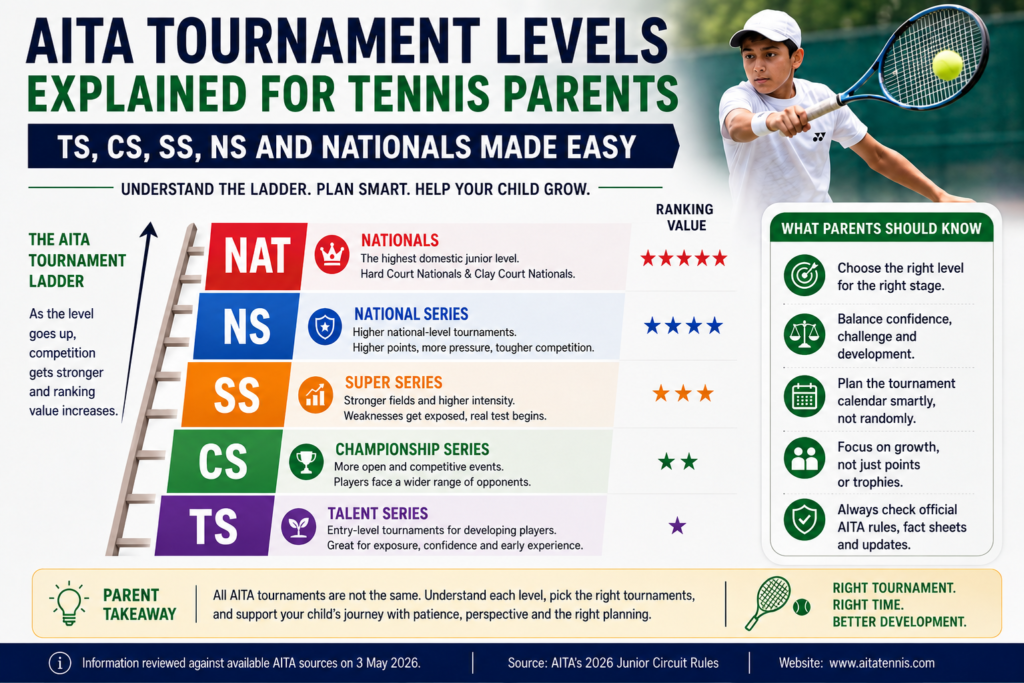
Information reviewed against available AITA sources on 3 May 2026.
In Part 1, we understood that AITA ranking is important, but it is not the full identity of a tennis player.
Now comes the next big confusion for parents:
What is TS? What is CS? What is SS? What is NS? What is Nationals?
Many parents enter tournaments without fully understanding the level of the event. Then they feel confused. Their child may win matches but get fewer points. Another child may lose early in a stronger tournament but still gain valuable experience.
The simple truth is this ….
All AITA tournaments are not equal.
The tournament level decides the strength of the field, the ranking value, the seriousness of the event, and how parents should plan the child’s tournament calendar.
As per AITA’s 2026 Junior Circuit Rules, the junior tournament structure includes Talent Series, Championship Series, Super Series, National Series, and two Nationals – Hard Court and Clay. The official AITA website also lists these junior circuit categories under its tournament structure. Use the phrase “AITA’s 2026 Junior Circuit Rules” as a hyperlink to the official PDF, and use “official AITA website” as a hyperlink if needed.
AITA Tournament Levels Explained in Simple Words
For parents, the easiest way to understand AITA tournament levels is to imagine a ladder.
At the lower steps, the child gets tournament exposure and learns how competitive tennis works.
As the child climbs higher, the competition becomes stronger.
At the top, the child faces stronger national-level players.
The basic AITA junior ladder is:
- Talent Series – TS
- Championship Series – CS
- Super Series – SS
- National Series – NS
- Nationals
This does not mean Talent Series is useless or Nationals is the only important event.
Every level has a purpose.
The real wisdom is knowing which tournament level is right for the child at the right time.
1. Talent Series – TS
Talent Series is usually the first serious AITA tournament level for many young players.
For parents, TS should be seen as a starting platform. It gives children tournament exposure, match experience, pressure situations, and a chance to understand the AITA environment.
A very important rule point …. as per AITA’s 2026 Junior Circuit Rules, there will be no Talent Series tournaments for the Under-18 age group. The rules also state that the top 75 AITA-ranked players in their respective age groups are not permitted to take part in TS tournaments in that age group, and TS tournaments are zone-based.
Parent Meaning
Talent Series is not meant for already highly ranked players to keep collecting easy points. It is more useful for developing players who are entering the competitive system.
Coach’s Insight
TS is good when a child needs match confidence, basic tournament discipline, and early ranking exposure.
But if a child is already dominating TS comfortably, staying there too long may slow development. At that stage, the player needs a tougher test.
2. Championship Series – CS
Championship Series is the next step above Talent Series.
AITA has both Championship Series 3 Days and Championship Series 7 Days in the junior structure. As per the official rules, there is no restriction in Championship Series, and ranked players can play irrespective of rank.
Parent Meaning
CS is a more open and useful competition level. Since ranked players can participate, the child may face stronger opponents compared to TS.
Championship Series can be a very good testing ground. The child starts meeting different styles, different temperaments, and different competitive levels.
Coach’s Insight
CS is where parents should start observing patterns:
Can the child handle pressure?
Can the child beat players of a similar level?
Can the child compete with slightly stronger players?
Is the child winning because the draw is weak, or because the game is truly improving?
This is the real value of CS.
3. Super Series – SS
Super Series is a serious step up.
At this level, the field is usually stronger, the matches are more demanding, and weak habits start getting exposed.
AITA’s 2026 rules mention that for Super Series and National Series, only one age group is allowed at a venue in a week, and only one Super Series or National Series tournament for a particular age group is permitted in a week across the country. The rules also mention stronger tournament requirements such as minimum court requirements and officiating requirements for Super Series, National Series, and Nationals.
Parent Meaning
Super Series is not just “one more tournament.”
It is a more serious competitive test. A child who does well in Super Series is showing better tournament maturity and stronger competitive ability.
Coach’s Insight
Super Series is where weak habits get punished.
At TS or CS level, a player may escape with an average serve, poor recovery, loose ball control, or emotional reactions.
At Super Series level, stronger players start attacking these weaknesses.
That is why SS is a very important mirror for serious players.
4. National Series – NS
National Series is a higher national-level tournament. The competition is stronger, the ranking value is higher, and the pressure is more serious.
AITA’s 2026 Junior Circuit points table shows that National Series carries higher ranking value than Talent Series, Championship Series, and Super Series. For example, the winner’s points increase as the tournament level moves from TS to CS, SS, NS, and then Nationals.
Parent Meaning
National Series is not just for participation. A child should ideally go there with some readiness.
Of course, sometimes even losing early in a National Series can be useful if the child learns what higher-level tennis demands. But if a player is totally unprepared, repeated heavy losses may damage confidence.
Coach’s Insight
Before entering a National Series, parents and coaches should ask ….
Is the child physically ready?
Is the child mentally ready?
Can the child handle pace?
Can the child sustain longer rallies?
Can the child recover between matches?
Can the child compete without panic?
National Series is where a child starts seeing the real national standard.
5. Nationals
Nationals sit at the top of the domestic junior structure.
AITA’s 2026 Junior Circuit Rules mention two Nationals: Hard Court and Clay. The rules also state that participation in Nationals is mandatory for players for selection to Junior Teams.
Parent Meaning
Nationals are not ordinary tournaments. They carry prestige, stronger fields, higher competitive value, and greater importance in the domestic junior pathway.
A good performance in Nationals sends a strong message.
But parents should remember one thing clearly:
Going to Nationals only for the name is not enough. The child must be prepared.
Coach’s Insight
Nationals require a different mindset.
At this level, the player must be ready for:
- strong opponents
- physical matches
- pressure points
- tactical variation
- emotional control
- recovery discipline
- no-excuse competition
Nationals should not frighten players. But players should respect the level.
Simple Parent Example
Suppose your child reaches the semifinal of a Talent Series.
That is a good result.
Now suppose another child reaches the semifinal of a National Series.
Both are semifinals, but they are not equal in ranking value or competitive strength.
This is why parents should not ask only:
“How many rounds did my child win?”
They should also ask ….
“At what tournament level did my child win those rounds?”
That one question gives better clarity.
How Parents Should Choose the Right Tournament Level
This is the practical part.
Parents should not blindly chase the biggest tournament.
They should also not always search for the easiest draw.
A good tournament calendar should include the right mix:
1. Confidence tournaments
These help the child compete, win matches, and build belief.
2. Level-matching tournaments
These give close matches where the child learns how to handle pressure.
3. Challenge tournaments
These expose the child to stronger players and show the real gap.
The right tournament is not always the biggest tournament.
The right tournament is the one that helps the child grow at that stage.
Common Mistakes Parents Make
Mistake 1: Thinking all AITA tournaments are the same
They are not. TS, CS, SS, NS, and Nationals have different value, different strength, and different purpose.
Mistake 2: Staying too long in comfort-level tournaments
If a child keeps playing only where winning is easy, the ranking may move slowly, but development may become limited.
Mistake 3: Jumping too early into very tough tournaments
The opposite mistake is also dangerous. If a child is not ready, constant early losses in strong tournaments can break confidence.
Mistake 4: Looking only at points
Points matter, but match quality, opponent level, pressure handling, and improvement also matter.
Mistake 5: Not checking the official fact sheet
Tournament details, entry process, draw, sign-in, venue, and schedule must always be checked from official sources.
Parent Takeaway
AITA tournament levels become easier to understand when parents know the purpose of each stage.
The AITA tournament ladder becomes simple when understood properly.
Talent Series gives entry-level exposure.
Championship Series gives broader and stronger competition.
Super Series tests serious players.
National Series shows national-level readiness.
Nationals represent the highest domestic junior level.
Parents should not blindly chase the biggest tournament or the easiest tournament.
The better approach is ….
Choose the right tournament for the child’s current stage of development.
That is where smart planning begins.
Gomesee Way Insight
A tournament calendar should not be made only for ranking points.
It should be made for the child’s growth.
Sometimes the child needs confidence.
Sometimes the child needs a tougher test.
Sometimes the child needs training, not travel.
Sometimes the child needs rest.
The wise parent and wise coach understand timing.
Right tournament. Right time. Right purpose.
That is better than blind tournament chasing.
Mini FAQ
Which AITA tournament level should my child start with?
For many developing players, Talent Series or Championship Series is a practical starting point, depending on age, level, confidence, and coach’s advice.
Is National Series higher than Super Series?
Yes. In ranking value and national-level seriousness, National Series is placed higher than Super Series in the AITA junior points structure.
Should my child play Nationals?
If the child is serious and eligible, Nationals are important. But the child should go with preparation, not just excitement.
Should parents chase easy draws?
Easy draws may give short-term comfort, but long-term development needs the right mix of winnable matches and challenging matches.
Coming Next
In Part 3, we will understand the most important parent question ….
How do AITA ranking points actually work?
We will explain tournament level, round reached, best results, and why ranking may rise or fall even when parents feel confused.
Disclaimer
This article is written only for educational guidance for tennis parents and players. AITA rules, tournament formats, ranking systems, eligibility conditions, sign-in procedures, points structure, and selection criteria may change from time to time. Parents and players should always verify the latest information from the official AITA website, official tournament fact sheets, official circulars, and the tournament referee before making tournament decisions.
Leave a Reply