Information reviewed against available AITA sources on 10 May 2026.
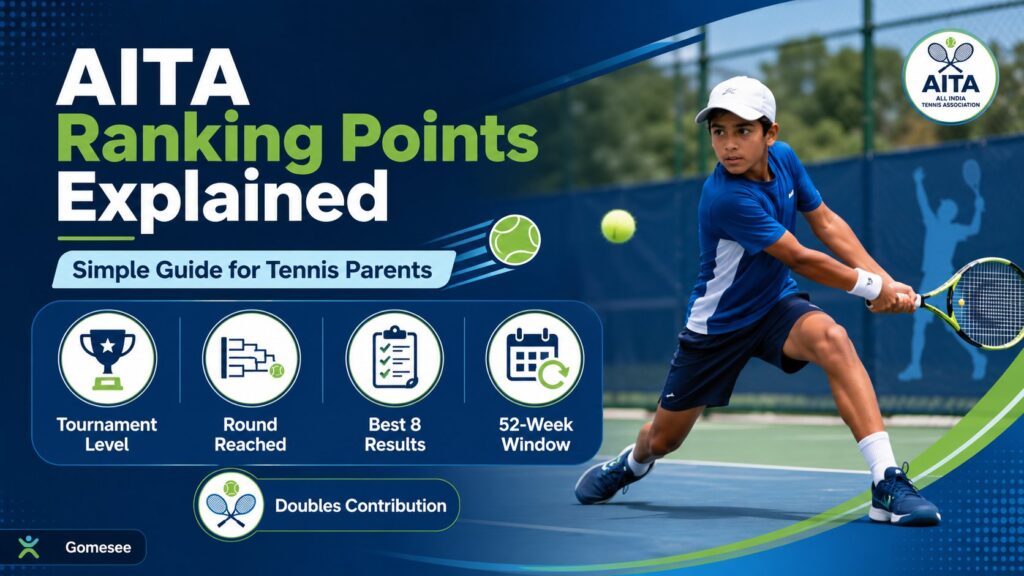
AITA ranking points can confuse parents, but once the system is understood, tournament planning becomes calmer and smarter.
In Part 1, we understood what AITA ranking really means.
In Part 2, we understood the AITA tournament ladder – Talent Series, Championship Series, Super Series, National Series, and Nationals.
Now we come to the question that creates the most confusion for parents ….
“How does my child actually get AITA ranking points?”
Many parents feel that if their child wins two or three matches, the ranking should immediately jump. Sometimes it happens. Sometimes it does not.
The reason is simple ….
Ranking points depend on tournament level, round reached, draw validity, ranking rules, and the ranking window.
So before getting emotional about ranking, parents should understand the points system calmly.
AITA’s 2026 Junior Circuit Rules include the official points system for Talent Series, Championship Series, Super Series, National Series, and Nationals. The same document also mentions important ranking concepts like the 52-week period and best 8 tournament results.
AITA Ranking Points Explained in Simple Words
For parents, the first basic rule is this:
A player gets points mainly according to the tournament level and the round reached.
This means a quarterfinal in Talent Series and a quarterfinal in Nationals are not the same.
A semifinal in Championship Series and a semifinal in National Series are not the same.
A final in Super Series and a final in Nationals are not the same.
So parents should not ask only ….
“Did my child win?”
They should also ask ….
“Which tournament level did my child play, and which round did my child reach?”
That gives a much clearer picture.
Official AITA Junior Points Table
As per AITA’s 2026 Junior Circuit Rules, the points increase according to the grade of the tournament and the round reached. The official points table lists points for R64, R32, R16, quarterfinal, semifinal, finalist, and winner.
| Tournament Level | R64 | R32 | R16 | QF | SF | Finalist | Winner |
| Talent Series 7 Days | — | 2 | 6 | 8 | 10 | 12 | 15 |
| Championship Series 3 Days | — | 1 | 3 | 4 | 6 | 8 | 10 |
| Championship Series 7 Days | — | 4 | 8 | 10 | 15 | 20 | 25 |
| Super Series | — | 5 | 10 | 20 | 30 | 40 | 50 |
| National Series | 5 | 10 | 20 | 30 | 40 | 50 | 75 |
| Nationals | 20 | 40 | 60 | 80 | 100 | 150 | 200 |
This table explains why all results cannot be treated equally.
A player winning a Talent Series 7 Days gets 15 points, while a player winning Nationals gets 200 points under the official AITA points table.
Practical Parent Example
Suppose two children both say:
“I reached the semifinal.”
Parent A’s child reached the semifinal of a Talent Series.
Parent B’s child reached the semifinal of a National Series.
Both are semifinals, but the ranking value is different.
As per the points table, a semifinal in Talent Series 7 Days gives 10 points, while a semifinal in National Series gives 40 points.
So the better parent question is not only:
“How far did my child go?”
The better question is:
“How far did my child go, and at what tournament level?”
This one question removes a lot of confusion.
Best 8 Results: Very Important for Parents
This is one of the most important ranking concepts.
AITA’s 2026 Junior Circuit Rules state that the ranking system considers tournaments played during the last 52 weeks. The same rules state that from 2025, the results of the best 8 tournaments are considered for ranking.
In simple parent language:
Your child may play more than 8 tournaments, but the ranking calculation focuses on the best 8 results as per the official rules.
This means playing more tournaments is not automatically better.
Playing smarter tournaments is better.
A player who plays 20 tournaments without strong results may not benefit as much as a player who carefully plans tournaments and produces 8 solid results.
The 52-Week Ranking Window
Parents often panic when ranking drops.
But ranking works like a moving window.
Because AITA ranking considers tournaments played during the last 52 weeks, older results can go out of the calculation.
Example:
Suppose your child won a good tournament last year and earned points.
After the 52-week period moves forward, those points may no longer remain in the ranking calculation. If the child has not replaced those points with new results, the ranking may drop.
This does not always mean the child has become weaker.
Sometimes it simply means:
- old points went out
- new points were not enough
- other players gained better points
So parents should not panic immediately. First, they should check the ranking cycle.
Singles and Doubles Points
Singles is the main base, but doubles can also support ranking.
For Under-18, Under-16, Under-14, and Under-12 categories, AITA’s 2026 Junior Circuit Rules mention that rankings include best 8 singles tournament results along with 25% of the best 8 doubles tournament points. The rules also mention category-specific additions involving ITF Juniors, Asian tournaments, higher AITA age-group results, and AITA Men/Women tournament points where applicable.
For parents, the simple meaning is:
Do not ignore doubles.
Doubles can support ranking, but more importantly, it develops:
- return quality
- net game
- reaction speed
- communication
- tactical thinking
- pressure handling
But doubles should not be played only as a point trick.
It should be used to build a more complete tennis player.
Qualifying Points: Small but Useful
The official rules also mention qualifying points.
For National Series and Nationals, qualifying points are listed as 6-4-2. For Talent Series 7 Days, Championship Series 7 Days, and Super Series, 1 point is awarded to players who qualify.
Parent meaning:
Even qualifying can have value, especially when the player is trying to enter stronger tournaments.
But qualifying points should not become the main goal.
The bigger goal is to improve enough to compete well in the main draw.
Important: Sometimes No Ranking Points Are Awarded
This is a very important point for parents.
As per AITA’s 2026 Junior Circuit Rules, if the singles main draw has fewer than 16 players, or the doubles main draw has fewer than 8 pairs, the tournament may continue, but no ranking points will be awarded. For three-day tournaments, if the draw has fewer than 8 players, the tournament may continue, but no ranking points will be awarded. The rules also mention a North East Sector exception with minimum participation conditions.
Parent meaning:
Your child may play and even win matches, but ranking points may not come if the draw does not satisfy the required condition.
Before travelling, parents should check:
- draw size
- tournament level
- fact sheet
- official notices
- whether the event is valid for ranking points
This can save confusion after the tournament.
Coach’s Insight: Points Are Important, but Planning Is Bigger
Parents often ask:
“How many points will my child get?”
That is a valid question.
But a better coach will also ask:
“What is the purpose of this tournament?”
Sometimes the purpose is points.
Sometimes the purpose is match exposure.
Sometimes the purpose is testing the child against stronger players.
Sometimes the purpose is confidence.
Sometimes the purpose is preparation for a bigger event.
Gomesee Way Insight
Do not chase points blindly. Build a player who can earn points repeatedly.
That is the difference between short-term ranking and long-term development.
Common Mistakes Parents Make About Ranking Points
Mistake 1: Thinking every win gives the same value
A win in TS, CS, SS, NS, and Nationals does not carry the same ranking value. Tournament level matters.
Mistake 2: Playing too many tournaments without planning
More travel does not always mean more progress. Since best 8 results matter, tournament planning should be intelligent.
Mistake 3: Ignoring the 52-week window
Old points can drop. Ranking can fall even if the child has not played badly.
Mistake 4: Forgetting doubles
Doubles can support ranking and develop important tennis qualities.
Mistake 5: Not checking draw size
If the draw does not meet the minimum requirement, points may not be awarded.
Parent Takeaway
AITA ranking points are not emotional. They are systematic.
They depend on:
- tournament level
- round reached
- best 8 results
- 52-week ranking window
- singles and doubles calculation
- valid draw conditions
- category-specific rules
Parents do not need to become mathematicians.
But they must understand the basics.
The simple formula is:
Right tournament + good result + proper planning = stronger ranking progress.
The deeper formula is:
Better development creates better results. Better results create better ranking.
Mini FAQ
Does playing more tournaments always improve ranking?
No. Since best 8 results are considered under the current junior ranking rules, quality results matter more than simply playing too many tournaments.
Why did my child’s ranking drop?
Possible reasons include old points dropping out of the 52-week window, other players gaining points, or the child not replacing previous strong results with new results.
Does doubles help AITA ranking?
Yes. Doubles points can contribute in junior ranking calculation as per category-specific AITA rules, but only a percentage of doubles points is added.
Should my child play only high-point tournaments?
Not always. The child should play tournaments that match readiness, confidence, fitness, recovery, and development needs.
Coming Next
In Part 4, we will understand:
Singles, doubles, and playing higher age groups.
This is important because many parents do not know when doubles helps, when playing higher category is useful, and when it becomes ego-based tournament selection.
Disclaimer
This article is written only for educational guidance for tennis parents and players. AITA rules, tournament formats, ranking systems, eligibility conditions, sign-in procedures, points structure, ranking calculation, and selection criteria may change from time to time. Parents and players should always verify the latest information from the official AITA website, official tournament fact sheets, official circulars, and the tournament referee before making tournament decisions.
Leave a Reply