By Alex Gomes | The Gomesee Way
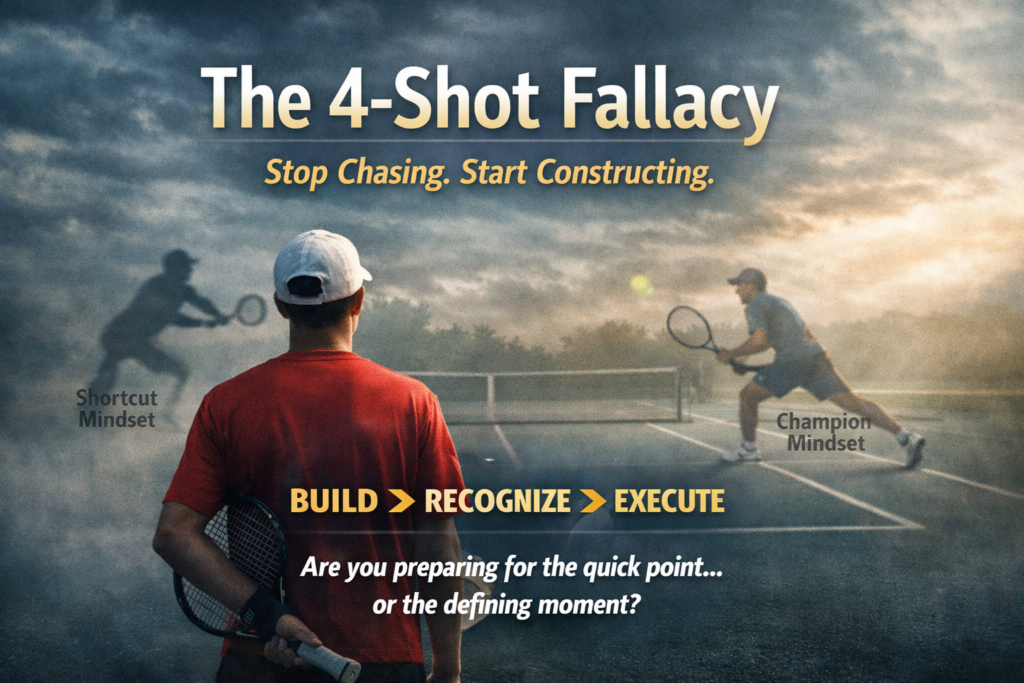
Rally tolerance in tennis is the hidden engine behind every dangerous modern player. Yes, many points finish within four shots …. but that does not mean developing players should stop learning how to rally. The player who can survive longer with quality earns the right to finish earlier with control.
There is a dangerous half-truth spreading through the academy bleachers and social media feeds. It sounds like this: “Modern tennis is fast. 70% of points end within four shots. Stop wasting time rallying.”
On the surface, the math is correct. But the application is a developmental disaster. Especially for players 14 and older, this “shortcut mindset” doesn’t just stall progress; it kills careers. To build a champion, we have to look beneath the statistics and understand the engine that actually drives those short points.
Rally Tolerance in Tennis Is the Engine of Modern Development
Rally tolerance in tennis does not mean playing safely or defensively. It means having the physical, technical, and mental strength to stay at the point until the right attacking ball appears. From a physiological standpoint, tennis is an intermittent high-intensity sport. While a point might end in four shots, the threat of the tenth shot is what creates the opening for the fourth.
In sports psychology, many developing players suffer from Action Bias, the overwhelming urge to “do something” just to relieve the mental pressure of a neutral rally. When you rush to finish a point without an opening, you aren’t playing “modern tennis”; you are simply surrendering to your own lack of physical and mental discipline.
The Gomesee Truth …. You do not earn the right to finish a point early until you have proven you can survive a point that goes long.
Research from Grand Slam match analysis (including data tracked by the ATP Tour and performance analytics platforms) consistently shows that while a majority of points finish within four shots, the average rally length still hovers around 3.8 to 4.2 shots.
However, what is often ignored is that error rates increase dramatically when players are forced beyond their rally tolerance threshold.
In simple terms ….
👉 The player who can sustain quality longer… forces the opponent to break first.
This concept is deeply supported in performance psychology. Research on decision-making under pressure shows that athletes often default to premature action to relieve cognitive stress, rather than making optimal decisions.
In tennis, this translates into low-percentage shot selection under neutral conditions, not because the player sees an opportunity, but because they cannot tolerate the uncertainty of the rally.
Respecting the 40% That Defines Your Career
Analytics tell us the majority of points are short, but they rarely distinguish between “noise” and “signal.” Short points are often the noise, double faults, missed returns, or unforced errors.
The 40% of points that go beyond five shots are the signal. These are the 30-30 points, the deuce games, and the break points in the deciding set. This 40% is where the match is won or lost. If you haven’t built the “aerobic mental capacity” to handle these moments, you will fold the moment the score reaches 4-4.
The Hybrid Model of the Modern Elite
At the elite level, rally tolerance in tennis is not passive grinding. It is controlled aggression. The best players use rally tolerance in tennis to stay stable, absorb pressure, and wait for the right moment to attack with discipline.
Look at Jannik Sinner or Carlos Alcaraz. Yes, they hit a massive ball, but their dominance isn’t built on “guessing and hitting.” It is built on High-Octane Neutrality, and it means playing fast, deep, and strong …. while staying completely in control.
The foundation of their game is the ability to hit fifteen balls at 80% intensity with zero technical breakdown. Only when they receive a ball that is two inches shorter or 2mph slower do they engage the “4-shot” finish. You cannot skip the building phase to get to the finishing phase. Without the ability to grind, your “attack” is just a gamble, and the house always wins in the long run.
As elite coach Patrick Mouratoglou has repeatedly emphasised:
“Top players don’t take risks early in the rally. They build the point until the right ball comes.”
This is the part most developing players skip.
Modern Player Insight
Even today, when analysing players like Jannik Sinner and Carlos Alcaraz, performance data shows that their neutral rally tolerance is among the highest on tour, despite their aggressive playing styles.
Their ability to finish points early is not instinctive; it is engineered through control.
The Anatomy of a Constructed Point
To move toward a world-class game, a player must master the natural evolution of a point. It begins with The Build: hitting 4–6 solid balls with depth and margin. This requires a patient, disciplined mind that respects the net.
Only then can you move to Recognition …. identifying the short ball or the weak reply. This is the hunter waiting for the right moment. Finally, you reach Execution: a clinical finish with precise intention. It isn’t flashy; it’s effective.
Novak Djokovic, one of the greatest returners and rally players in history, has often spoken about this principle indirectly through his game style:
“Tennis is a game of patience… the one who can stay longer in the rally usually has the advantage.”
His dominance was not built on finishing early…
It was built on outlasting the opponent’s discipline.
A Message to the Support Team
When parents or coaches tell a developing player to “hit winners” or “stop rallying,” they are inadvertently teaching that player to fear the struggle. Development isn’t a highlight reel; it’s a marathon of consistency.
This is why every serious parent must understand that the tennis improvement timeline is never straight. Players like Tirth, Ruju, and Satvi didn’t reach their level by avoiding hard work. They reached it because they mastered the grind so thoroughly that they made the “hard” parts look effortless.
👉 If your rally breaks at 5 balls… your match will break at 5–5.
The Final Reality Check
You are faced with a choice every time you step onto the court. You can chase the Shortcut Mindset, avoiding rallies, hitting through panic, and looking good in practice while struggling in matches.
Or, you can embrace the Champion Mindset. You can build patiently, trust the process under pressure, and treat the 4-shot finish as a tool you’ve earned, not a crutch you lean on.
Studies in skill acquisition consistently show that high-repetition, controlled practice environments build decision-making clarity under pressure, while low-discipline, random play builds inconsistency.
In tennis terms ….
👉 Structured rally tolerance builds champions. Shortcut hitting builds frustration.
Practice is where you build your strength; matches are where that strength is tested. If you skip the hard part, don’t expect easy results.
Don’t chase quick points. Build the player who is capable of creating them.
The Gomesee Way
Leave a Reply