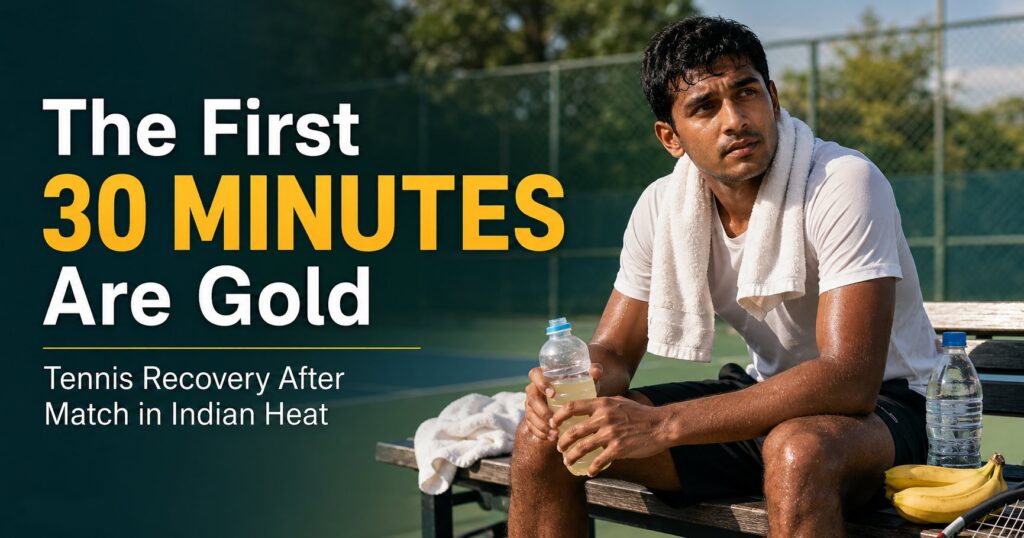
The First 30 Minutes Are Gold: Tennis Recovery After Match in Indian Heat
Tennis Performance Code · Recovery Series · Part 2
By Gomesee
A complete hour-by-hour recovery map for Indian tennis players — built for our heat, our tournaments, and our realities.
Tennis recovery after match is not just rest; in Indian heat, it is the first preparation for tomorrow’s performance.
Part 1 ended with the monkey sitting on Tirth’s shoulder in Round 3 — legs stiff, stomach cramping, body refusing to cooperate, despite the talent being fully there.
Part 2 is the map he needed — built for our heat, our conditions, our players. Because:
They lose it in the first 30 minutes after today’s match ends.”
Why Recovery Has Time Windows — And Why Missing Them Costs You
Recovery has time windows. Miss them, and no amount of sleep the following night will fully undo the damage. Dr. Stacy Sims, exercise physiologist at Stanford:
For Indian junior players — who may play two or three rounds in 40°C plus heat, with limited facilities, on hard courts, in back-to-back days — this is not theoretical. This is survival.
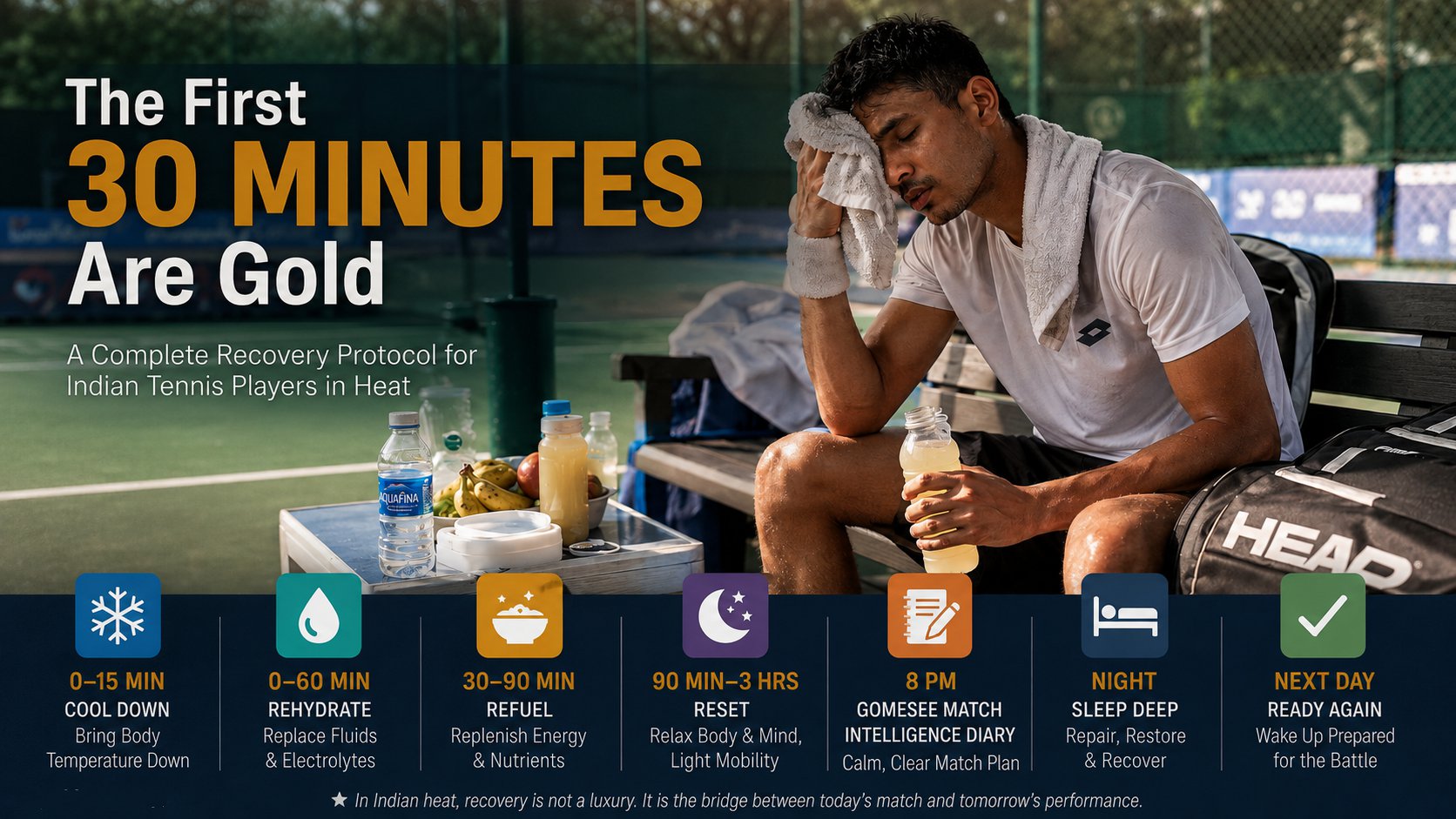
The Recovery Map
Seven phases. One goal: walk onto tomorrow’s court as a fully loaded player, not a patched-up one.
Phase 1 — Immediate Cooling (Minutes 0 to 15)
● What is happening in the body
Core body temperature can reach 38.5°C to 39.5°C or higher during hard play in extreme Indian heat. Until the core temperature begins dropping, the internal recovery process cannot begin properly.
● What to do — immediately after leaving the court
- Get out of direct sunlight. Find shade, an indoor space, or sit under an umbrella.
- Do not stand and talk in the heat. Sit down. Lower the metabolic demand on the body immediately.
- Take a cold, wet towel and place it on your neck, forehead, and wrists — areas where blood vessels sit close to the skin. This helps bring core temperature down faster.
- If available, a cold water bottle pressed against the neck or wrists works well.
- Avoid immediately sitting in a cold AC room with soaking wet clothing. Go to shade first, change out of wet clothes, then enter a cooler environment if available.
● Research note
A 2012 review published in the British Journal of Sports Medicine confirmed that neck and forehead cooling provides meaningful reduction in perceived thermal strain during and after exercise in hot conditions — and is practical even in low-resource environments.
● Indian tournament reality
At any tournament — whether in Ahmedabad, Bhuj, or anywhere on the Indian circuit — a player sitting courtside between matches will not always have immediate access to an ice bath or a physio’s table. That is completely normal. A small insulated cool bag, two thin towels, and shade are enough to begin this phase correctly. Work with what you have — but work with it immediately.
The Sports Authority of India (SAI) and the All India Tennis Association (AITA) operate within this Indian reality. Recovery protocols must be calibrated for our dry heat, high solar radiation, and subcontinental conditions — not imported wholesale from temperate climates. Our players deserve guidance built for where they actually play.
Phase 2 — Rehydration and Electrolyte Replacement (Minutes 0 to 60)
● The most misunderstood part of recovery
When a player sweats heavily for two or three hours in 42°C heat, they do not only lose water. They lose sodium. They lose potassium. They lose chloride. These electrolytes are not optional extras. They are the electrical system that runs the muscles and nerves.
Heat Cramps: Fluid and Electrolyte Challenges During Tennis in the Heat
This is exactly what happened to Tirth. The cramp in Round 3 did not begin in Round 3. It began quietly — possibly in Round 1 — with the first litre of sweat that was replaced with plain water and no sodium.
● The two-bottle rule — practical for Indian conditions
- Bottle 1: Plain water — drink slowly, not in large gulps.
- Bottle 2: Electrolyte drink — ORS (Electral or similar) mixed per packet instructions, OR homemade nimbu pani with a small pinch of kala namak (black salt) and a little sugar if needed.
The goal in the first 60 minutes is not to flood the system with liquid. It is to replace fluid and sodium steadily — sipping, not gulping.
Research by Maughan & Shirreffs (2010), published in the Scandinavian Journal of Medicine & Science in Sports, confirms that effective rehydration after exercise in hot conditions requires both fluid volume and electrolyte replacement together — neither alone is sufficient to fully restore the body’s balance.
● Budget-friendly electrolyte options for Indian players
| Option | How to Use |
|---|---|
| ORS / Electral packet | Mix one sachet in 1 litre of water. Sip over 45–60 minutes. |
| Nimbu Pani | Fresh lemon juice, water, small pinch of kala namak, small amount of sugar. Easy to carry in a flask. |
| Sports drink (Gatorade etc.) | If available and budget allows. Read the label — dilute if too sweet. |
| Coconut water | Natural electrolytes. Excellent if fresh and available locally. |
| Plain water | Always important — but combine with one of the above, do not use alone after heavy sweating. |
Phase 3 — Carbohydrate and Protein Recovery (Minutes 30 to 90)
● The fuel tank and the repair crew
A long match in heat depletes glycogen — the stored carbohydrate fuel inside your muscles. When glycogen is low, everything suffers: movement, reaction speed, serve power, mental sharpness, and emotional resilience. A player with empty glycogen tanks does not just feel tired. They feel like the battery has been removed from their game.
Research published in the Journal of Pediatric Orthopaedics and the American College of Sports Medicine supports a recovery ratio of approximately 3:1 carbohydrates to protein in the first 90 minutes post-exercise for young athletes in high-intensity sport.
● The ideal recovery food timing
| Time After Match | What to Eat | Indian Options |
|---|---|---|
| 0–30 mins | Easy-to-digest carbohydrates. Nothing heavy. | Banana, dates, raisins, chikki |
| 30–90 mins | Carbohydrate + protein together. | Curd-rice (if kept cool and fresh), peanut-butter sandwich, roasted chana, paneer if kept cool |
| 90 mins+ | Proper meal. Real food. | Dal-chawal, sabzi-roti, curd, vegetables. Avoid heavy fried food. |
● Important notes
- Curd-rice, paneer, and milk-based items should only be consumed if kept cool and fresh. In 42°C heat, dairy spoils quickly. When in doubt, carry these in an insulated dabba with ice.
- Peanuts and heavier foods are better as later recovery food, not immediately after the match when the stomach is under stress.
- Do not eat a large meal immediately after the match. The stomach, like the muscles, is in recovery mode. Give it easy, digestible food first.
- Bananas are not magic. They help — potassium is useful — but they cannot replace a full electrolyte and carbohydrate protocol on their own.
Phase 4 — Light Mobility and Avoiding Stiffness (Minutes 20 to 45)
● The mistake most players make
After a tough match, most players want to collapse. This is understandable. But if the body is left completely still and cold — especially after a heat match — the muscles begin to stiffen. Lactic acid and metabolic waste sit in the tissue instead of being flushed out. The next morning, the player wakes up feeling like concrete.
● What to do
- 5 to 10 minutes of slow walking after drinking and cooling. Just easy movement. No intensity.
- Gentle calf stretches, hip flexor stretches, quad stretches — holding each for 30 to 45 seconds, not bouncing.
- Foam rolling if available — slow, gentle passes on the calves, quads, and upper back. Not aggressive.
- Change out of wet, salty clothes immediately. Staying in wet, salty clothing keeps the body in a low-grade stress state.
- Dry socks and clean footwear matter more than most players realise. The feet carry the entire match. Give them air and rest.
Dr. Shona Halson, a leading recovery researcher who spent over a decade at the Australian Institute of Sport, has written that low-intensity active recovery accelerates the removal of metabolic by-products from exercised muscle more effectively than complete rest — and that the greatest gains from this type of recovery are seen in athletes who perform it consistently, not occasionally.
Phase 5 — Nervous System Reset (Hours 1 to 3)
● The part nobody talks about
The muscles are not the only system that gets fatigued in a long, tough match. The central nervous system — the brain, the spinal cord, the nerve-to-muscle communication pathways — also accumulates fatigue. This is central nervous system fatigue. And it responds poorly to pressure, noise, urgent conversations about the next match, and analysis of what went wrong.
Professor Samuele Marcora of the University of Kent, whose research on the psychobiological model of exercise fatigue has been widely cited, has shown that perceived effort and mental fatigue directly impair physical performance — independently of what the muscles are doing. The brain that is tired sends a tired body onto the court.
● The mental reset protocol — simple and practical
- Find a quiet corner. Away from the courts, the results board, the noise, and other players talking about their matches.
- Ten minutes with earphones in — calm music, not high-energy. Or silence. The nervous system needs quiet to begin settling.
- No coach analysis for at least 60 to 90 minutes after the match. The player’s nervous system is not ready to process tactical feedback in this window. Information given here is often not properly retained.
- No social media. No watching other matches immediately. Just rest the mind.
- Some players find it helpful to write three things that went well in the match — not what went wrong. This shifts the brain from survival mode to learning mode.
Phase 6 — Sleep and Next-Day Readiness
● Sleep is the master recovery tool
● Sleep targets for tournament players
- Minimum 8 hours for juniors and young adults in heavy tournament play. 9 hours is better when multiple matches are involved.
- Sleep before midnight. The hours between 10pm and 2am are particularly rich in deep sleep and growth hormone release.
- Cool, dark room if possible. Body temperature needs to drop slightly for deep sleep to occur — which is why a cool room helps even more after a heat match.
- No screens for 30 to 45 minutes before sleeping. Blue light suppresses melatonin — the sleep hormone.
● The night-before failure that haunts Round 3
A player who sleeps at 12:30am is not sleeping 8 hours even if they wake at 8:30am. The growth hormone window has closed. They wake up unrested — and wonder why.
Sleep discipline in tournaments is not optional. It is as important as the match plan.
Phase 7 — The Pre-Sleep Match-Plan Conversation
● The session most coaches skip
● What the pre-sleep conversation should include
- What is the opponent’s main pattern? One or two lines only. Not an analysis. Just the key read.
- What is our game plan? Simple. How are we going to play — not how we are going to avoid losing.
- What is our first-ball focus? Give the player one clear, specific intention for the start of the match.
- What do we stay away from? One thing to avoid. That is all.
- Finish with belief. Not pressure. Close with something like: “Your body is recovering. Your mind knows what to do. Sleep well and go compete.”
This conversation should feel like a coach speaking to a trusted athlete — not a general giving orders before a battle. The tone is calm confidence. The length is short. The message is clear.
Phase 8 — The Gomesee Match Intelligence Diary (Around 8:00 pm)
● The step that completes the circle
Around 8:00 pm — after the body has been cooled, fed, hydrated, and allowed to rest — the player sits with the coach or the parent. Not to receive a lecture. Not to replay the mistakes of today. But to do something very specific and very powerful:
They fill the Gomesee Match Intelligence Diary.
This is the tool that ensures the player does not just recover physically — but goes to sleep with a completely clear, calm, and focused mind. No open questions. No anxiety about tomorrow. No confusion about how to play. Just clarity.
● Why the diary matters — the science of pre-sleep mental clarity
Dr. Jim Loehr, sports psychologist and co-author of The Power of Full Engagement, who spent decades working with world-class tennis players, wrote that elite competitors distinguish themselves not only by physical preparation but by the quality of their mental recovery rituals.
● Before Sleep: Diary, Not Drama
Goal: sleep with clarity, not pressure.
Before sleep, the player should not receive a long tactical lecture. The body is repairing. The mind is tired. This is not the time to overload the player. But the player should also not sleep blindly.
In my coaching system, filling the Gomesee Match Intelligence Diary is non-negotiable. I will not reveal the internal structure of that diary here. That belongs to my player-coach system.
But the principle is simple:
The diary prevents two dangerous things: confusion and overthinking. A player should not go to bed with twenty voices inside the head. One clear direction is enough.
The player closes the diary. The player sleeps. And in the morning, they wake up as a complete athlete — body restored, mind focused, plan in place, belief intact. Not just recovering the legs. Recovering the whole player — body and mind, together.
The Indian Tournament Recovery Bag
This is not a luxury list. It is a practical, budget-conscious toolkit that every Indian junior player and their parent can put together before every tournament.
| Category | Item | Why It Matters |
|---|---|---|
| COOLING | 2 thin towels in a cool bag | Neck/forehead cooling reduces core temperature |
| COOLING | Small umbrella or wide-brim cap | Shade between matches reduces heat load |
| HYDRATION | 2L plain water | Base hydration — always essential |
| HYDRATION | ORS sachets or nimbu pani flask with small pinch of salt | Sodium replacement — prevents cramping |
| FUEL | 2 bananas or a small box of dates/raisins | Immediate carbohydrate — easy to digest |
| FUEL | Peanut-butter sandwich or roasted chana | Carb + protein — muscle repair fuel |
| FUEL | Curd-rice in insulated dabba (if fresh and cool) | Carb + protein + gut-cooling effect |
| COMFORT | 3 spare T-shirts and 2 extra pairs of socks | Dry, clean clothing removes salt stress from the skin |
| COMFORT | Flip-flops or open footwear | Let feet breathe and recover between matches |
| MENTAL RESET | Earphones — for 10 minutes of quiet after the match | Nervous system cannot recover inside noise |
| MENTAL RESET | Small notebook — write 3 things that went well | Shifts brain from survival mode to learning mode |
Stop Play Immediately — Know These Signs
Heat is not a small matter. What begins as tiredness can escalate into a medical emergency quickly. Every parent, coach, and player must know when to stop.
If the player shows any of the following, stop play and seek medical help without delay:
- Confusion or unusual behaviour — says things that do not make sense
- Dizziness or inability to stand or walk normally
- Vomiting that does not stop
- Fainting or loss of consciousness
- Severe weakness where the body cannot function
- Severe cramps that do not respond to rest and fluids
- Stops sweating while still in the heat — the body’s cooling system is shutting down
Health comes before the trophy. There is no match, no prize money, and no ranking point that is worth a serious medical event.
The Body Is Ready. Now Go Compete.
Recovery is not what you do after the match.
Recovery is the first decision of the next match.
The players who last in tournaments are not always the most talented. They are the most prepared — in every meaning of that word. They prepare their rackets. They prepare their tactics. And the ones who win multiple rounds, day after day, in heat and pressure — they prepare their bodies.
The map is in your hands now. It does not require a fancy facility. It does not require an expensive physio or a sports science lab. It requires discipline, timing, and the understanding that the tournament does not pause between matches — and neither should your preparation.
But I will add to this, with respect to Ali’s greatness:
Champions are also made in the hours after the match ends — in the quiet discipline of recovery, when nobody is watching.
The trophy does not go to the strongest player in Round 1. It goes to the player who was most ready for Round 3.
Take care of the body tonight. The match is already beginning.
This article was written because of you, and it was written for every talented Indian player who has not yet been given the recovery map they deserve. Now you have it. Use it.
🔗 Read Part 1 of the Recovery Series here
References and Research Sources
The following sources informed the research framework for this article:
- Bergeron, M.F. (2003). Heat cramps: fluid and electrolyte challenges during tennis in the heat. Journal of Science and Medicine in Sport, 6(1), 19–27.
- Burke, L.M. et al. (2011). Carbohydrates for training and competition. Journal of Sports Sciences, 29(sup1), S17–S27.
- Gabbett, T.J. (2016). The training-injury prevention paradox. British Journal of Sports Medicine.
- Halson, S.L. (2014). Monitoring training load to understand fatigue in athletes. Sports Medicine, 44(S2), 139–147.
- Marcora, S.M., Staiano, W., & Manning, V. (2009). Mental fatigue impairs physical performance in humans. Journal of Applied Physiology, 106(3), 857–864.
- Maughan, R.J. & Shirreffs, S.M. (2010). Dehydration and rehydration in competitive sport. Scandinavian Journal of Medicine & Science in Sports.
- Sims, S. (2016). ROAR: How to Match Your Food and Fitness to Your Unique Female Physiology. Rodale Books.
- Walker, M. (2017). Why We Sleep: Unlocking the Power of Sleep and Dreams. Scribner.
- British Journal of Sports Medicine (2012). Cooling interventions for exercise-induced hyperthermia.
- JPOSNA / American College of Sports Medicine youth athlete recovery guidelines.
- NHS / CDC criteria for heat exhaustion and heat stroke.
- Sports Authority of India (SAI) — Sports Science and Research Division. Guidelines for athlete health, hydration, and heat management in Indian climatic conditions. NCSSR, New Delhi.
- All India Tennis Association (AITA) — Tournament regulations and player welfare framework. Ministry of Youth Affairs and Sports, Government of India.
Coach’s Note: All quotes attributed to named researchers reflect positions from their documented published work. The Muhammad Ali quote is widely attributed. No quotes in this article have been invented.
Tennis Performance Code · Recovery Series · Part 2
Leave a Reply