A real tennis improvement timeline is rarely straight, fast, or comfortable. Parents often look for results in match scores, but coaches first look for hidden signs: better movement, cleaner contact, stronger decisions, emotional control, and the ability to repeat good habits under pressure.
This article is a reality check for junior players and parents who want to understand how tennis improvement actually happens.
“Why the Scoreboard is a Lagging Indicator.”
The Question Nobody Asks Loudly
Every player asks it silently; every parent carries it like a weight: “How long should this take?”
We aren’t just asking about forehands or footwork. We are asking, “How long before the sacrifice feels worth it?”
In a culture of 60-second highlight reels and “13-year-old prodigy” headlines, the truth has been buried. We have been sold a lie that progress is a straight line. It isn’t. It’s a series of long, invisible plateaus punctuated by sudden, violent leaps in performance.
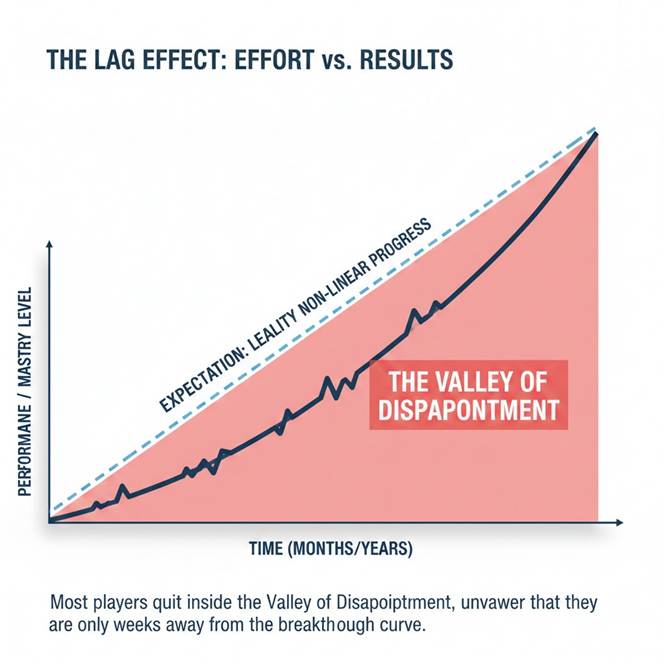
If you feel like you’re standing still, you probably aren’t. You’re just in the “Lag Phase.”
I once worked with a player for 18 gruelling months. We were rebuilding his technical foundation and his mental approach from the ground up. During that time, he didn’t win a single tournament. To the outside world, he was “failing.” To his parents, the investment felt like it was disappearing into a black hole.
We were weeks away from them removing him from the program. We sat down, looked at the Invisible Layers of Progress, and I asked them to trust the “Lag Phase” for just one more season.
Three months later, he won three consecutive titles.
He hadn’t suddenly become a better player overnight; his results simply caught up to the work we had been doing for a year and a half. Use this article as a “Contract of Patience.” Remind yourself: a temporary dip in results is often the prerequisite for a permanent jump in performance.
1. The Outcome Fallacy: Why Your Clock is Wrong
Most people borrow their timelines from Outcomes, not Development.
When you see a junior jump 200 spots in the rankings in six months, you are seeing the eruption, not the tectonic shift. That “sudden” success is usually the result of two years of grueling, un-glamorous work that finally “clicked.”
The Trap: When you compare your internal struggle to someone else’s external highlight reel, you create a “Developmental Debt.” You feel behind, so you rush. You rush, so you skip fundamentals. You skip fundamentals, and your ceiling collapses.
2. The Five Layers of Invisible Progress
Coaches don’t look at the scoreboard to see if a player is improving. They look for the “Lead Indicators.” If these five things are happening, the wins are inevitable, even if they haven’t arrived yet:
- Layer 1: Cognitive Calm. The game “slows down.” The player isn’t panicking between shots.
- Layer 2: Shot Selection. They are losing points because they missed the right shot, not because they chose the wrong one.
- Layer 3: Recovery Efficiency. Not just physical, but emotional. How long does it take to reset after a double fault? 30 seconds? Or three games?
- Layer 4: Technical Robustness. The swing doesn’t break down at 4-4 in the third set.
- Layer 5: Match Expression. The ability to do in a tournament what you did in practice on Tuesday. (This is the final layer to settle).
The 10x Truth: You can be improving 1% every day in Layers 1 through 4 while still losing matches. This isn’t failure; it’s “loading.”
3. The Honest Timeline (By Phase, Not Hype)
| Phase | Duration | The “Vibe” | The Danger Zone |
| Foundational | 6–12 Months | High excitement. Rapid “newbie” gains. | False Confidence. Thinking the whole journey will be this easy. |
| Reconstruction | 1–2 Years | Frustrating. “I was better a month ago.” | The Regression Trap. Reverting to old, bad habits just to win a local match. |
| The Grind | 2–4 Years | Long plateaus. Subtle tactical shifts. | The Quit Point. Most players stop here because the “ROI” feels low. |
| High Performance | 5–8+ Years | Margins of 1%. Non-linear jumps. | Burnout. Treating tennis like a job instead of a craft. |
The “Contract of Patience”
Remember the player I mentioned at the start of this article? The one who went 18 months without a trophy?
His breakthrough didn’t happen because we found a ‘secret’ technique in month 19. It happened because he and his parents signed a silent Contract of Patience. They understood that the ‘Competitive to High Performance’ phase (which we discussed above) is a test of character, not just talent.
If you are a coach or a parent reading this: your job is to be the ‘Guardian of the Timeline.’ When the player is in the Valley of Disappointment, they cannot see the upward curve. You have to see it from their perspective.
How to Audit Your Progress This Weekend
To get out of the “Outcome Trap,” stop looking at the score and start tracking these 5 Performance Codes. If you can check 3 out of 5, you are winning the “Invisible Game”:
- [ ] The Technical Lock: Did your swing stay fluid on break points, or did you start “pushing”?
- [ ] The 15-Second Reset: After a double fault or a bad miss, did you regain focus before the next point started?
- [ ] Tactical Intent: Did you hit the right shot to the right target, even if the ball went out by an inch?
- [ ] Physical Floor: Did your footwork intensity stay the same from the first point to the last?
- [ ] Emotional Neutrality: Did you stay “level” regardless of whether you were winning or losing?
4. The “Lag Effect”: Why Progress Feels Slow
In physics, there is a concept called Hysteresis, the lag between a change in a force and the manifestation of its effect.
Tennis is the ultimate Hysteresis sport. Your work today will not show up in Saturday’s tournament. It will show up in a tournament six months from now.
This is why “Coach Shopping” is so lethal. Parents often fire a coach right when the player is at the peak of the “Lag Phase.” They switch coaches, the “click” occurs two months later, and the new coach gets credit for the previous coach’s two years of labour.
5. What Parents Feel (But Rarely Say)
If you are a parent, you have likely felt the “Quiet Panic”:
- “Are we pouring money into a black hole?”
- “Why is the kid we beat last year winning titles now?”
These thoughts don’t make you a “bad tennis parent” …. they make you human. But remember: Tennis is a long-term apprenticeship. You are not building a result; you are building a person who can handle pressure, solve problems, and endure boredom.
The Final Reality Check
Tennis does not reward impatience. In fact, it actively punishes it.
If you are obsessed with the “When,” you lose sight of the “How.” But if you focus on the habits, the layers of invisible progress, and the 1% shifts in decision-making, the timeline takes care of itself.
The hardest part of tennis isn’t the 100mph serve. It’s the three-year wait.
Trust the work. The work is always recording, even when the scoreboard isn’t.
Ready to Crack the Code?
Improvement feels slow because most players track the wrong metrics. I’ve developed a Developmental Milestone Map designed specifically for serious players and parents who want to see the “invisible” progress they are making every day.
If this article helped you understand why progress feels slow, keep this PDF with you. Read it again when doubt creeps in.
Leave a Reply