Information reviewed against available AITA sources on 15 May 2026.
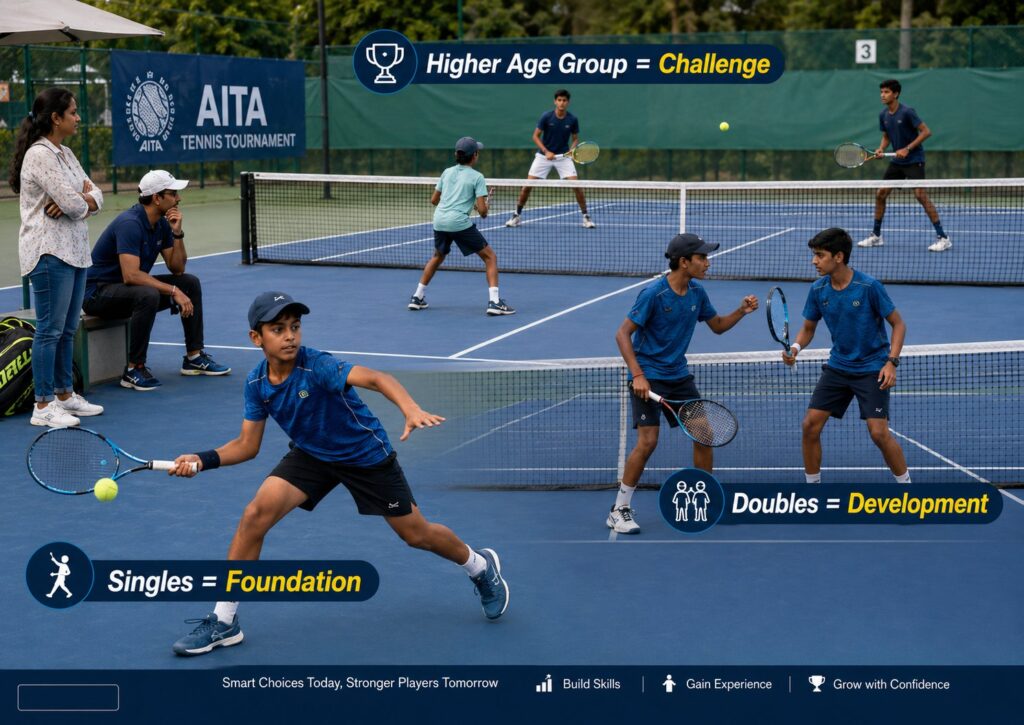
Higher age group, singles and doubles decisions should always support the child’s long-term development, not ego or pressure.
The three tools every junior tennis parent needs to understand:
Singles is the foundation. Doubles is the development tool. Higher age group is the challenge tool.
But tools are only as good as the hands that use them.
A child should not play singles only for ranking points. A child should not play doubles only as a shortcut to ranking. A child should not play a higher age group only to satisfy ego.
Before every tournament entry, the right question is not:
“Can my child enter this event?”
The better question is:
“Will this event help my child grow as a player?”
That is where mature tennis parenting begins.
For ranking-points basics, read the previous article …. How AITA Ranking Points Work.
1. Singles: The Foundation That Cannot Be Faked
Singles reveals a player’s true competitive identity.
There is no partner to cover weaknesses. No hiding place. The child must manage the full court alone — serve, return, rally construction, movement, fitness, shot selection, and emotional control. Everything is exposed.
This is why, no matter how well a child performs in doubles or how boldly they compete in a higher age group, if the singles foundation is weak, ranking progress will not hold.
A good parent does not watch only the score. A good parent learns to watch the player.
Better questions after a singles match:
- Did the child compete more maturely than before?
- Did the child recover after mistakes?
- Did the child handle pressure points better?
- Did the child construct points rather than just trade shots?
- Did the child show improved emotional control?
These questions tell you more about a player’s development than the final scoreline ever will.
2. Doubles: More Than a Ranking Supplement
Many parents treat doubles as an afterthought.
“Doubles is only extra.” “Let us play doubles only if points come.”
That is a mistake.
Ranking Value
As per AITA’s 2026 Junior Circuit Rules, for Under-18, Under-16, Under-14, and Under-12 categories, 25% of the best 8 doubles tournament points are included in rankings, along with category-specific additions stated in the rules.
So yes, doubles supports ranking. But that is the smaller reason to play it.
Development Value
Doubles builds a different and more complete tennis player:
- Return quality sharpens because the ball comes faster with less margin
- Net play and volley confidence grows under real match pressure
- Serve placement becomes more deliberate
- Reaction speed improves
- Tactical intelligence develops through partner communication and court awareness
- Pressure-point courage is tested at the net
A chronic baseliner who avoids the net becomes braver in doubles. A player with a weak return becomes sharper. A nervous player at the net gains courage. These improvements feed directly back into singles.
What Parents Must Know Before Entering Doubles
Per AITA’s 2026 Junior Circuit Rules:
- There is no doubles in Championship Series 3-Day tournaments
- For TS7, CS7, SS, NS, and Nationals — doubles is part of the event and points count toward rankings
- The minimum draw size for points to be awarded is 8 pairs
- Doubles entry is decided on the merit of combined ranking
Before planning doubles, verify:
- Does this tournament include doubles?
- Is a suitable partner available?
- What is the combined ranking situation?
- Is the draw valid for points?
- Will doubles create excessive physical or mental load for the child this week?
3. Higher Age Group: Useful Tool or Ego Trap?
This is the most emotionally charged area of junior tennis parenting.
An Under-12 playing Under-14 looks impressive. An Under-16 competing in Under-18 feels like progress. Parents take pride. But pride and development are not always the same thing.
When Higher Age Group Genuinely Helps
Playing up benefits a child who is:
- Physically ready for the heavier pace and more physical play
- Technically stable enough to compete, not just survive
- Mentally mature enough to handle losses without confidence damage
- Guided by a coach with a specific developmental purpose in mind
When It Harms
When the child is pushed up before readiness:
- Repeated heavy losses damage confidence
- Physical mismatch raises injury risk
- Mental wear begins to create tournament fear rather than competitive hunger
Playing higher age group must be a development decision, not a status decision.
The question is not: “My child is playing above age — doesn’t that mean something?”
The better question is: “What exactly are we trying to develop here, and is the child ready?”
If the answer is clear and grounded, proceed with purpose. If the answer is ego, comparison, or anxiety, pause.
Ranking Value
AITA’s 2026 Junior Circuit Rules allow higher age-group results to count in junior rankings:
- Under-16 ranking includes points from the best 8 AITA Under-18 results
- Under-14 ranking includes points from the best 8 AITA Under-16 results
- Under-12 ranking includes points from the best 8 AITA Under-14 results
Category-specific provisions exist for Asian tournaments, ITF Juniors, and AITA Men’s/Women’s tournaments where applicable.
Rules may permit it. Ranking may benefit from it. But development must decide it.
A wise parent understands the difference between permission and readiness.
4. Tournament Load: The Hidden Cost Parents Ignore
AITA’s 2026 Junior Circuit Rules set yearly tournament limits:
| Age Group | Annual Tournament Limit |
| Under-12 | 18 AITA tournaments |
| Under-14 | 25 AITA tournaments |
| Under-16 | 30 AITA tournaments |
| Under-18 | No restriction |
Critically: A tournament played in any age group counts toward the total. An Under-12 player eligible for Under-12, Under-14, and Under-16 still has a combined limit of 18 tournaments.
This rule carries a message beyond compliance: children are not machines.
More tournaments do not automatically produce better players. Over-scheduling affects body freshness, injury risk, school balance, emotional health, training quality, and — most importantly — the child’s hunger to compete.
The proud parent who says “My child is playing every week” should instead be asking: “Is my child improving every month?”
A child needs tournaments. A child also needs training blocks, recovery blocks, and time to reflect and reset.
5. Event Combination Rules: Know the Limits
AITA rules also govern how events can be combined within a single tournament week:
- A player cannot enter two different tournaments at different venues during the same week
- If a tournament runs two age groups, a player cannot play qualifying in both. The player may play the main draw of one age group and qualifying of the other
- In a multi-age-group tournament, a player may enter a maximum of three events: two singles main draws and one doubles main draw
- A player cannot enter one singles and two doubles events
Do not approach tournament entry like shopping. Every entry carries body load, mental load, and recovery cost. A disciplined tournament plan protects the child.
The Five Questions Before Every Entry
Before entering doubles or a higher age group, any parent can run this simple check:
- Purpose — Why are we entering this event?
- Readiness — Is the child physically, technically, and mentally ready?
- Load — Will this create excessive body or travel load?
- Confidence — Will this stretch the child or break the child?
- Review — After the tournament, what will we learn and improve?
These five questions cut through emotional decision-making before it does damage.
Common Mistakes Parents Make
Ignoring doubles entirely. Doubles builds match skills that singles practice cannot replicate and contributes to ranking. Skipping it is a real cost.
Playing doubles only for points. Points are a by-product. The real return is a sharper return game, braver net play, and better tactical thinking.
Pushing higher age group too early. Repeated heavy losses before the child is ready do not build resilience — they erode confidence.
Treating higher age group as a badge. It is a test, not a trophy. Use it with a specific purpose.
Forgetting recovery. A tired player cannot compete at full quality. Recovery is not optional — it is part of the development plan.
The Bottom Line
Singles is the foundation. Doubles is valuable. Higher age-group tournaments can be useful.
All three must be planned with maturity.
The best question before entering any event:
Will this help my child grow as a player?
If yes — enter with purpose. If the honest answer is ego, comparison, pressure, or fear of missing out — think again.
A child is not a ranking project. A child is a developing athlete. The goal is not to collect tournaments. The goal is to build a player.
Coming Next: Tournament Procedures — Entry, Fact Sheet, Sign-In, Qualifying, Main Draw, Seeding, Lucky Loser, Withdrawal, and No-Show. Many parents lose opportunities not because their child cannot play, but because they do not understand tournament procedure.
Disclaimer: This article is written for educational guidance only. AITA rules, tournament formats, ranking systems, eligibility conditions, points structure, and participation limits may change. Always verify current information from the official AITA website, tournament fact sheets, official circulars, and the tournament referee before making any tournament decisions.
Leave a Reply