Three rare technologies entering tennis right now, and why the players who know them first will win.
By Coach Gomes · Roland Garros Week, May 2026
Picture this. It is a warm Monday morning. The French Open …. Roland Garros, the qualifying rounds and practice week before the main draw.” has just begun its first day of play in Paris. Millions of tennis fans are watching. Coaches around the world are glued to their screens, studying technique, observing tactics, taking notes.
This tennis technology revolution is not coming someday, it has already started.
But here is what almost none of them noticed.
While everyone was watching who was playing, something far more important was happening quietly on the sidelines. A technology revolution, one that has been building for three years …. silently crossed a threshold this week that changes tennis coaching forever.
I noticed. And today, I want to share it with you, because that is what this blog is for. Not the obvious. Not the mainstream. The rare. The genuine. The things that give you and your game a real edge before anyone else even knows they exist.
The Tennis Technology Revolution Has Already Started
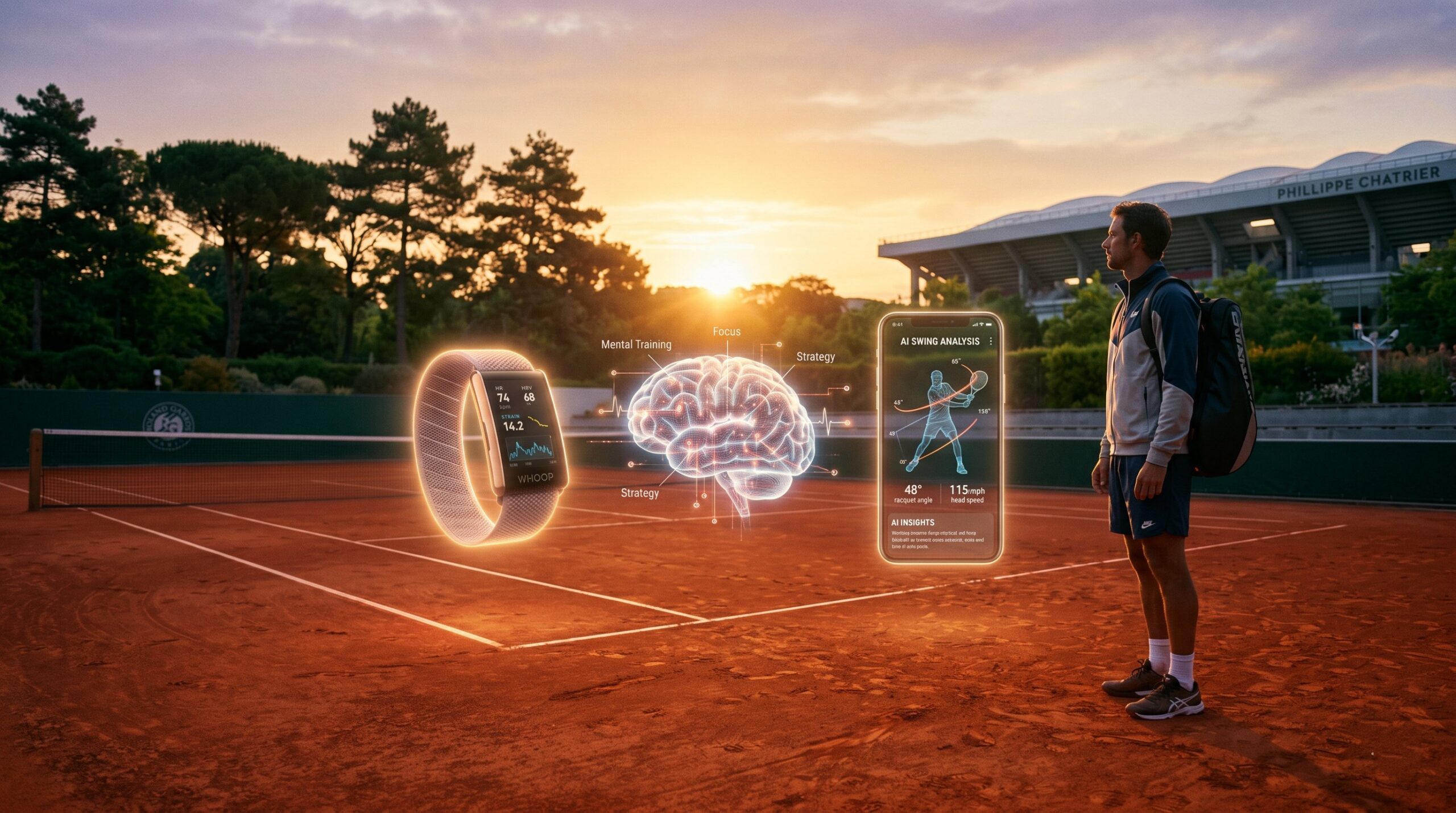
Here are three technologies that are changing tennis at the highest level right now, and what they mean for every player, at every level, including yours.
Player development is no longer only about strokes; it is about recovery, mindset, decision-making, and smarter training.
DISCOVERY ONE The Wristband Inside the Grand Slam
For the first time in the history of Grand Slam tennis, players are now officially permitted to wear connected biometric devices …. like the Whoop band, during competition. This started today. Day one of Roland Garros 2026.
The Whoop band tracks heart rate variability, sleep quality, recovery scores, respiratory rate, and strain levels in real time. Players can now collect real biometric data during competition, information that can later help them and their teams understand strain, recovery, and physical readiness more accurately.
This is not a gadget. This is a physiological truth-teller worn on the wrist.
Think about what this means at the coaching level. For years, we have been asking our players “how do you feel?” And they say “fine” ….. because they are competitors, they want to play, they do not want to show weakness. But their body tells a different story.
The Whoop band removes the guessing. It does not care about ego. It reads the body’s honest signals: heart rate variability, recovery percentage, sleep debt. And now, for the first time, this data is permitted inside a Grand Slam court.
“Wearable devices monitor physiological metrics such as heart rate variability, fatigue, and recovery, providing a comprehensive view of an athlete’s readiness.” – Euro School of Tennis, Technology in Tennis Report, 2026
What should you take from this as a player or parent? Simple. Recovery is not laziness. It is strategy. The best players in the world are now wearing science on their wrist. You do not need a Grand Slam to start thinking this way. You need a coach who understands it.
DISCOVERY TWO The App That Trains Your Mind Like a Muscle
Ask any great coach what separates the good from the great. They will not say the forehand. They will not say fitness. They will say …. the mind.
Vodar is a new coaching app built on neuroscience and cognitive psychology. Every week, new mental drills are released …. covering focus, resilience, emotional control, and confidence. Each drill comes with step-by-step instructions and animated 3D video. On-court. Practical. No psychology degree needed.
The science behind it? It enhances BDNF …. Brain-Derived Neurotrophic Factor …. a protein that literally strengthens memory and resilience in the brain. This is not motivation talk. This is biology.
The man behind Vodar’s methodology is Jeff Greenwald …. one of the most respected sports psychology consultants in the world, who has worked with USTA, Stanford Men’s Tennis, and UC Berkeley Men’s Tennis. This is not a startup built in a garage by someone who plays twice a week. This is credentialed, tested, real-world thinking – brought onto the court.
Here is the insight that stunned me when I first read about Vodar. They described it like this: imagine playing tennis with one hand tied behind your back. That is what players do when they train only technique and fitness, and ignore the mind. They play at 75% of their potential. Every single match.
“Mental strength often becomes the deciding factor in high-pressure moments, yet it remains one of the most neglected aspects of training. Remove mental coaching, and a player instantly loses 25% of their potential.” – Vodar App Research Brief, as reported by Tennis365, 2025
At grassroots level, at our level, nobody is using this yet. Parents are spending money on rackets, on shoes, on private lessons. And the mind …. the thing that determines whether your child holds serve at 5-4 in the third set, is left entirely to chance.
That ends here. That ends today. Know about Vodar.
DISCOVERY THREE Compare Your Swing to Djokovic. From Your Phone.
Here is the question I want you to sit with for a moment. What if you could compare your student’s backhand …. in real time …. to Novak Djokovic’s? Not conceptually. Not by watching YouTube. Actually, scientifically, biomechanically …. stroke by stroke?
SportAI makes this possible. Using only a standard phone camera, the app uses computer vision and machine learning to analyse a player’s swing: hip rotation, shoulder velocity, wrist speed, kinetic chain, follow-through. Everything. Then it generates a detailed overlay, comparing the player’s swing curve to a professional’s.
SportAI received a Special Mention in TIME Magazine’s Best Inventions of 2025. And very few academy-level coaches have started using this kind of technology yet.
This was built by Lauren Pedersen …. a former NCAA Division I tennis player from New Zealand who grew up far from elite coaching resources. Her mission was personal: she knew what it felt like to have raw talent but no access to elite analysis. So she built the tool she wished she had.
“This technology means that anyone could compare their serve against Serena or their backhand against Djokovic,” says Pedersen. “It’s an incredible tool for both recreational players and professionals, giving insights that might otherwise go unnoticed.”
“SportAI gives tennis players elite-level technique analysis …. straight from their phone. It turns complex data into clear, actionable guidance …. exactly what coaches need to help athletes get better, faster.” – SportAI.com · Named TIME Best Invention, 2025
And here is the detail that made even me pause. One of SportAI’s early investors …. the person who looked at this technology and said “yes, I believe in this” …. is Magnus Carlsen. The greatest chess player in the history of the game. A man who understands pattern recognition, precision, and the science of performance at the deepest possible level. He put his money into this tennis AI company. That tells you something.
THE COACH’S PERSPECTIVE The Gap Is Opening. Which Side Are You On?
Three technologies. One wristband now inside the Grand Slams. One neuroscience app training the mind like a muscle. One AI that puts Djokovic’s swing side by side with your student’s …. from a phone camera.
None of these require a million-dollar budget. None require a high-performance centre. They require awareness. They require curiosity. They require a coach who cares enough to look beyond the obvious.
I have spent my career believing that world-class coaching is not about geography. It is not about how close you are to a centre of excellence. It is about how far you are willing to go in your thinking.
The players at Roland Garros in Paris this week are wearing Whoop bands. Their coaches are working with SportAI analysis. Their mental coaches are implementing structured resilience drills just like Vodar prescribes. This is the reality at the top of the sport – today.
And now you know it too. That is the whole point of this blog.
Technology will not replace good coaches.
But it will reward the coaches who keep learning.
“The difference between a good coach and a great one is not technique. It is the relentless pursuit of what others are not yet seeing.” – Coach Gomes
Share this with one coach, one parent, one player who deserves to know. Knowledge shared is coaching elevated.
See you on the court.
– Coach Gomes Tennis Coach –Lifelong Student of the Game
Leave a Reply